
Quick Specs
- Type: Seated monk figure, decorative statue
- Height: 9 inches
- Pose: Cross-legged, hands resting in lap, eyes lowered
- Finish: Terracotta-toned skin, brown robe, gold-toned details
A Young Monk in Stillness
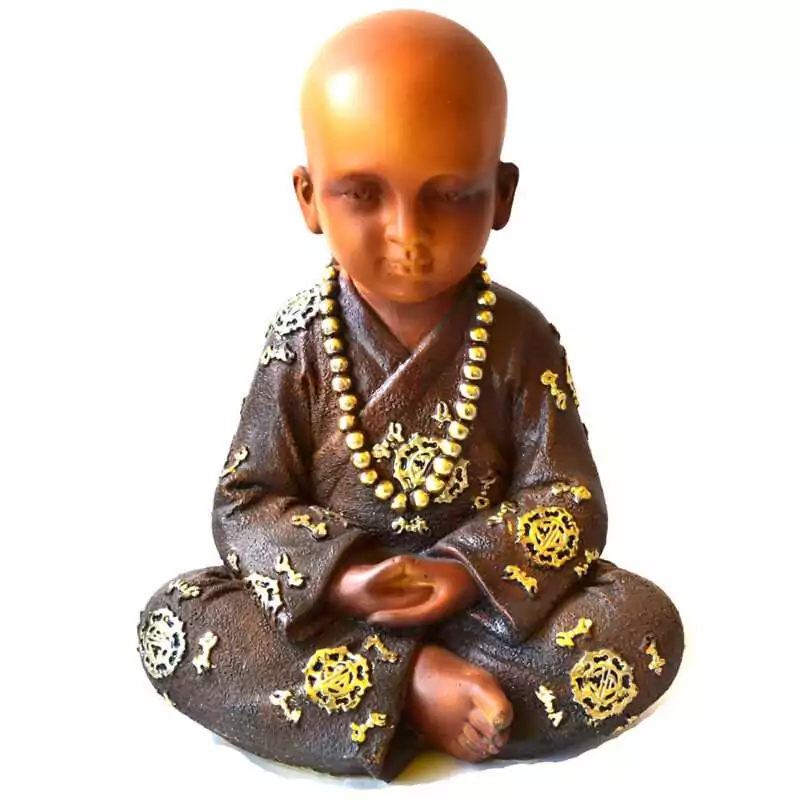
His face is young and round, with a smooth brow, a small closed mouth, and heavy lids over lowered eyes. The proportions are childlike, with a large head and small hands, which gives the figure a gentle, unguarded look. The shaved head is bare and rounded, painted in the same warm terracotta as his hands and the one bare foot that shows from under his knees. The robe wraps across his chest in a crossed collar and falls in wide sleeves. Its surface is grainy and dark brown, like worn cloth, and gold-toned roundels with open, patterned centers mark the shoulders, sleeves, lap, and knees, with smaller gold marks scattered between them. A long strand of large, evenly spaced gold-toned beads hangs from his neck to his breastbone, picking up the tone of the roundels, and his hands rest one in the other in his lap. He sits low, with his knees spread wide, so the base is broad and the figure looks settled. The gold is the only bright note, so the figure reads as dark and quiet with small flashes of metal.
The details follow the imagery of Buddhist monastic life. Shaving the head is part of becoming a Buddhist monk or nun, and the tonsure is renewed as often as needed to keep the head cleanly shaven; some Catholic and Hindu orders tonsure as well, and taken together these details follow Buddhist imagery. Prayer beads called malas are used by Buddhists, and by followers of several other Indian religions, to count recitations of mantras and prayers. A full mala usually has 108 beads, though shorter ones exist. Buddhist monks and nuns keep and pass on the Buddha’s teaching and guide lay people, and sitting meditation is part of life in many monasteries, though the amount and form vary widely between traditions. Three surviving codes of monastic discipline, the Vinaya, govern monastic life in different regions, so robes, vows, and habits differ from one Buddhist country to another. Sitting cross-legged is also the posture most often used for images of the Buddha in meditation. This figure is an unnamed monk, a figure of the practice.
Practical Display and Meditation Uses
Give him a clean, steady place of his own, such as a shelf, a desk, or the corner where you sit for quiet time. He works as a visual cue to pause: set him where you will see him when you want to stop and breathe for a few minutes. On an altar he pairs with a candle in a separate holder, fresh flowers, or a small bowl, but the choice of offerings is yours, and Buddhist traditions that make formal offerings have their own customs and teachers. At this size he also suits a bookshelf beside books on meditation or Buddhism. A corner with a cushion, a small table, and a lamp gives him a setting; keep the arrangement simple, since the figure is dark and detailed. For more figures, see my Buddhist figurines and decor collection.
How to Place and Sit With the Monk Statue
Three steps from choosing a place to a few minutes of quiet beside him.
- Give Him a Respectful Place
Walk through the room and pick a spot out of daily traffic, at or above waist height and off the floor, such as a shelf or a desk corner. Leave a few inches clear around him so the gold details read, and keep him back from the edge, since a fall from a shelf can chip the paint.
- Dust and Settle Him
Dust the figure with a soft dry brush, working into the folds of the robe and around the beads. If the surface is polished, set a plain cloth or a small tray under him, then step back and see how the gold details catch the light from where you sit.
- Sit for a Few Minutes
Sit where you can see him, with your feet flat or your legs crossed, and let your attention rest on your breathing for five minutes. When your mind wanders, bring it back to the breath, and notice your feet and the weight of your body, a simple grounding exercise. Seated practice has teachers and communities behind it, so if it takes hold, look for a local sangha or teacher.
The Tarot Fellow Standard
I stock this monk as a quiet figure for meditation corners and for shelves where a seated, still image belongs. He is an unnamed monk, and Buddhism is a living religion with temples, teachers, and communities that a statue can point toward. Its traditions vary widely, so a local teacher can tell you what a figure like this means in their lineage. The grainy brown robe and the gold-toned details make him a good fit for a spare, quiet corner. Browse my statues collection for more figures.
Frequently Asked Questions
Images of the Buddha follow conventions: a raised bump on the crown called the ushnisha, elongated earlobes, and a posture or gesture that points to a moment in his life. This figure has a smooth bare head and ears of ordinary length, so none of those marks appear on him. Monks and nuns are ordained members of the Buddhist monastic order.
A strand of prayer beads is called a mala, from the Sanskrit word for garland. It is used to count repetitions of mantras, prayers, or other sacred phrases, and it can also be worn. A full mala usually has 108 beads, though shorter ones in factors of 108, such as 54 or 27, exist. Malas are used in Hinduism, Buddhism, Jainism, and Sikhism, so the beads belong to several traditions.
Buddhist teachers differ, and the question is partly subjective. A Zen teacher writing in a Buddhist magazine says a statue suits a temple and can be insensitive as bathroom decor or in an advertisement, and suggests treating religious images with respect and the compassion they represent. The figure is a reminder of a living religion, and temples and teachers are where the practice itself is learned, so a local temple is a good place to ask.

Reviews
There are no reviews yet