
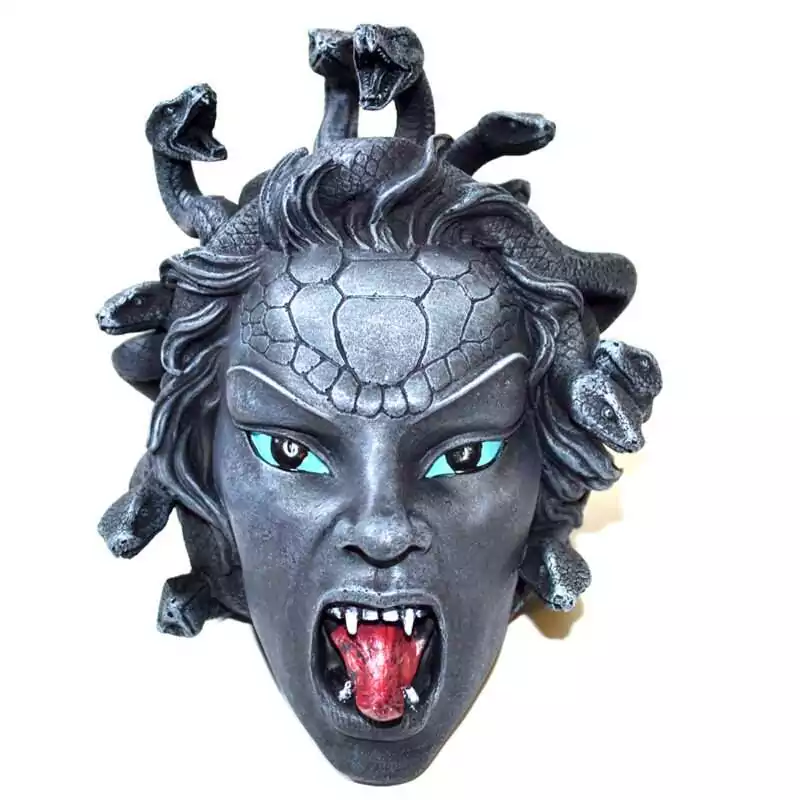


Quick Specs
- Type: Medusa head, decorative statue
- Size: 6 1/2 inches
- Material: Cast resin
- Finish: Stone-gray, with turquoise eyes and a red tongue
- Best for: Greek mythology displays, gothic decor, altars
Medusa: The Myth and the Face
In Greek myth Medusa is one of three Gorgon sisters, daughters of the sea god Phorcys and the sea monster Ceto. The name Gorgon comes from a Greek word meaning grim or terrible. Hesiod places the sisters far to the west, beyond the river Oceanus, at the edge of night. Apollodorus gives the Gorgons wings of gold, hands of bronze, and tusks like a boar’s. Her sisters Stheno and Euryale were immortal, and Medusa alone was mortal. She had living snakes for hair, and anyone who met her gaze turned to stone. The hero Perseus was sent to bring back her head, and he killed her with help from Athena and Hermes; according to Hesiod, the winged horse Pegasus and the giant Chrysaor sprang from her neck. The severed head kept its power. Perseus carried it in a bag and used it as a weapon, turning King Polydectes, who had sent him on the errand, to stone, and then gave it to Athena, who set it on her shield, the aegis. Medusa’s name comes from a Greek verb meaning to guard or protect, which suits the protective use her face later found.
The Gorgon’s face became an image in its own right, the gorgoneion, a staple of Greek, Etruscan, and Roman art that typically faces the viewer, as on vessels, shields, and breastplates. In the Archaic period Greek artists made it grotesque, and by the late Classical period they were also showing the face of a beautiful young woman. This statue follows the fierce, early kind. The turquoise eyes, bright against black pupils, are the only cool color on the piece, and they sit wide under a heavy brow. A band of scale-like plates crosses her forehead, and her mouth gapes with fangs and a red tongue. Snakes coil through her hair and rise from the crown, each with its jaws open, so the silhouette bristles. The stone-gray finish has a soft, pitted texture with dark recesses in the hair and between the coils, and it reads like weathered stone, which suits a figure whose gaze was said to petrify. She is a head alone, cut off at the neck, and she rests upright by herself.
Practical Ritual Applications
Gorgon faces were set on temple pediments and shields, stamped on coins, and painted inside drinking cups, and classical scholars generally read the image as apotropaic, a device meant to ward off unwanted things. If you like that old placement, turn her to face the entrance of a room. If you would rather keep her as sculpture, she suits a shelf of Greek myth and classics, a desk, or a gothic or dark-academia display. A small mirror beside her echoes the reflection Perseus used to approach her. Her silhouette is busy, so give her a plain background and room around her, at eye level or a little above, where the face looks out across the room. In a dim corner, a small warm light picks out the pitted texture and the turquoise eyes. For more figures, see my statues collection.
How to Display and Care for the Medusa Head
Three steps for setting her up and keeping the details sharp.
- Pick a Steady Spot
Set her on a flat, stable surface such as a shelf, desk, or altar, well back from the edge, since a fall can break the snakes. She is a solid piece, so a bookshelf or sturdy table suits her. Keep her out of walkways and away from pets and small children.
- Choose Her Direction
Decide where she looks. Facing the entrance of the room echoes the temple pediments where Greek builders set the Gorgon's face. Facing inward makes her a piece of sculpture for the people inside. Either way, turn her so the eyes and the open mouth are the first thing a visitor sees, since that is where the design concentrates.
- Dust and Handle With Care
Dust her with a soft dry brush, working into the hair and between the snakes. Skip water and cleaning sprays, which can pool in the recesses and dull the finish. Lift her with one hand under the neck and the other at the base of the head, since the thin coils at the crown are the most exposed parts.
The Tarot Fellow Standard
I stock this head for readers of Greek myth, collectors of gothic and dark-academia decor, and anyone who wants the Gorgon’s face in the house. The story has been told many ways since Hesiod and Homer, and a statue can hold more than one of them: the monster, the guardian, the victim. The protective reputation of the gorgoneion belongs to ancient Greek art, and this piece is a sculpture that borrows the image. If you want the myth at its sources, start with Hesiod’s Theogony and the fourth book of Ovid’s Metamorphoses. Browse my home decor collection for more pieces for a mythic shelf.
Frequently Asked Questions
It depends on the source. Hesiod and other early poets present her as a monster in a family of monsters. Ovid, writing some seven centuries later, tells of a beautiful woman violated by Poseidon in Athena's temple and punished by the goddess, who turned her hair into snakes. In the twentieth century many feminist writers and artists reclaimed her as a symbol of female power and rage; Hélène Cixous's essay The Laugh of the Medusa is a well-known example. Scholars read the myth in different ways, and no single telling is the canonical one.
He never looked at her directly. Athena gave him a polished bronze shield, and Perseus watched Medusa's reflection in it while he cut off her head with a sickle from Hermes, with Athena guiding his hand. He also carried winged sandals, a cap of invisibility from Hades, and a bag to hold the head, which kept its power after her death. Her two sisters woke and chased him but could not see him in the cap.
Archaic Greek artists showed the Gorgon's face with fangs or tusks, a wide-open mouth, and a stretched tongue, features that made the image frightening. One explanation links the open mouth to the Gorgons' cry, which the Hesiodic Shield of Heracles describes as so loud that the shield itself seems to shriek. Another, associated with the scholar Jane Ellen Harrison, proposes that the gorgoneion began as a ritual mask later misunderstood; masks of this kind from Tiryns and Sparta survive.


Reviews
There are no reviews yet