
Quick Specs
- Type: Water globe with gold-toned coin tree
- Height: 5 inches
- Globe: Clear sphere of water with glitter
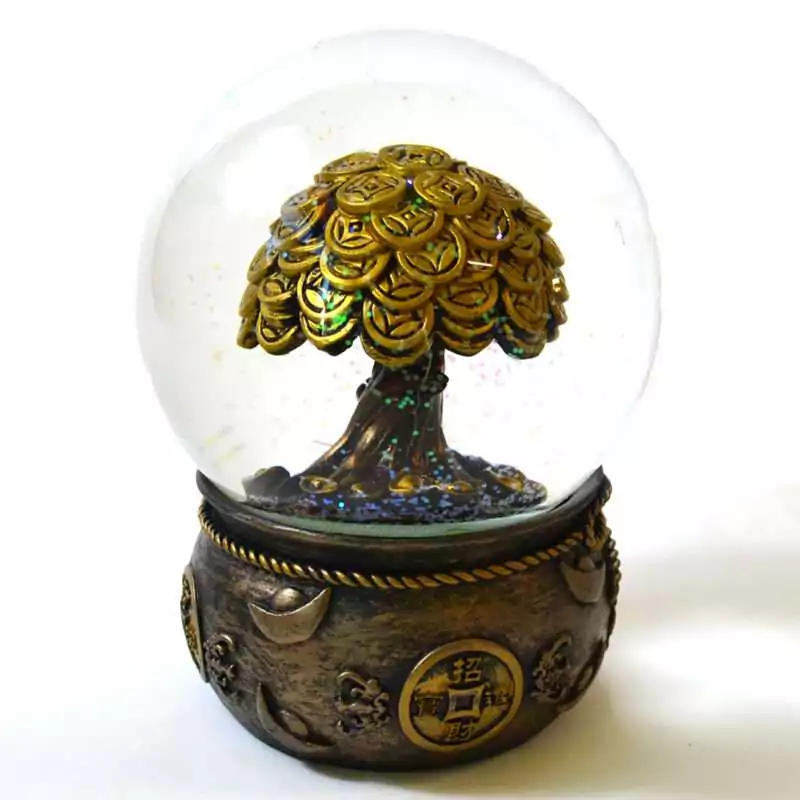
- Tree: Gold-toned, with coin-shaped leaves
- Base: Bronze-toned, wrapped in gold-toned rope, with ingots and a coin medallion
A Coin Tree in a Water Globe
The tree stands at the center of the sphere on a bed of dark glitter, with a short, twisting trunk, brown with golden highlights, and a domed crown built of overlapping gold-toned coins in rows, each one round with a square hole at the center, like the cash coins of imperial China. A few more coins and ingots lie among the roots, and each coin has a raised rim and a stamped pattern across its face. Glitter in green, blue, and soft pastel flecks drifts through the water when you tilt or turn the globe, and the tree stays fixed at the center while it moves around it. Below, the base is rounded and bound at the shoulder with twisted gold-toned rope, and the dark bronze finish shows lighter wear in the raised parts, so the gold-toned details stand out against it. Boat-shaped ingots are set into its sides, modeled on the sycee, or yuanbao, that served as gold and silver money in imperial China, and scrolling motifs and a crescent run between them. At the front is a coin medallion with four characters arranged around its square hole.
Trees hung with coins have a long history in Chinese culture. Chinese legend describes a money tree, yaoqianshu, as a sacred tree that sheds coins when shaken, and cast-bronze money trees have been excavated from Han dynasty tombs in Sichuan, where branches carry coins beside figures from the paradise of immortals. The motif returns at Chinese New Year, when money trees are among the customary decorations; by one description of the custom, a New Year money tree is a bushy pine or cypress branch in a pot, hung with gold and silver coin garlands. The coins and ingots on this globe come from the same vocabulary. Cash coins were cast from the Warring States period until 1912, and the round shape with a square hole later carried over to good luck charms and decorations, while sycee remain a symbol of wealth and prosperity at New Year festivities today. The maker sells the globe as a feng shui piece, a practice in which a golden money tree stands for wealth and abundance.
Practical Display and Ritual Applications
Set the globe on a desk where you pay bills, on a bookshelf near your budget binder, or on an entry table where you will see it as you come and go. For a Lunar New Year display, place it among other seasonal decorations. Gold and bronze tones sit well against dark wood, so a walnut desk or a black shelf shows the coins best. On an abundance altar it makes a central image, with candles in separate holders, coins, or a green and gold cloth; the arrangement belongs to your own practice. It also works as a gift for someone starting a business or a new job, a nod to a symbol of prosperity. See my abundance, prosperity, and money collection for other pieces that pair with it.
How to Display and Care for the Money Tree Globe
Three steps from the box to a steady, clean display.
- Pick a Steady Spot
Set the globe on a flat, level surface away from the table edge, since a dropped globe can crack and leak. Keep it out of strong sun and away from heaters, which are hard on water-filled pieces and painted finishes. Choose a place at eye level or below, where you can watch the glitter without lifting the globe overhead.
- Set the Glitter Moving
Lift the globe by its base with both hands, tilt or turn it gently, and set it back down to watch the glitter move around the tree. A slow turn is enough. Let the glitter settle before you move it again, so you can see the tree and the coins clearly.
- Keep It Clean
Dust the base with a soft dry brush, working around the rope and the ingots, and wipe the clear sphere with a soft cloth. Skip abrasive cleaners and sprays on the painted base. If water ever leaks from the globe, move it away from electronics and paper and set it on a towel.
The Tarot Fellow Standard
I stock this globe for shoppers who want a prosperity symbol with a design vocabulary behind it: cash coins, sycee ingots, and a four-character New Year greeting. Chinese New Year customs and feng shui belong to living traditions with their own practitioners and teachers, and the globe is imagery that sits beside them. Most of the design has a named source in Chinese material culture, from the cash coins to the sycee to the greeting, so there is something to learn from the piece as well as something to display. Browse my home decor collection for more pieces for a shelf or entry table.
Frequently Asked Questions
No. The plants sold as money trees are Pachira aquatica, a tropical wetland tree from Central and South America, or the similar Pachira glabra, and they are grown as houseplants, often with a braided trunk. The name is commercial. The coin-leaved tree in this globe is a different thing: an ornament drawn from the money tree of Chinese legend and from Han dynasty tomb trees hung with coins, and it needs no watering or light.
The four characters around the square hole read zhāo cái jìn bǎo (招財進寶), an idiom that dictionaries gloss as ushering in wealth and prosperity. It is also a traditional greeting, especially at the New Year. The same four characters appear on Chinese charm coins, which carry wishes for good fortune.
They are the same kind of object; a snow globe is also called a waterglobe or snowdome. It is a clear sphere enclosing a miniature scene and water, and its particles drift down when you shake the globe and set it back in place. This globe uses glitter and works the same way. Some globes also carry a design around the outer base, as this one does with its rope, ingots, and medallion.

Reviews
There are no reviews yet