

Quick Specs
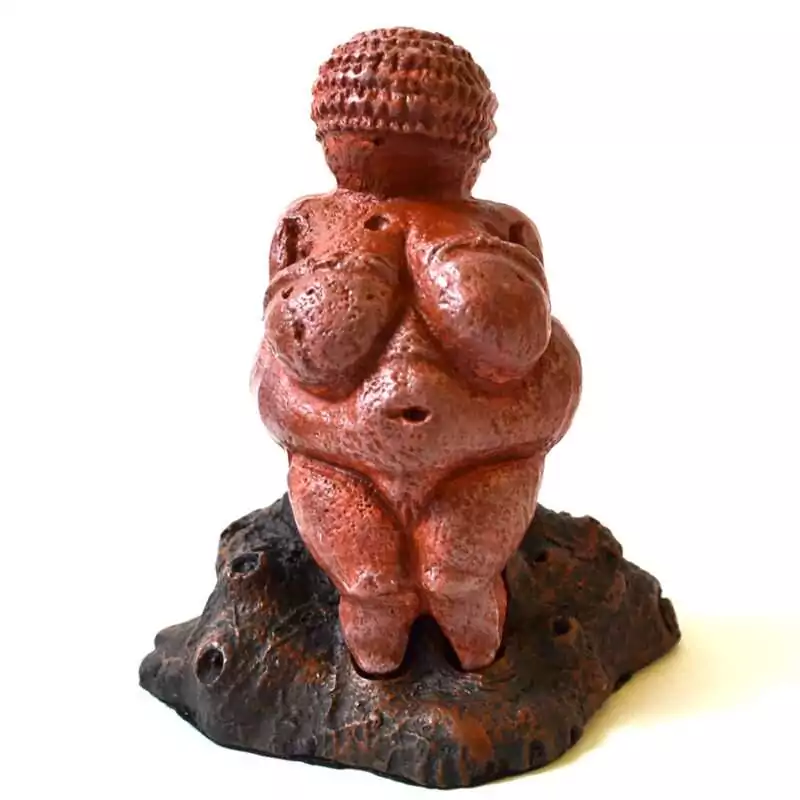
- Type: Replica of a prehistoric figurine
- Height: 4 inches
- Material: Cast resin
- Finish: Red-brown figure on a dark, rock-textured base
- Best for: Goddess altars, harvest altars, prehistory and archaeology displays
The Venus of Willendorf: Original and Replica
The original was recovered on 7 August 1908 during an excavation led by Josef Szombathy at Willendorf, a village on the Danube River in Lower Austria. It stands 11 centimeters tall, small enough to rest in the palm of a hand. The stone is oolitic limestone, painted red, possibly with ochre, though cleaning at the time of the discovery removed almost all of that pigment. She belongs to the Gravettian period of the Upper Paleolithic. Researchers put her age at roughly 30,000 years, and published estimates run from about 25,000 to 30,000 years; the Natural History Museum in Vienna, which displays her in its Venus Cabinet, currently gives about 29,500. Rows of horizontal bands cover her head and are read as plaited hair or a headdress, while her face is left blank. Her arms rest across her breasts, and her belly, hips, and thighs are full and rounded. Willendorf is one of the earliest known sites of modern human settlement in Europe, with occupation going back about 43,500 years, so she comes from a place with a long human record.
This replica recreates the original’s shape in cast resin. At 4 inches tall, the replica comes close to the 11 centimeters of the original. The surface is grainy and pitted, like weathered stone, the bands on the head stand out in relief, and the navel is a deep hollow. The red-brown finish recalls the red the original was painted, and the dark, rough base gives the figure a stone-like seat. She’s hand-sized, so she fits on a shelf, a windowsill, or a crowded altar. The people who carved her left no writing, so her purpose is open to interpretation. Related female figurines from the Gravettian turn up from France to Russia. In the later twentieth century, many people in Goddess spirituality and other modern Pagan paths began using reproductions of Paleolithic figurines as images of the Great Goddess, a reading associated with the archaeologist Marija Gimbutas that many archaeologists dispute. You can bring that reading to her, bring a different one, or keep her as a piece of the deep human past.
Practical Ritual Applications
Set her where you keep images of the Goddess or the harvest. On an altar for Lughnasadh or Mabon, two of the harvest festivals in the modern Pagan Wheel of the Year, she sits well beside bread, grain, and seasonal fruit, the kind of abundance a harvest altar celebrates. In Goddess spirituality she can serve as a focus for devotion or reflection. If your interest is history, she belongs on a shelf of prehistoric pieces, a starting point for conversations about how long people have been making images of the human body. Keep the objects around her few, since her textured head and body already give the eye plenty to follow. She also suits a desk or bookshelf as a reminder of how far back human art goes. Pair her with other figures from my gods and goddesses collection, or let her anchor a small altar of your own design.
How to Display and Work With the Venus of Willendorf Replica
Three steps for giving the replica a place in your home or on your altar.
- Choose a Stable Spot
Set her on a flat, steady surface such as a shelf, desk, or altar, where a bump won't tip her over. Keep her away from radiators, stoves, and open flames, and out of reach of pets and small children, since a fall onto a hard floor can chip a cast figure.
- Give Her a Theme
Decide what she represents on your altar before you add anything around her. For a harvest altar, set bread, grain, or seasonal fruit beside her. For Goddess devotion, place a candle in a separate holder at her side and keep the flame well clear of the figure. For a history shelf, add a small card noting what the original is and where it is kept.
- Keep Her Clean
Dust her with a soft, dry brush, working into the bands on the head and the folds of the body. Skip water and cleaning sprays, which can dull the finish, and lift her by the body. If she sits on an altar with offerings, keep food on a plate or dish beside the base.
The Tarot Fellow Standard
I stock this replica because the Venus of Willendorf earns a place on two kinds of shelves, the goddess altar and the prehistory collection, and a hand-sized reproduction serves both. The details of her find, her size, and her museum home are well documented, which makes her a steady anchor if you want to build an altar around what is known. Whatever path you follow, a figure like this is a focus for your own practice, alongside a teacher or a community where your tradition has them. Browse my statues collection for more figures.
Frequently Asked Questions
The name comes from nineteenth-century archaeologists, who began calling female Ice Age figurines Venuses as a comparison to the Roman goddess of love. The figurine is far older than Rome. Some scholars object to the label and prefer Woman of Willendorf, since Venus reflects modern Western ideas.
Nobody knows, because no written record exists. Proposals include a fertility or mother-goddess image, since the breasts, belly, and hips are emphasized; a self-portrait, an idea from researchers Catherine McCoid and LeRoy McDermott based on how a woman sees her own body looking down; and a response to nutrition and survival in the cold Ice Age climate. Each is an interpretation.
The stone came from somewhere else, since oolitic limestone does not occur in or around Willendorf. A 2022 micro-CT study of the original compared oolite samples from France to Ukraine and found a close match in grain size near Lake Garda in the Southern Alps of Italy. The authors say this may indicate considerable mobility among Gravettian people and the transport of objects over long distances.
No. The Venus of Hohle Fels, a mammoth-ivory figurine found in a cave in southwestern Germany in 2008, dates to at least 35,000 years ago, which is at least 5,000 years before Gravettian figures like the one from Willendorf. Willendorf is the better known of the two.





Reviews
There are no reviews yet