
Quick Specs
- Type: Raw stone pendant
- Stone: Shungite
- Size: Stone about 1/2 by 3/4 inch
- Finish: Untumbled, glossy black with stepped edges
- Hanger: Silver-toned bail
- Mohs Hardness: 3.5 to 4
A Raw Block of Glossy Black Shungite
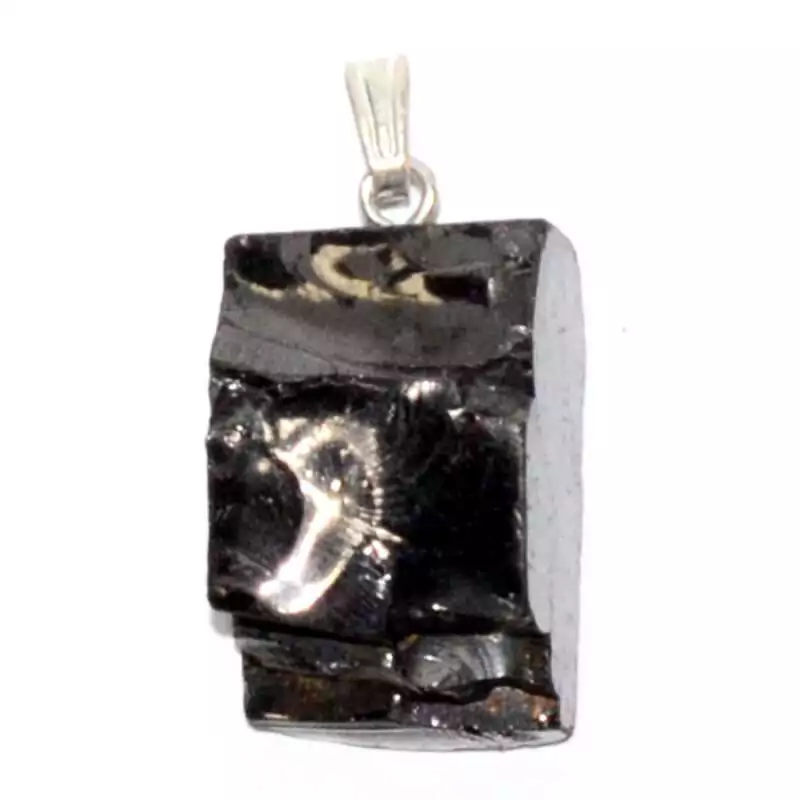
The pendant is a raw block of shungite in its untumbled form. At about 1/2 inch wide and 3/4 inch tall the block is compact, roughly rectangular and taller than it is wide. Its surfaces are glossy and black, and wherever a face is smooth it throws back bright reflections like a dark mirror. The top and sides step in small ledges and sharp edges, and a scooped, shell-like hollow near the middle catches the most light. A small cream-colored patch shows near the top, and the lower edge picks up a faint bronze tint below a band of fine ledges. On the right side, one flat face is matte gray and level. A silver-toned bail, a flat strip folded into a loop, sits at the top and takes a chain or cord, and it is the only bright metal against the black, gray and cream of the stone. Each untumbled stone keeps its own outline within the stated size, so the ledges, hollows and flat faces fall differently from one piece to the next, and the reflections shift with every turn of the hand.
Shungite is classed by its carbon content. A study of shungite as an electrode material sorts the rock into five categories, from shungite-1 at 90 to 98 percent carbon, which it calls noble elite shungite, down to shungite-5 at under 10 percent. The same study notes that veins of quartz, feldspars, carbonates, mica and pyrite are often visible to the naked eye, and GemRock Auctions says gold or white impurities are common. The stone is black, gray or silver and rates 3.5 to 4 on the Mohs scale, according to Fire Mountain Gems and GemRock Auctions. GemRock Auctions lists no cleavage and a fracture that is conchoidal in the glossiest type and granular or uneven in the others. Fire Mountain Gems says the Russian geologist Aleksandr Inostrantsev named the stone in 1879 after deposits near Shunga. GemRock Auctions describes three main varieties by carbon content and says the two lower ones are the most common for gemstones. Wikipedia describes shungite as a mineraloid with its main deposit in the Lake Onega area of Karelia, Russia.
Practical Ritual Applications
Hold the stone in your palm and turn it slowly to watch the glossy faces catch the light, then feel the flat matte side with your thumb. Wear it on a chain or cord where the raw black shows against a light top. On a desk, a small dish keeps the pendant in view beside a notebook, and an altar can hold it on a dark cloth next to a candle in its own holder, a safe distance from the flame. Crystal practice links shungite with grounding and protection, so a raw stone like this suits a grounding-themed arrangement. A card and a small box make it a gift for someone who prefers rough, natural shapes. Browse my raw stones for protection and energy shifting for more pieces to arrange around it.
How to Wear and Care for the Shungite Untumbled Pendant
Three steps cover the bail, wearing the stone, and cleaning it.
- Check the Bail and Edges
The bail is the flat metal strip folded into a loop at the top. Check that the end of your chain or cord passes through it, then lift the pendant and see how the stone hangs. Run a fingertip along the stepped edges, since a raw surface can have sharp ledges that catch on knitwear and silk, and keep the pendant away from fine fabrics until you know where it snags.
- Wear It With Care
GemRock Auctions says shungite scratches and chips easily and recommends removing shungite jewelry before any activity where it could be hit. Fire Mountain Gems adds that the stone is very soft, can be scratched by some metals, and may leave black carbon residue on hands, packaging and clothes. Wear it over dark or washable clothing, and take it off for sports, sleep and heavy work.
- Clean and Store It
GemRock Auctions advises mild soap in lukewarm water and a soft brush, a rinse in cool water, and a pat dry with a microfiber cloth. A soft brush reaches into the ledges and hollows of a raw surface. Store the pendant apart from other gems, as the same source recommends, in a small pouch or a lined box, away from harder stones that could scratch it.
The Tarot Fellow Standard
I stock this pendant because it shows shungite in its raw form, with glossy black faces, stepped edges and a flat gray side, hung from a plain silver-toned bail. The root chakra, protection and grounding themes belong to modern crystal lore, and I offer them as themes for your own reflection. Shungite is soft and can leave black residue, so I treat the pendant as a piece for careful wear. For more stones to wear at the neck, browse my crystal and gemstone pendants.
Frequently Asked Questions
Luster depends on carbon content and on the surface. A study of shungite as an electrode material says the richest shungite is black or dark gray with a metallic luster, and that all shungite turns dull black after mechanical grinding. Wikipedia sorts shungite into bright, semi-bright, semi-dull and dull luster, and GemRock Auctions says higher carbon gives a metallic luster while lower carbon and traces of sulfur give a matte look.
Shungite formed in the Paleoproterozoic era, roughly two billion years ago. Wikipedia dates the Shunga sequence by a gabbro intrusion at about 1,980 million years and the underlying dolomites at about 2,090 million years. Fire Mountain Gems places the deposits in lagoons that existed over two billion years ago, and GemRock Auctions gives a likely formation age of 2.2 billion years. The sources differ on the exact figure, and all place it near two billion.
Most shungite is shaped into cabochons, beads, pyramids and carvings. GemRock Auctions says its low rank on the Mohs scale makes faceted cuts difficult and virtually nonexistent, and adds that jewelers may use cabochons or even raw stones for a shungite pendant. Fire Mountain Gems says shungite requires little enhancement other than polishing, and that it pairs well with silver.

Reviews
There are no reviews yet