
Quick Specs
- Format: Boxed tarot deck with multilingual booklet
- Deck Style: Rider-Waite-Smith style
- Card Count: 78 cards
- Card Edges: Silver
- Author: Barbara Moore
- Illustrator: Franco Rivolli
- Brand: Llewellyn Publications
- ISBN: 9780738784786
Inside the Silver Witchcraft Tarot
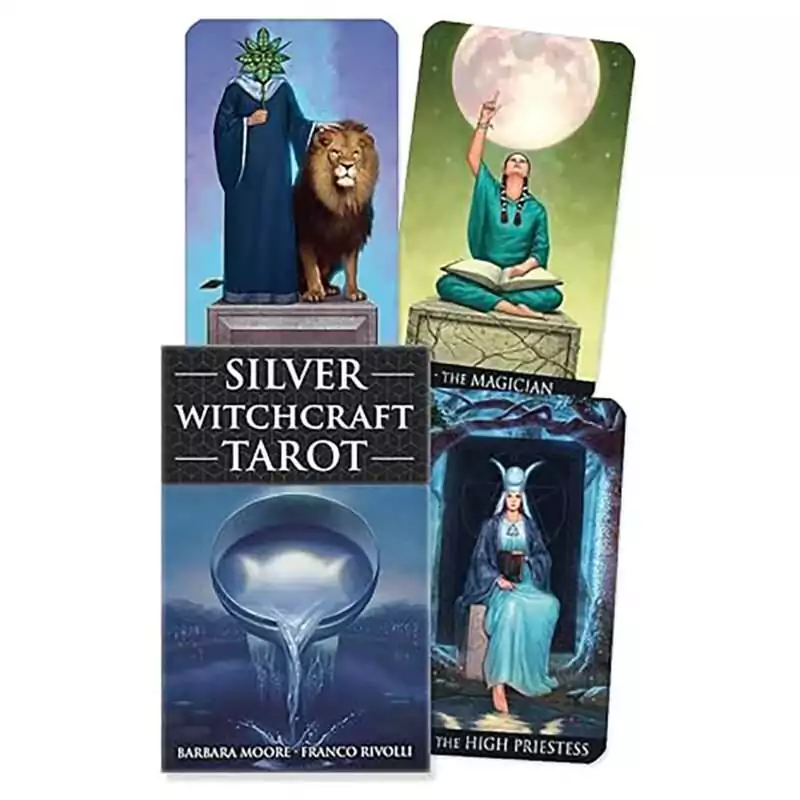
Silver Witchcraft Tarot reads the Rider-Waite-Smith tradition by the light of the moon. Barbara Moore built the deck around modern Pagan symbolism, and Franco Rivolli painted it digitally, with the phases of the moon and the Pagan holidays woven into each suit. In the Minor Arcana the numbered cards follow the Wheel of the Year, each number tied to a sabbat, so a draw tells you something about the season as well as the situation. The publisher says the deck offers knowledge of a material, emotional and spiritual nature. The palette matches the theme: deep blues, silvers and purples, with scenes lit as if by moonlight. The Fool, the Magician and the rest of the Major Arcana keep their familiar poses, which means a reader who knows the Rider-Waite-Smith system can begin with this deck immediately. The moon and calendar symbolism sits on top of the old structure, so what you already know about the cards stays useful while a second layer opens up. The deck is silver-edged on all 78 cards. It’s a deck for readers who like their tarot tied to the calendar.
The box art gives a clear picture of the style. A silver bowl tips water over a landscape at dusk, with the title in white capitals on a black panel above it. The fanned cards keep to cool, moonlit colors. In The Magician, a woman in teal sits cross-legged on a stone block with an open book and points at a full moon. The High Priestess wears a crescent-horned crown and a turquoise gown, seated before a dark doorway in a forest glowing blue. A robed figure with a cluster of green leaves for a face stands beside a lion on a stone plinth. Card titles appear in capitals on a dark band at the foot. Rivolli paints his figures with realistic detail, and the moon returns as a backdrop and in the High Priestess’s crown. The cards are borderless, so the artwork runs to the cut edge, and the silver on every edge frames that image like a thin rim of moonlight. The result is a deck whose look matches its name.
Practical Ritual Applications
Because the deck is built around the moon and the Wheel of the Year, it fits readings that follow a calendar. Draw one card at each new moon and each full moon, and write down the date, the card and what stood out. On a sabbat, draw one card and notice whether its number connects to that festival. A moon calendar helps you match each draw to the sky, and my calendars and almanacs are a good place to find one. Evening suits the palette; if you light a candle, set it on the far side of the table from the cards. Reversed cards belong in every one of these readings: a card that lands upside down adds to the picture you’ve drawn. Over a year, the notes become a record of how each phase and festival looked in your own life.
How to Read with the Silver Witchcraft Tarot
Start by noting the Moon and the season, then lay out a first spread with this deck.
- Note the Moon and the Season
Before you shuffle, check the sky or a calendar and write down the moon's phase and how far you are from the next sabbat. Put that line at the top of a journal page with your question. The deck is built around the moon and the Wheel of the Year, so this small record gives each reading a place in time and makes it easier to see patterns across a season.
- Mix, Draw, and Keep Reversals
Spread the cards face down on a table and mix them in slow circles with both hands, which turns some cards upside down at random. Gather the deck without straightening it, then draw one card for a focused answer or three to follow a situation from start to finish. Place each card exactly as it comes. A reversed card stays reversed on the table and in your notes, because it's part of the message.
- Read the Light Before the Meaning
Look at where the light falls in the scene and what the moon is doing, then name the mood in a few words. After that, open the booklet and compare its meaning with your impression. Write both in your journal. If the card's number links it to a sabbat, add a line about how that festival's themes sit with what you saw. Over a few weeks the pairs of notes show you how the deck speaks.
The Tarot Fellow Standard
I stock this edition of Silver Witchcraft Tarot because it adds a moon and calendar layer to a structure you may already know, and because the silver edges and borderless art give every card a finished look. If the Wheel of the Year shapes your own year, the numbered cards give you something to read against it. You’ll find more options for every kind of reader in my tarot and divination collection, and this deck sits there as the one to reach for on moonlit nights.
Frequently Asked Questions
This edition has silver edges on every card and premium packaging, and its booklet is new: written by Floreana Nativo and printed in several languages. The earlier kit pairs Barbara Moore and Franco Rivolli's deck with a 160-page guidebook by Moore that covers the cards and spreads. Both are editions of the same deck, so choose by whether you want the silver edges and multilingual booklet or the longer guidebook.
One review of this edition describes good-quality satin card stock that shuffles easily without peeling at the borders. A retailer notes that, as with all foil-edge cards, the corners can wear a little with heavy use. An earlier review praises the flexible stock for shuffling well but leaves open how the silver holds up over time.
Tarot began as a card game: the cards first appeared in northern Italy in the 1440s as tarocchi, and there's no historical evidence of significant divination use before the late 1700s. The witchcraft in this deck is a design choice: its imagery draws on modern Pagan symbolism, and you can read with it whether or not witchcraft is part of your life.


Reviews
There are no reviews yet