
Quick Specs
- Stones: Stichtite and amethyst
- Large Beads: 8mm stichtite
- Small Beads: 4mm amethyst
- Shape: Round
- Finish: Polished
- Color: Olive green and plum mottling with lilac to violet
- Closure: None, one continuous loop of beads
Stichtite and Amethyst in Two Bead Sizes
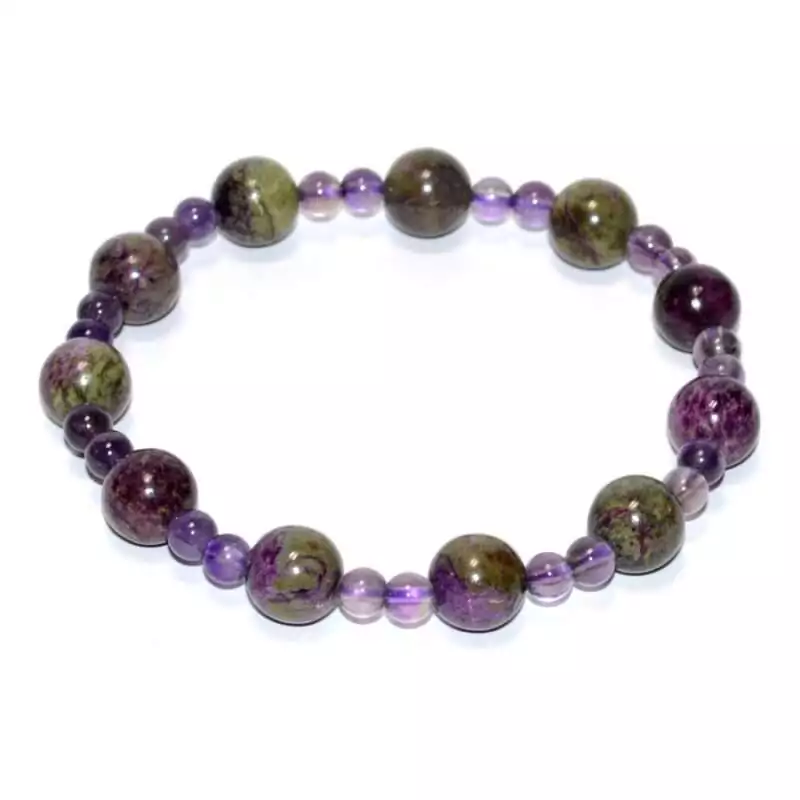
This bracelet pairs two purples that come from different minerals. The 8mm beads are stichtite, a rare mineral that ranges from pink through lilac to rich purple. The large beads here mix olive green with plum and violet patches, and a few run almost entirely dark purple. The 4mm beads between them are amethyst, the purple variety of quartz, in shades from pale lilac to deep violet. Short runs of two or three small amethyst beads sit between the large beads, so the strand moves in a steady rhythm of one large bead followed by a few small ones. Amethyst gets its violet from iron in the quartz together with natural irradiation, and it often shows color zoning, which is why the small beads differ in depth from one to the next. Every large bead has its own pattern of green and purple, so the loop reads as a varied, organic strand. Brazil and Uruguay are among the places amethyst is mined, and its quartz is polished here to a clear, glossy finish that lets the violet show from within.
In modern crystal practice both stones are linked with the crown chakra, the highest point in the chakra scheme, and crystal guides tie stichtite to forgiveness and compassion and amethyst to calm. These are symbolic associations from crystal lore, and you can take them as prompts for a pause or an intention. Stichtite rates 1.5 to 2 on the Mohs scale and amethyst rates 7, so this bracelet suits careful, occasional wear. The two bead sizes give it a clear structure: the 8mm stichtite beads carry the color and the weight, and the 4mm amethysts lighten the strand and add a clear violet. The mix of olive, plum and lilac sits well with black, gray and cream clothing, and with silver or antiqued metal. Both stones are polished smooth, and the 8mm beads sit proud of the small ones, which gives the loop a gently scalloped outline when it lies flat. The olive tones in the large beads soften the purple, and the small amethysts bring it back up, so the strand moves between muted and bright along its length.
Practical Ritual Applications
Keep this bracelet for moments when you want a deliberate, quiet piece on your wrist: a day of writing, a meditation, an evening with a journal. When you sit down, slip it off and lay it beside your notebook so the violet stays in view. For a short ritual of letting go, hold one large bead and name one grudge you would like to set down, then move to the small amethyst beads and take three slow breaths. On an altar, it can circle a purple candle or rest on a dish with a small stone. To compare with other strands in the same bead size, my 8mm beaded bracelets collection holds more stones. Take it off before work that could knock the beads.
How to Wear and Care for Your Stichtite and Amethyst Bracelet
Three steps cover looking closely, setting an intention with the two bead sizes, and caring for a soft stone.
- Look at the two stones in daylight
Hold the bracelet near a window and turn it slowly. Compare a large bead with the small beads beside it: the stichtite shows olive green mixed with plum, and the amethyst shows clear lilac to violet. Find the darkest and palest small bead; that spread is the color zoning typical of amethyst.
- Use the bead rhythm as a pause
Rest your thumb on one large bead and take a slow breath, then move across the two or three small beads that follow and take one breath for each. Pick one intention for the pause, such as patience or letting go. Over a few weeks, the pattern of big and small beads becomes a cue you can find by touch.
- Protect the stichtite
Wipe the bracelet with a soft cloth after wearing, and keep it out of the way of hard surfaces. Remove it for washing up, lifting, sports and any task where the beads could knock against a counter or doorframe. Set it down on a soft cloth or in a pouch of its own.
The Tarot Fellow Standard
I stock this bracelet because it puts two uncommon-looking purples side by side: soft, mottled stichtite and clear amethyst in a pattern of large and small beads. The crown chakra and forgiveness associations come from modern crystal lore, and I offer them as symbolism to take or leave. Stichtite is a very soft mineral, so I recommend careful wear and gentle storage. Each large bead has its own green and purple pattern, which makes every bracelet a little different. To see how amethyst looks in other bracelets and settings, my stone and crystal beaded bracelets collection gathers more strands.
Frequently Asked Questions
Stichtite is a carbonate of chromium and magnesium, and its color ranges from pink through lilac to rich purple. It was found in 1910 at Dundas on the west coast of Tasmania and is named for Robert Carl Sticht, manager of the nearby Mount Lyell mine. It is a rare mineral, rates 1.5 to 2 on the Mohs scale and counts among the softest minerals cut as beads.
Stichtite forms as an alteration product of chromite-bearing serpentine, and green serpentine is usually found alongside it. Dark purple stichtite patches in green serpentine are sold under the trade names atlantisite and tasmanite, and the two-color material is cut into ornamental stones and beads.
Wipe it with a soft cloth. Skip bleach, acids, ultrasonic cleaners and steam, since the stone is a hydrated carbonate that reacts to harsh products. Store it flat in a pouch apart from harder jewelry, and remove it before work that could knock the beads. Jewelers note that soft stichtite suits pieces that avoid impact, such as necklaces and earrings, so a bracelet calls for careful, occasional wear.
The name comes from the Greek amethystos, meaning not intoxicated. Ancient Greeks believed the stone protected its owner from drunkenness, and drinking vessels were carved from amethyst in the hope of keeping the drinker sober. It remains one of the best-known pieces of gem folklore.


Reviews
There are no reviews yet