
Quick Specs
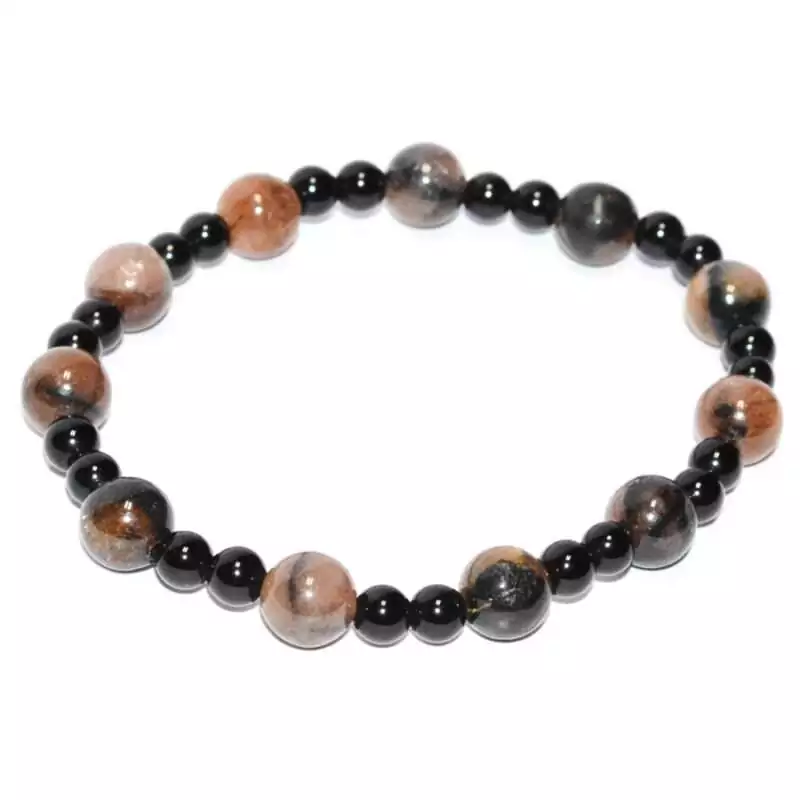
- Stones: Chiastolite and black obsidian
- Bead Sizes: 8mm chiastolite, 4mm obsidian
- Shape: Round
- Layout: Pairs of black beads between the brown beads
- Finish: Polished, glossy
- Closure: None, one continuous loop of beads
Patterned Brown and Plain Black
Two materials share this strand, and each has its own surface. The larger 8mm beads are chiastolite, a variety of andalusite, an aluminum silicate that carries dark inclusions of carbon or clay arranged in regular shapes. On these beads the inclusions read as smoky patches and lines across a ground of warm brown, rust and gray, so no two of the larger beads match. Between them sit pairs of 4mm black beads of obsidian, a natural volcanic glass formed when lava cools quickly with almost no crystal growth. The black beads are smooth, glossy and uniform, and they give the strand a clear rhythm: a mottled bead, a pair of black ones, a mottled bead again. At 8mm the chiastolite beads are large enough to show their patterns, and the small black pairs keep them apart so that each pattern is seen on its own. Obsidian is brittle, so the strand rewards gentle handling and a soft landing when you set it down. Chiastolite’s ground color ranges from white and pale tones through reddish brown, and these beads sit in the brown and gray part of that range.
In modern crystal practice, black obsidian is a protection and grounding stone, associated with the root chakra, the base of the seven-chakra scheme. That is modern crystal lore, which took the chakra idea from Hindu and Buddhist traditions, and you can take it as symbolism. The bracelet’s palette suits that dark, steady mood. Brown, rust, gray and black sit comfortably with leather, denim, wool and silver, and they read as understated beside brighter strands. Because the small black beads come in pairs, they act as a dark thread that holds the pattern together from a distance, and the larger beads supply the texture when you look closer. The mix of two bead sizes gives the bracelet a varied outline, with the larger beads rising above the small black ones as the strand curves around the wrist. It suits anyone who likes dark, earthy jewelry, and it sits well beside a plain metal watch or a slim bangle. The dark palette also carries into evening wear, where black beads beside brown ones look at home against a dark sleeve.
Practical Ritual Applications
Wear the bracelet on days when you want a steadying presence: a commute, a meeting or a hard conversation. On an altar, lay the strand on a dark cloth beside a black or white candle, and let the pairs of black beads catch the flame. For a short grounding pause, stand still with your feet flat, hold the bracelet in both hands and name three things you can see in the room. Keep it in a dish on your desk if you like a visible reminder within reach. To layer it, my 8mm beaded bracelets collection holds other strands in the same larger bead size. If you read cards, lay the bracelet beside the deck as a dark accent for the table.
How to Wear and Care for Your Chiastolite and Obsidian Bracelet
Three steps cover studying the patterns, choosing a cue, and caring for the glass-like black beads.
- Look at the patterns in daylight
Hold the bracelet near a window and turn it slowly. Find the chiastolite bead with the most orange-brown and the one with the darkest smoky inclusions, then look at how the pairs of black beads sit between them. Notice which beads show lines or crossed shapes in their inclusions. Knowing your strand helps you recognize it every time you wear it.
- Pick a steadying cue
Choose one black bead as your cue and touch it when you want to slow down. In crystal practice black obsidian is tied to grounding, so many people pair the touch with three slow breaths and a glance at their surroundings. Keep the habit small, a few seconds at a time, and the bracelet becomes a familiar signal after a week or two.
- Protect the glass-like beads
Obsidian is brittle, so take the bracelet off for sports, lifting and heavy work, and store it apart from harder stones that could scratch it. Clean it with a soft cloth dampened in warm water with a little mild soap, and dry it afterward. Skip ultrasonic and other mechanical cleaners, since inclusions in obsidian can expand when heated.
The Tarot Fellow Standard
I stock this bracelet for its pairing: patterned chiastolite in brown and rust, set between plain glossy obsidian in black. The two stones have different stories, one a crystal with a cross in its inclusions and the other a volcanic glass, and they make an easy strand to read at a glance. The protection and grounding links belong to modern crystal lore, and I offer them as symbolism. To see more stone bracelets, my crystal and stone bracelets collection shows strands in a wide range of materials and sizes.
Frequently Asked Questions
Chiastolite is a variety of andalusite that contains dark carbon or clay inclusions arranged in regular symmetrical shapes. In a section cut across the crystal, those inclusions form a cross or X. Because the cross shows on a cut face, lapidaries usually cut chiastolite as slabs or cabochons. In round beads like these, the same inclusions appear as dark patches and lines through the brown.
Pilgrims returning from Santiago de Compostela took chiastolite home to many European countries as a souvenir, a practice that dates back at least to the sixteenth century. A stone with a natural cross in its inclusions suited a pilgrim's keepsake. Gem references still connect the cross stone with that pilgrimage route.
No. Obsidian is a natural volcanic glass, formed when silica-rich lava cools so quickly that crystals barely grow. It is amorphous, which is why it breaks with a smooth, curved fracture, and gem references class it as a rock. It rates 5 to 6 on the Mohs scale.


Reviews
There are no reviews yet