
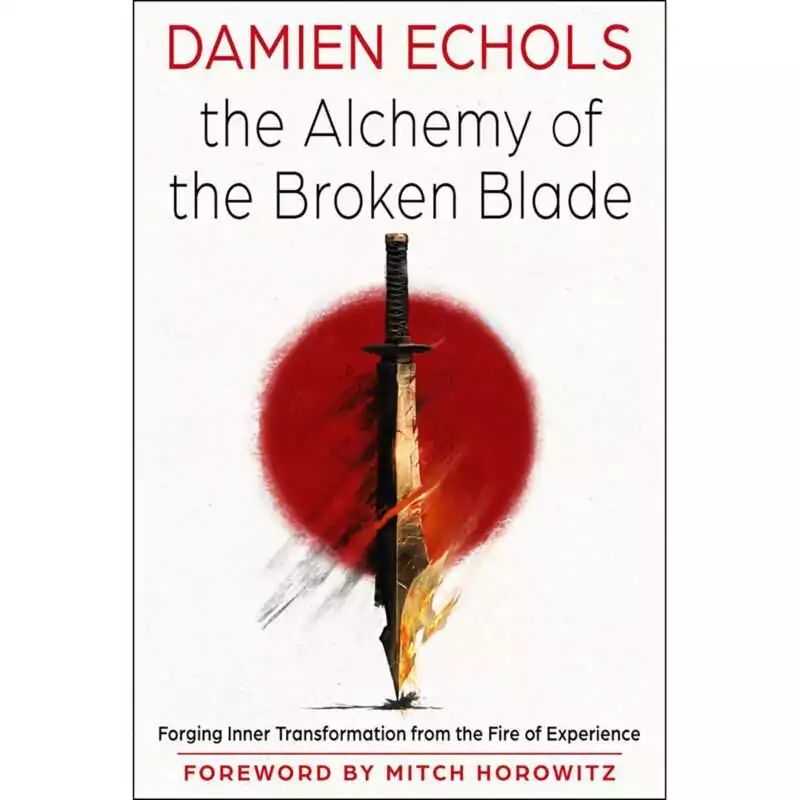


Quick Specs
- Brand: Weiser
- Author: Damien Echols
- Subtitle: Forging Inner Transformation from the Fire of Experience
- Format: Paperback, 240 pages
- Dimensions: 6 x 9 in
- ISBN-13: 9781578639397
- Published: September 7, 2026
A Field Manual for Inner Transformation
The publisher calls The Alchemy of the Broken Blade a field manual for people walking through the fire. It speaks to anyone who has been shattered by trauma, grief or the slow erosion of purpose in a world that worships distraction, and it frames its message as a call to live differently. The method is ritual, discipline and relentless presence, and presence is the thread that runs through every part: attention to where you are right now, kept up over time. At the center sits the idea of a personal Way, written dō, which the publisher describes as a path of lasting transformation achieved through sustained practice. Echols stresses that you have to find your own path, because inner transformation is personal to each reader. Your varied experiences supply your tools, and the book calls them your materia magica. It asks you to take stock of what you already carry and decide how to use it, one practice at a time. Each idea is meant to be tried in daily life before you move on to the next. The publisher describes the result as the lifelong work of inner alchemy, a process you revisit.
The book blends Eastern (Zen) and Western (Hermetic) philosophy into a single spiritual process. Alchemy and kaizen may seem worlds apart, the publisher says, yet they share a root principle: transformation through presence. Alchemy says to take yourself apart, purify, refine and recombine. Buddhism says to start where you are and take one small step, then another. Both are described as doorways to becoming, and together they give the book its working vocabulary: purify and refine on the Western side, begin again from the present moment on the Eastern side. That pairing gives the book two rhythms. One is the large arc of dismantling and rebuilding, and the other is the daily habit of small, repeated steps. The Buddhist line sets the entry point: you begin from where you stand today. The publisher calls the work lifelong, so plan to return to the book at different stages of your own practice. Keep a pencil nearby. A book built on sustained practice rewards notes, underlining and a second read after a few weeks of trying its ideas.
Working With the Book Day to Day
Treat the book as a practice companion. Choose a regular time, such as early morning or the end of the workday, and read a short section before you act on it. Pick a single repeatable practice and keep it modest. Use a notebook to record what you tried, what you noticed and which of your own experiences you’d count among your tools. Revisit those notes after a few weeks and see which steps held. A candle, a quiet corner or a regular seat can mark the start of each session if you like ritual to frame your reading. This is a book of spiritual practice, and it doesn’t replace care from a doctor or counselor. For companion reading, browse my mind, body, soul and new age books and read them one at a time.
How to Work Through The Alchemy of the Broken Blade
Use this sequence to turn the book's ideas into a practice you can sustain.
- Start Where You Are
Before you read ahead, write a few sentences about where you are right now: what feels broken, what you carry and what you'd like to change. The publisher draws on the Buddhist instruction to start where you are, so begin with what is true today. Date the page, since it becomes your baseline and gives you something to compare with later entries.
- Choose One Small, Repeatable Step
Pick one practice from your reading and commit to a small, specific version of it, something you can still do on your busiest day. Repetition is the point here. Note each day you complete it, and hold off on adding a second practice until the first feels steady.
- Review and Find Your Own Way
After a few weeks, reread your notes and ask which steps changed how you show up in daily life. Keep what works and let your Way take its own shape. Return to the book when you want to refine the practice, and expect the same pages to read differently once you've tried them.
The Tarot Fellow Standard
I stock The Alchemy of the Broken Blade because it pairs two long-standing currents, Zen and Hermetic thought, in a practice-first format. Both have teachers, communities and bodies of study of their own, so a single book works as an entry point, and studying with a teacher is the next step if you want to go further into either path. I carry it for readers who come to alchemy as a way of thinking about change. If that kind of work calls to you, it sits well among my esoteric and occult books, where Western esoteric thought is gathered.
Frequently Asked Questions
Kaizen is a Japanese word meaning improvement or change for the better. Outside Japan it became a business term for continuous improvement built from many small changes, an approach tied to postwar Japanese manufacturing and Toyota's production methods, and people now apply it well beyond the workplace. In this book kaizen sits beside alchemy, so small, repeated steps are the thread to watch for as you read.
Alchemy began as an effort to purify and perfect materials, and many alchemists described the work as the perfecting of body and soul too. Inner or internal alchemy usually points to Taoist neidan, an esoteric system of meditation and practice taught to initiates within that tradition. In this book the phrase names personal transformation.
They overlap, and they have separate roots. Hermeticism is a philosophical and religious tradition rooted in writings attributed to Hermes Trismegistus. Alchemy is a craft and philosophy that was practiced in several parts of the world, and in the West it often went by the name of the Hermetic art, which is why the two names keep turning up together. Hermetic alchemy names the place where they meet.
Zen is a school of Mahayana Buddhism, so it's a religion with its own temples, teachers and lineages. It grew from Chan in China and spread to Japan, Korea and Vietnam, and the traditional account stresses teaching passed from teacher to student in an unbroken line. This book draws on Zen ideas as one of two currents, and studying Zen itself means working with a teacher and a community.







Reviews
There are no reviews yet