
Quick Specs
- Stone: Tiger’s eye
- Shape: Oval
- Size: About 1 by 1 1/2 inches
- Finish: Polished
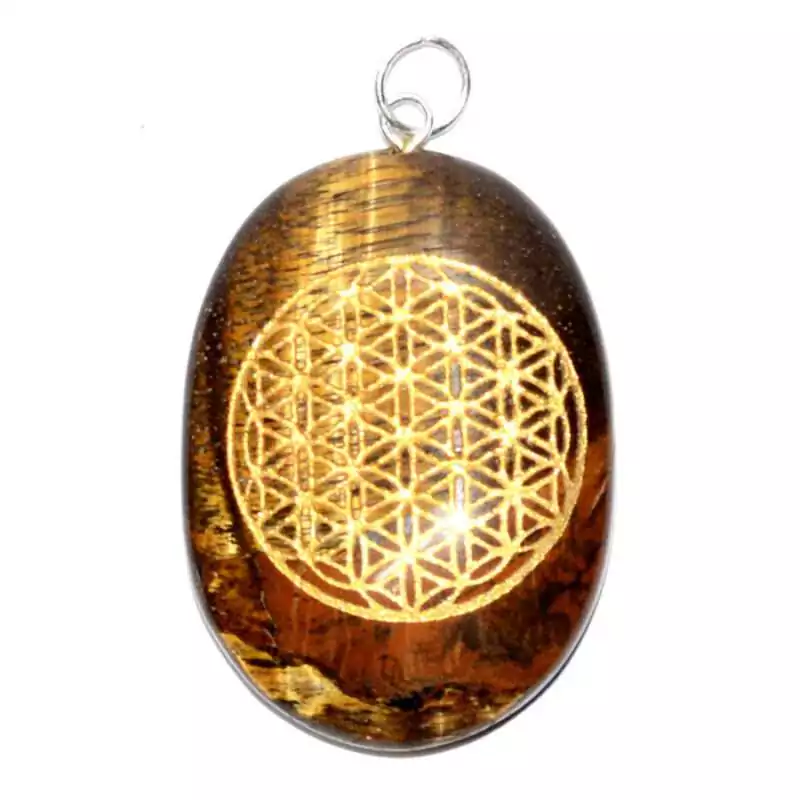
- Design: Gold-toned Flower of Life pattern
- Hardware: Small silver-toned ring at the top edge
- Mohs Hardness: About 7
Tiger’s Eye: A Quartz Stone With a Moving Band of Light
Tiger’s eye is a chatoyant gemstone of the quartz group, golden to red-brown in color, with a silky luster and a band of light that seems to travel as you turn it. It is mostly silicon dioxide, colored by iron oxide, and it forms from the alteration of crocidolite, a fibrous blue amphibole sometimes called blue asbestos. Geologists once thought quartz had replaced those fibers entirely. Newer work indicates that the fibers fractured repeatedly and were sealed in quartz, and the exact sequence of stages is still debated. Gold and brown are the natural colors, and the blue-grey version of the same material is called hawk’s eye. Red tiger’s eye is produced by gentle heating, and heat, bleaching and dye are all used on tiger’s eye in the trade. The stone rates about 7 on the Mohs scale and is usually cut as a cabochon or polished flat to show off the band. It is mined in South Africa, Australia, India, Myanmar, Brazil, China and the United States.
This worry stone is an oval of polished tiger’s eye measuring about 1 by 1 1/2 inches, a size that rests easily in the pads of a finger and thumb. The top of the stone carries a honey-gold band of light, and the lower part deepens to chestnut brown with darker patches. A gold-toned Flower of Life design fills the center of the face: overlapping circles of equal size, set inside a round outline, that form a lattice of petal shapes. The pattern’s gold tone matches the gold of the band, and it glints as the light moves. A small silver-toned ring sits at the top edge. Tiger’s eye shows its band best from one angle at a time, so the oval reads differently as you rotate it between your fingers, and the lattice of circles stays fixed while the band moves across the surface. In modern crystal practice, tiger’s eye is associated with the solar plexus chakra, with courage and with protection, themes that suit a stone you keep within reach.
Practical Ritual Applications
Keep the stone in a pocket or bag and bring it out when you want something to hold, rubbing the smooth face with your thumb during a long call or a quiet wait. Lay it on a journal page, pattern up, while you list the choices in front of you, and let the circles act as a point of focus for your eyes. Set it on your altar beside a gold or yellow candle, or rest it near your Tarot cards as a gold-toned marker for the center of the cloth. Keep it beside your keys so it goes out the door with you; a smooth oval this size fits a coin pocket, a pencil case or a small pouch. For other palm-sized stones, browse my worry and palm stones.
How to Use a Tiger’s Eye Worry Stone
Three steps for giving the stone a place in your day.
- Find the Band of Light
Hold the stone under a lamp or beside a window and tilt it slowly. The silky band moves across the surface as the angle changes, and the gold of the Flower of Life pattern catches the light along with it. Find the angle where band and pattern shine together and notice how it looks from there. A minute of looking is enough to learn the stone's surface before you use it.
- Rub It With Your Thumb
Hold the stone between your index finger and thumb and move your thumb gently back and forth across the face. Keep the motion slow and steady, and breathe in time with it for a minute or two. You can reach for it in a waiting room, at a desk or before a Tarot reading, any time your hands want something to do. Put the stone back in your pocket when you are done.
- Trace the Circles
Choose a single theme, such as a decision you are working through, and rest the stone on a table in front of you. With one fingertip, trace the circles of the pattern lightly, one at a time, and let each circle stand for a step or a question. Stop when you reach the outer ring. Write down anything that came to mind, then set the stone where you will see it tomorrow.
The Tarot Fellow Standard
I stock this worry stone for people who like a pocket-sized stone with a design on it: golden tiger’s eye in a polished oval, marked with a gold-toned Flower of Life. The band of light in the stone gives your eye something to follow, and the pattern gives your mind a theme to hold. The courage and protection themes belong to crystal lore, and they work best as ideas you choose to explore. For more stones in that spirit, browse my courage, strength and support stones.
Frequently Asked Questions
It is a pattern of overlapping circles of equal size on a triangular grid. The seven-circle form is called the seed of life and the 19-circle form the flower of life. The name is modern, associated with the New Age movement and commonly credited to Drunvalo Melchizedek's 1999 book, while the circle grid itself is older: it appears in a first-century BCE mosaic at Herod's palace, and related circle constructions appear in Leonardo da Vinci's Codex Atlanticus.
They are the same kind of material in different colors. Tiger's eye is golden brown, colored by iron staining, while hawk's eye is blue to blue-grey, and some pieces show both. Both show the silky band of light that comes from their fibrous structure, and gold and brown are the natural colors of tiger's eye.
A worry stone is a smooth, polished stone, usually oval and often with a thumb-sized dip, that is typically about an inch across. You hold it between your index finger and thumb and rub the thumb back and forth across it. The practice is a folk one with several claimed origins, and the smoothness of the stones is often produced naturally by running water.
The shimmer is chatoyancy, a band of light that moves as the stone turns. It comes from the parallel growth of quartz and thin fibers, which were once crocidolite and have largely altered to iron-stained limonite. The fibers lie in the same direction, so they catch light in one band, and the band shifts as you change the angle. Stones cut as polished cabochons or flat faces show the effect best.





Reviews
There are no reviews yet