
Quick Specs
- Material: Prophecy Stone (goethite-rich pseudomorphs after marcasite and pyrite)
- Origin: Egypt
- Quantity: 1 lb lot of pieces
- Piece Size: 0.75-1.75 inches (about 19 to 44mm)
- Color: Dark brown to near-black with tan and cream patches
- Goethite Hardness: Mohs 5 to 5.5
Prophecy Stone: Iron Minerals That Kept the Shape of Crystals
Prophecy Stone is a trade name, and the stone behind it is a pseudomorph. A pseudomorph is a mineral that has replaced another mineral while keeping the original’s outward shape, so the crystal forms you see are copies in a different material. Goethite is a common replacer. It is an iron oxyhydroxide that forms when iron-rich minerals weather, and because iron changes its oxidation state in that process, goethite is often seen as a pseudomorph. Goethite pseudomorphs after pyrite and marcasite are well known to collectors. Goethite itself ranges in color from yellowish and reddish to dark brown or black, which fits the dark browns in these pieces, and it sits at 5 to 5.5 on the Mohs scale. People have used goethite in ochre pigments for a very long time. The pieces keep the blades, points and clustered habit of the crystals they replaced, although the original mineral is gone.
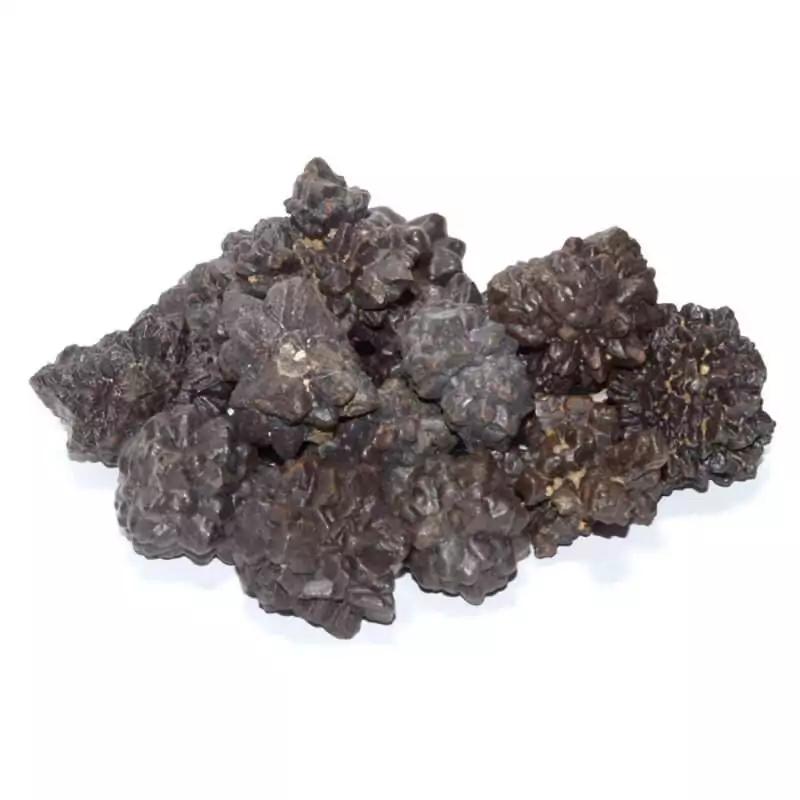
This lot weighs a pound, and the pieces measure from 0.75 to 1.75 inches, about 19 to 44mm, from compact clusters to ones nearly two inches across. Each is a rounded cluster of overlapping blades and knobs, dark brown to near-black, with a matte surface and a few tan or cream patches in the hollows. Some pieces are tight, rounded nodules, and others open into spiky, star-like groups. No two pieces match. Because the replacement kept the original crystal shapes, the surface reads as a crystal group in iron mineral. At 5 to 5.5, goethite is softer than quartz, so keep the pieces apart from quartz and other harder stones, which can scratch or wear them. A pound gives you enough to sort by shape and to spread across a shelf or altar bowl. Under a lamp set to one side, the blades throw small shadows across the hollows and bring out the texture of each cluster.
Practical Ritual Applications
Crystal sellers describe Prophecy Stone as a meditation stone for inner vision and intuition and as a grounding stone, and the name makes a few pieces a natural presence on a Tarot reading table. Hold one in your hand while you settle on a question and feel the knobs and blades under your fingers, then set it beside the cards you draw. A handful in a dark bowl makes a quiet altar centerpiece, and the earthy brown suits wood, linen and candlelight. Choose one piece to carry in a pouch, and leave the rest in the bowl. A single larger cluster makes a handsome weight for the top card of your deck. To see other natural pieces, browse my crystal and mineral specimens.
How to Work With Prophecy Stone Pieces
Three steps for sorting a pound of clusters, giving them a place and handling them well.
- Sort by Shape
Spread the pieces on a plain cloth in good light and group them by outline: tight, rounded nodules; open, spiky stars; and flatter, blade-heavy clusters. Look at the hollows, where tan and cream patches sit among the dark brown. Choose a few pieces from each group for a bowl and put the rest back in the pouch, so every time you reach for one, you can choose by shape.
- Set Up a Dark Bowl
Line a bowl with a dark cloth or a layer of sand and arrange five or six pieces in it, with the most striking clusters facing up. Place the bowl on a stable shelf or altar, away from the edge. Add a small candle in a holder beside it, and keep the flame clear of the cloth. The earthy color and rough surface make a simple, grounded arrangement that needs little else.
- Handle and Store With Care
Hold a piece by the body of the cluster and handle the points gently. Goethite is softer than quartz, so wrap pieces in a cloth or keep them in a pouch of their own, apart from harder stones. A box with a cloth lining keeps the pound together and stops the pieces from knocking against one another.
The Tarot Fellow Standard
I stock this lot for people who like natural pieces with a story behind them. The clusters are rough, earthy and different from one another, so a pound lets you sort for the shapes you like. At up to 1.75 inches they are small enough for a bowl and large enough to hold as individual pieces. Pieces like these are sold to collectors as mineral specimens, and they suit an altar bowl as easily as a specimen shelf. For more rough stones sold in quantity, browse my raw bulk stones collection.
Frequently Asked Questions
A 2014 Geological Society of America abstract by Hamilton College researchers concluded that the aggregates are iron hydroxide pseudomorphs, primarily goethite, after both marcasite and pyrite, with barite, gypsum and calcite also present. Dealers have labeled the material hematite, goethite and limonite over the years, and they describe the Egyptian pieces as goethite or limonite pseudomorphs after marcasite or pyrite.
The Egyptian material occurs in the Cretaceous Khoman Chalk of the White Desert, near Farafra Oasis in Egypt's Western Desert. The aggregates are found only within that chalk, and collectors have gathered them there for years. The abstract's authors collected the aggregates in an area of small polygonal faults roughly 500 to 1000 meters across.
The authors of the 2014 abstract suggest the aggregates precipitated after the chalk was deposited, possibly through diagenesis and dewatering as the chalk was buried. Marcasite and pyrite can form at low temperatures, below 100 degrees Celsius, and goethite forms when iron-rich minerals weather, so the iron hydroxide took over the shapes of the iron sulfides. The exact formation conditions remain uncertain.



Reviews
There are no reviews yet