

Quick Specs
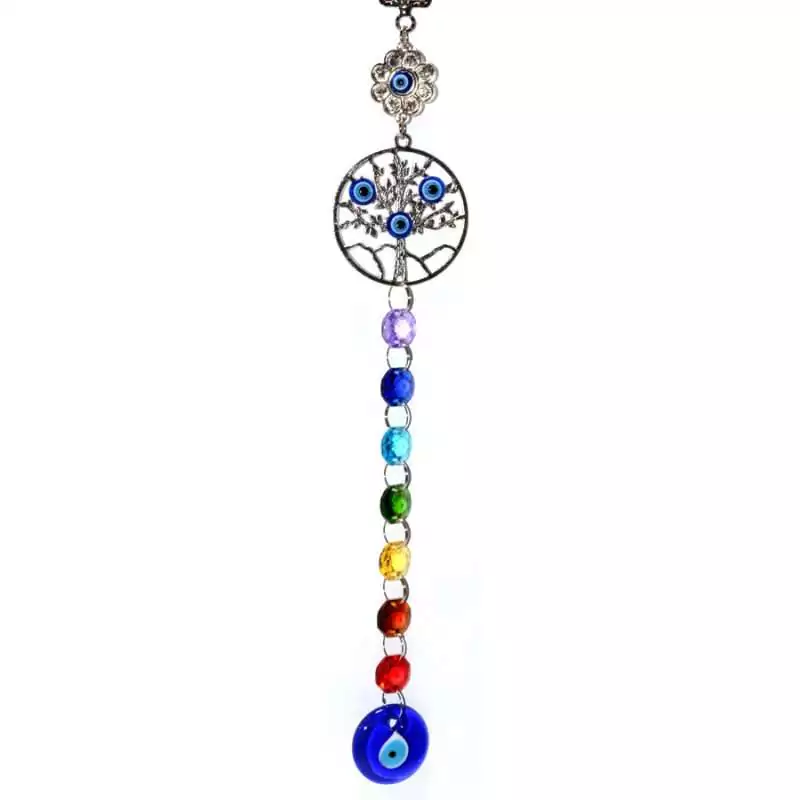
- Type: Wall hanging with eye beads, a tree of life ring and a seven-bead chain
- Size: 11 3/4 by 2 inches
- Tree of life: Silver-toned ring with three eye beads among the branches
- Bead chain: Seven faceted beads in violet, deep blue, light blue, green, yellow, orange and red
- Eye beads: Small bead in the flower above; round blue bead at the bottom
A Slim Hanging in Silver, Spectrum Colors and Blue
Four parts hang one beneath another. At the top, a small silver-toned flower holds a round eye bead at its center. Below it, a tree of life fills a plain silver ring, with a wide crown of branches, roots spreading at the base and three eye beads set among the leaves. Fine leaves fill the branches around the beads, and the ring itself is smooth, so the tree is the only texture in the middle of the piece. Short links then carry seven faceted beads in a single column, running from violet at the top through deep blue, light blue, green, yellow and orange to red at the bottom, the order of the spectrum. A flat round eye bead finishes the chain: a deep blue field with a white ring, a light blue center and a black pupil. The piece is 11 3/4 inches long and 2 inches wide, so it hangs as a slim vertical line that fits a narrow stretch of wall. Silver and blue keep the upper half cool, and the orange and red beads supply the only warm color, gathered just above the dark blue eye. A chain at the top lets the whole hanging swing free from a single hook.
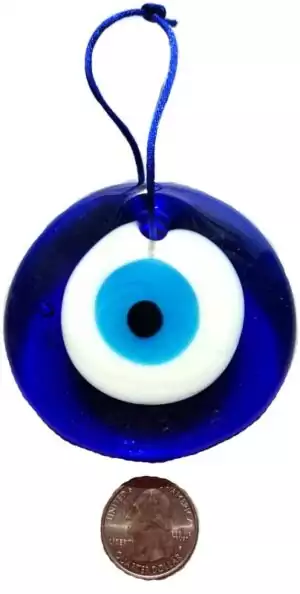
The eye beads belong to the evil eye belief, the idea that a harmful glance, usually inspired by envy, can bring misfortune. A museum catalogue lists glass eye beads among the commonest forms of evil eye amulet and says such amulets are worn or carried. In Turkey the beads are called nazar boncuğu. This hanging uses the eye in two ways: as small accents in the flower and the branches, and as a full-size eye at the foot of the chain. The tree of life brings a second motif, a sacred-tree image that turns up in many traditions, each of which reads it in its own way. A museum catalogue, for example, uses the name for a stylized tree carved on an Assyrian palace panel from the 9th century BC. The seven colored beads between the ring and the eye lengthen the line and add a bright stripe to it. The three parts stack into one vertical shape: a flower and a ring above, a column of color in the middle and the large eye closing the line at the bottom.
Practical Ways to Display It
A long, thin piece suits spots where a broad hanging would crowd the wall: the strip beside a door frame, the gap between two windows, the side of a mirror or the end of a bookshelf. Slip the chain over a small nail or hook and let the hanging drop straight. The faceted beads catch more light near a window or a lamp, and the blue eye at the bottom stays visible from across the room. If you keep other eye pieces, such as a nazar bead on a keychain, this one adds a vertical accent beside them. It also works as a gift for a new home, since a single hook is all it needs. For more pieces made to hang, see my wall hangings collection.
How to Hang and Care for the Tree of Life Hanging
Three steps cover choosing a narrow spot, hanging the chain and dusting the beads.
- Choose a Narrow Spot
Hold the hanging against the wall and step back to judge the fit. At 11 3/4 inches long and 2 inches wide it needs a clear vertical run, so look for a stretch with no shelf, frame or switch within reach of the eye bead as it swings at the bottom. Eye level or just above shows the flower, the ring and the bead column together.
- Hang It from the Chain
Set a small nail or hook into the wall at your mark and slip the chain over it. Let the hanging settle for a minute, then check that the column of beads falls straight below the ring. If the piece leans, move the chain one link along the hook until the beads hang in a line.
- Dust It Gently
Dust the ring and the beads with a soft dry brush or cloth every few weeks, working downward from the flower. Rest the lower beads on your palm while you wipe them so the links hang free. Take the hanging down before you paint or clean the wall around it.
The Tarot Fellow Standard
I stock this hanging because it fits a tree of life, a seven-color bead chain and an eye bead into 2 inches of width, which suits the narrow wall spaces that wider pieces leave empty. The evil eye belief is a living folk custom in Turkey and many other places, and the tree of life belongs to every tradition that uses it. This hanging is a decorative reference to both, never a substitute for the customs of the people who keep them. If the nazar is part of your family’s tradition, you already know how it’s gifted and hung. If it’s new to you, learn those customs before you decide what the eye means in your home. You’ll find more eye pieces in my evil eye collection.
Frequently Asked Questions
Traditional nazar beads are handmade glass in concentric circles or teardrop shapes. A university page on the nazar describes the glass as a mixture of molten glass, iron, copper, water and salt, materials believed to shield people from evil. Wikipedia gives the same list of materials and the same circle and teardrop shapes.
In Turkish belief, blue acts as a shield against evil and absorbs negativity, which is the usual explanation for the color of the nazar. Wikipedia adds that blue disks with concentric circles are common talismans in West Asia and the Balkans. Other places use other colors; in South America, Wikipedia notes, a red ribbon is attached to a baby, an animal or an object to draw the gaze away.
Wikipedia lists the Mediterranean, the Balkans, Eastern Europe, West, Central and South Asia, Africa, the Caribbean and Latin America. A museum catalogue says glass eye beads are found particularly around the Mediterranean, Central Asia and the Middle East. The belief carries different names and customs in each place, so a family's own practice is the best guide to how an eye bead is gifted and hung.


Reviews
There are no reviews yet