
Quick Specs
- Publisher: The Witches’ Almanac
- Editor: Andrew Theitic
- Edition: Issue 46, Standard Edition
- Format: Trade paperback, 208 pages
- Dimensions: 6 x 9 in
- ISBN-13: 9781938918056
A Year Built Around Plants
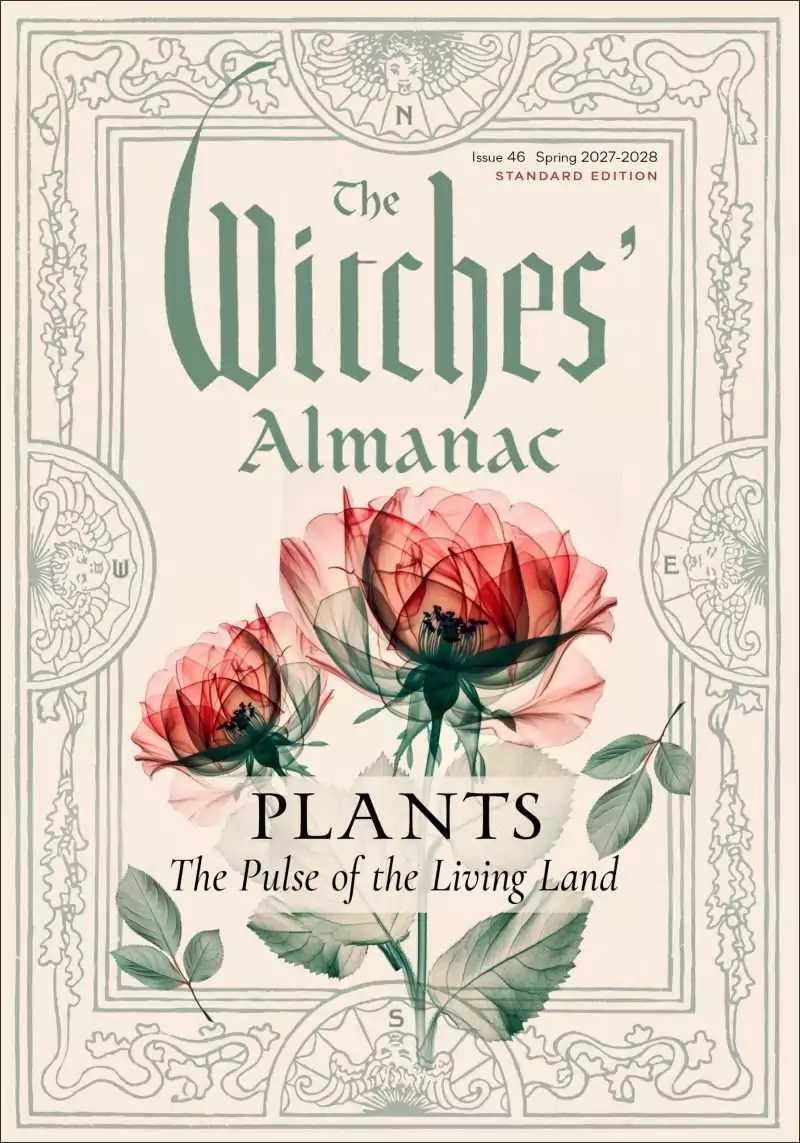
Issue 46 of The Witches’ Almanac runs from spring 2027 to spring 2028 and takes Plants: The Pulse of the Living Land as its theme. The cover answers the theme with two roses drawn as translucent layers of pink and red petals, with sage green leaves, inside an ornamental border that marks north, south, east and west. The publisher’s list of articles names geomancy, the lunar nodes, protection and the spirit world, kitchen magic, April Fool’s Day, Dubious Witch (Part 2) and the Orisha, followed by many more. The list ranges from divination and the Moon’s orbit to the kitchen and the spirit world. The annual moon calendar runs through the same twelve months. That calendar is the part you consult as the year goes by, and the articles give you something to read between one lunar phase and the next. Because the issue spans one spring to the next, it suits a reader who likes to open a book at the turn of the season and keep it within reach until the following spring.
Elizabeth Pepper founded The Witches’ Almanac in 1971, after years as art director of Gourmet magazine. She modeled it on The Old Farmer’s Almanac, which Robert B. Thomas founded in 1792, and gave witchcraft and folklore a yearly almanac of their own. After Pepper’s death the editorship passed to Andrew Theitic, and a 50 Year Anniversary Edition has since gathered articles from five decades of the series into one anthology. Plants have been a theme here before. Issue 28, for spring 2009 to spring 2010, took plants and herbs as its subject, with articles on roses, saffron, chocolate, absinthe, papyrus and the language of flowers. Issue 37, for spring 2018 to spring 2019, took the magic of plants, and its article list ran to sigil witchery and seer stones as well. Issue 46 returns to the subject under a new title. Because each issue carries a single theme, a run of them shelves as a set, one subject per year, with water in Issue 45 followed by plants in Issue 46.
Practical Ritual Applications
Keep the issue where you tend your plants, whether that is a garden bed, a windowsill of herbs or a shelf of dried bundles, and keep it beside your seed packets and watering schedule, where its moon calendar is at hand. The plant theme also suits a reading circle: give each member one article, take turns summarizing it, and compare the folklore with what each person grows. As a gift it fits a gardener who likes folklore or a reader who collects almanacs year by year. For deeper reading on plant lore, browse my oils, herbs and plant magic books. Plant lore records tradition, so identify a plant with a field guide before you handle it, and check with a qualified professional before eating, brewing or burning any plant, particularly if you are pregnant or take medication, since some plants are poisonous.
How to Use The Witches’ Almanac Across Its Year
Use this sequence to work with the issue from the first spring moon to the last.
- Mark the Year on Your Own Calendar
Begin when the issue's year begins, in spring. Copy the moon phases from the Almanac's moon calendar onto a wall calendar or into a notebook, so the dates sit in front of you each day. Add the seasonal dates you already observe. A page of your own gives you somewhere to record what you plant, gather and notice as the months move along.
- Read One Plant Article Each Season
Choose a plant article from the contents and read it through once. Note three things: the plant's name, one tradition about it, and one fact you can check in a second source. Pick a plant you can grow, dry or simply look at in a park, and compare what the Almanac says with a field guide. Spread the reading across the seasons so the theme stays in view from spring to spring.
- Return at Each New and Full Moon
At each new and full moon, open the moon calendar, check the phase and the date, and add a line to your notes: what you read, what you tried and what you saw outside. A reading from the issue's other topics, such as geomancy or the lunar nodes, fits the same sitting. By the following spring you hold a year of dated observations beside the printed calendar.
The Tarot Fellow Standard
I stock The Witches’ Almanac because an almanac earns its place by being used. It gives you a moon calendar to consult, a theme to follow and a contents page to dip into, and a theme that changes every spring gives you a reason to open the next issue. Issue 46 follows Issue 45 on my shelf, and its plant theme adds a year of plant lore to the run. It sits with my calendars and almanacs, next to other books and calendars that mark the year. If you collect the series, adding each issue as it arrives keeps your own set in order.
Frequently Asked Questions
It is an annual guide to witchcraft, folklore and the mystic year. The publisher describes a witty, literate publication for general readers who enjoy folklore, mythology and culture as well as practicing Wiccans, with a moon calendar that carries weather forecasts and horoscopes, plus legends, rituals, herbal secrets, incantations and interviews. The moon calendar is the dated part. The publisher says much of the rest is both current and timeless, not specific to the issue's date range, so much of an issue stays readable after its year ends.
Geomancy is a form of divination that builds a reading from sixteen figures made of dots. The name comes from Greek roots meaning earth divination, and the Arabic method it grew from was called ilm al-raml, the science of the sand, because the dots were traditionally marked in sand. Latin treatises on the technique date to the twelfth century, and it was widely used in medieval Europe. It is one of the topics the publisher names for Issue 46.
The lunar nodes are the two points where the Moon's orbit crosses the ecliptic, the plane of Earth's path around the Sun. The orbit is tilted about 5.1 degrees to that plane, so the Moon crosses it twice a month: heading north at the ascending, or north, node and heading south at the descending, or south, node. A solar or lunar eclipse needs a new or full moon close to a node. The line joining the two nodes turns around the sky about once every 18.6 years.
It is a gardening tradition that ties sowing to the Moon's phase. The Old Farmer's Almanac describes planting annual flowers and above-ground crops between new and full Moon, and bulbs, perennials and root crops between full and new, and traces the practice to ancient Egypt and Rome. Roman farm writers such as Palladius advised planting while the Moon is increasing.
Reviews
There are no reviews yet