

Quick Specs
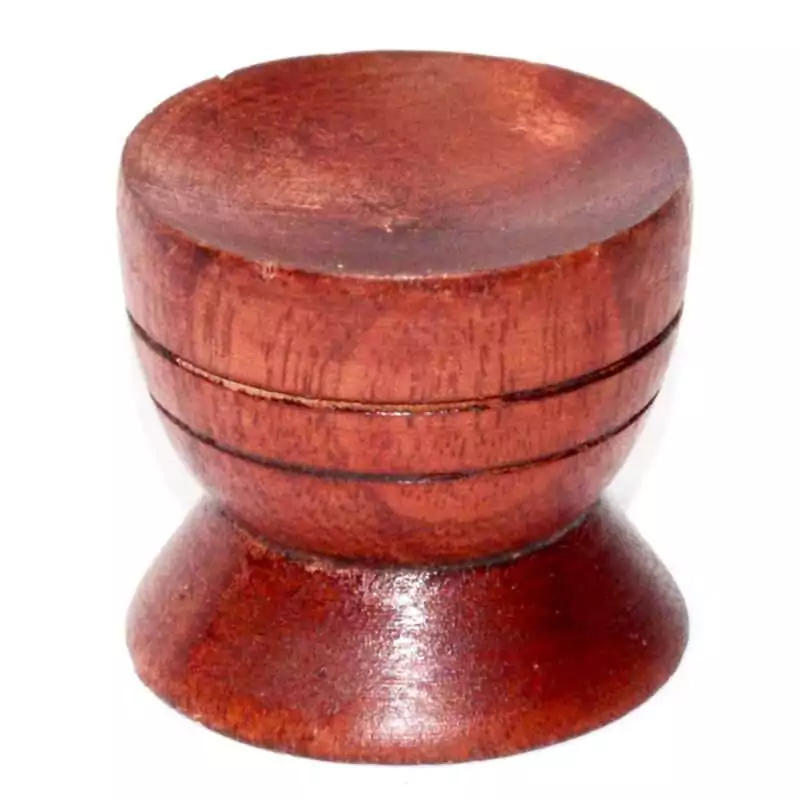
- Type: Stand for a crystal or gazing ball
- Size: 1 1/4 inches
- Material: Wood
- Finish: Reddish-brown, grain visible
- Top: Shallow dish
- Design: Flared foot, rounded body, two incised rings
A Small Reddish-Brown Stand With a Dish Top
The stand has three parts that read at a glance. A wide foot flares outward at the bottom and narrows as it rises. Above it, a rounded body swells like the bowl of a goblet, and two thin rings are cut around its middle. The top is a shallow dish with a thin rim, and that dish is where a ball rests. The finish is a warm reddish-brown, darker inside the cut rings and around the edge of the dish, and lighter where light catches the foot. Fine streaks of grain run down the body and show through the color, so the wood still looks like wood. The sides curve smoothly, and the stain and the grain are the only decoration, so whatever sits on top holds the attention. At 1 1/4 inches, it is a compact piece, sized for a modest sphere and a modest corner. A shelf end, a bedside table, or the front of a desk gives it enough room, and the plain profile suits a space that already has a lot of other objects in it, from candles to books to a Tarot deck in its box.
A sphere has no flat side, so it needs a base before it can be displayed or used at eye level, and that is the job of this stand. People who scry, which means gazing into a surface such as a crystal ball in the hope of receiving messages or visions, tend to describe the sphere as a point of focus. Some say it helps them quiet stray thoughts, in the way a mantra does, and many choose dim light so the ball reflects very little. A stand lets the ball stay put while your attention is on it, which frees your hands for a notebook or a pen. Crystal balls are the best-known scrying tool, and the same stand also suits a sphere that you keep as a display piece, a polished stone, or a gazing ball from your own collection. Scrying has a long and varied history across cultures, and a small wooden stand is among the simplest pieces of equipment it needs.
Practical Ritual Applications
Set the stand on a flat, level surface, such as a desk, a reading table, or a shelf, and rest a crystal or gazing ball in the dish. Conservators note that light damage to wood is cumulative and irreversible, so a shaded spot keeps the finish looking as it does now. A corner of a Tarot table works well, since the stand takes up only a small patch of the cloth. You can also keep it on an altar next to a candle or a bowl, as long as the flame sits well clear of the wood. If you read or journal by lamplight, a lamp placed to one side gives the sphere a soft glow while the stand stays in gentle shade. My crystal ball stand collection has other styles if you want a different material or a larger dish.
How to Set Up and Care for the Wooden Stand
Three steps cover where to put it, how to seat a ball, and how to keep the wood clean.
- Choose a Level, Shaded Spot
Pick a flat surface away from radiators, heaters, and direct sunlight. Conservation guides advise keeping wooden objects away from heat sources, where the air is very dry, and note that light damage to wood builds up over time. A table that stays out of the afternoon sun is a good choice.
- Seat the Ball in the Dish
Hold the ball in both hands and lower it until it rests in the dish at the top. Let go slowly, with your hands still close, and check that the ball sits still before you step away. Keep the stand out of reach of small children and pets.
- Dust It Lightly
Wipe the stand with a clean, dry cloth or a soft brush, and work the brush into the two rings. Conservators advise avoiding spray polishes and silicone products, which can leave residues on a finish. Keep drinks and spills away from the wood, since water can damage it.
The Tarot Fellow Standard
I stock this stand because a ball needs a base, and a plain wooden one fits any table. It is a simple, quiet piece: a reddish-brown wood stand that holds a sphere and leaves the sphere as the focus. If you are building a scrying table, pair it with a ball from my crystal balls and spheres collection, and pick a sphere with the size of the dish in mind. A small stand gives a ball a place to sit, and the rest of the practice is yours.
Frequently Asked Questions
Dust it with a clean, dry cloth or a soft brush, and skip spray polishes and anything containing silicone, which can leave residues on a finish. Conservation guidance says wooden objects can be damaged by light, humidity, water, and pests, and that furniture should stay away from radiators because the air around them is very dry. A shaded spot with steady room conditions suits the wood best.
Scrying has been practiced in many cultures, and the crystal ball has a long record. A clear beryl globe about 3.8 centimeters across was found in the Merovingian tomb of Childeric I. Crystal gazing became a popular pastime in the Victorian era, when the ball was said to mist from within just before a vision appeared.
Scrying media include reflective, refractive, or luminescent surfaces such as crystals, mirrors, water, fire, and smoke. Genesis 44 mentions a silver cup used for divination, the Persian Shahnameh describes the Cup of Jamshid, and Nostradamus is said to have scried into a bowl of water or a magic mirror. Some practitioners close their eyes instead, a practice called eyelid scrying.




Reviews
There are no reviews yet