
Quick Specs
- Material: Green onyx
- Shape: Six-sided die
- Size: 2 inches (about 5 cm)
- Finish: Polished, with softly rounded edges
- Markings: Black and red dots
- Color: Translucent pale green with white veining
Green Onyx: A Banded Stone Cut Into a Die
Onyx is typically the black-and-white banded variety of agate, a banded chalcedony, which is microcrystalline quartz. The bands run in straight, parallel lines, and the name points to that pattern of color. It comes from the Greek onyx, meaning claw or fingernail, and onyx with pink and white bands can resemble a fingernail. The stone has a long history in hardstone carving, and its bands have made it a classic material for cameos and for intaglio engraved gems, where the layers let the image contrast with its ground. Over time the word has been applied to other banded stones as well, and green onyx belongs to that wider family. Dice carry an equally long record. A die is a small, throwable object with marked sides that can rest in several positions. Dice may have developed from fortune-telling with the knucklebones of hoofed animals, and rolling them remains a standard example of cleromancy, the reading of random results as answers. A die of polished green onyx joins those two histories: a banded carving stone shaped into one of the oldest tools for games and divination.
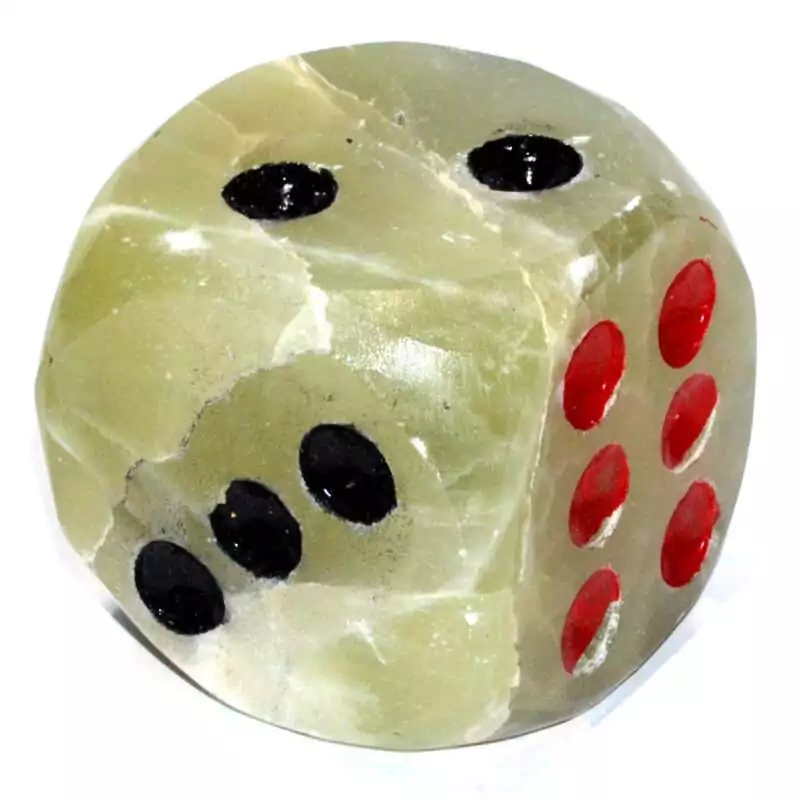
This die measures 2 inches, about 5 centimeters, which makes it a large one, big enough to fill a palm and to be seen across a table. The stone is a pale, translucent green in shades from soft celadon to yellow-green, crossed by white veins and fine lines where the banding shifts. The edges are softly rounded, and the surface is polished. The three black dots run along a diagonal, and the six red dots stand in two neat columns of three. Pale white bands pass through the green like mist, and a few darker flecks and hairline marks show where the stone’s layers meet. Veined stone differs from one die to the next, so the pattern of green and white on this one belongs to it alone, and turning the die in your hand brings a different stretch of vein to the front. At 2 inches it also works as a desk piece, and the soft green sits well beside wood, brass and a deck of cards.
Practical Ritual Applications
Dice divination uses numbered dice, cast and read as answers, and a large stone die gives that practice a handsome tool. Decide what each number stands for before you cast, and write the list in your journal so your readings stay consistent. Roll the die for a quick odd-or-even answer, or let the number you roll choose which position in a Tarot spread you study first. A single cast can also pick which of six journal prompts you write about that day. Between uses, set the die on a stand of folded cloth at the center of a small altar or beside your reading cards, where the green catches the light. It works equally well in a game of chance at the table. To see other dice and casting tools, browse my runes and gaming dice.
How to Cast and Care for a Green Onyx Die
Set your meanings, cast over a soft cloth, then store the die with care.
- Choose a Meaning for Each Number
Before your first cast, decide which theme each number from one to six will carry. One simple set of themes is home, work, love, money, health and travel, written in a notebook beside the date. A fixed list keeps your readings consistent from week to week. Revise the list only when you start a new notebook, so earlier readings stay readable.
- Cast Low Over a Soft Surface
Spread a folded cloth on a sturdy table and hold the die in both hands. Say your question once, aloud or in your head, and roll the die low over the cloth so that it settles softly. Read the face that lands on top against your list, then note the question, the number and the date. A cloth under the die protects both the table and the edges of the stone.
- Rest the Die Between Readings
After a session, wipe the die with a soft dry cloth and set it in a pouch or a small lined box. Keep it apart from other stones and metal pieces so the polish stays smooth, and look over the corners and edges from time to time for chips.
The Tarot Fellow Standard
I stock this die for readers who like a casting tool with some weight in the hand. Dice are among the oldest divination tools, and a polished green stone die looks good on a desk or an altar when it is resting. The pattern of green and white veining differs from die to die, so each one is its own piece. At 2 inches it is a generous size for readers who like to see a cast from across the table, and the meanings you give each number are yours to set. Browse my Tarot decks and divination collection for more tools to pair with it.
Frequently Asked Questions
Sources use the name for more than one material. Minerals.net says green onyx often refers to chalcedony dyed deep green, or to banded light green and white agate, and notes that the name is sometimes applied to banded onyx marble. Wikipedia adds that most carved items sold as onyx today are banded calcite, a carbonate much softer than true onyx.
It is called astragalomancy, also known as cubomancy, and it counts as a branch of cleromancy, the reading of random results as answers. The word comes from the Greek astragalos, a knucklebone, because historical dice were usually marked knucklebones from sheep and goats. Today the word is also applied to casting ordinary numbered dice.
Yes. Some stone sold as onyx is banded calcite, and calcite dissolves in dilute acids with a fizz of carbon dioxide, so vinegar, lemon juice and acidic cleaners can etch it. Banded calcite is also much softer than onyx in the strict sense, which is banded chalcedony, a form of quartz. Keeping acids away protects the polish whichever stone the die is cut from.

Reviews
There are no reviews yet