
Quick Specs
- Material: Green onyx
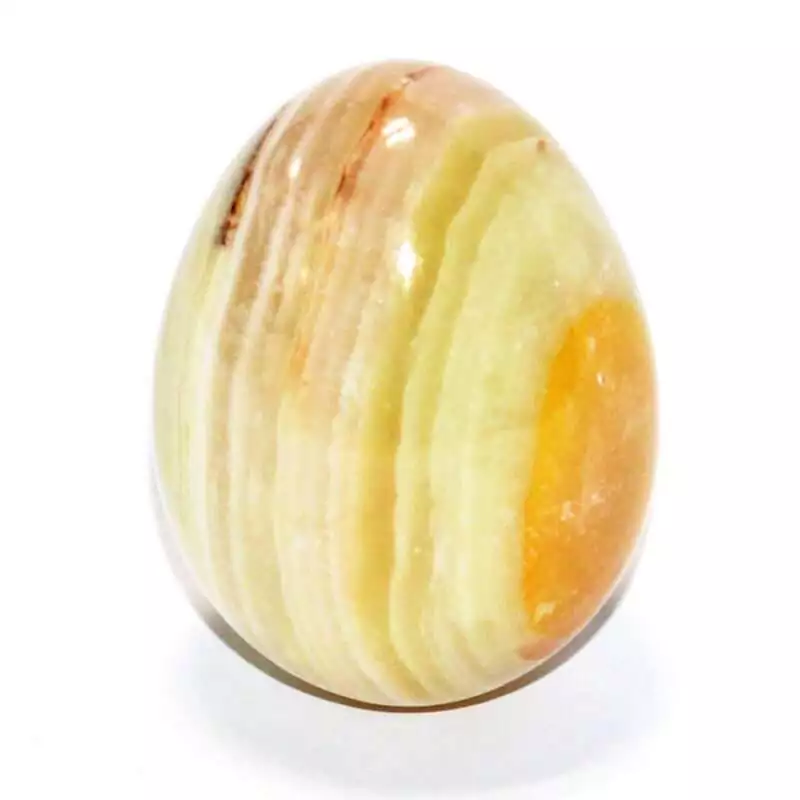
- Shape: Egg
- Height: 1.5 to 2 inches (about 38 to 51mm)
- Width: 1 1/4 to 1 3/4 inches (about 32 to 44mm)
- Finish: Polished
- Color: Pale green to yellow-green with cream bands and an orange patch
Green Onyx: One Name for Several Banded Stones
Green onyx is a trade name, and the trade applies it to more than one material. Strictly, onyx is a banded form of chalcedony, a fine-grained quartz with straight, parallel bands, and green onyx can mean chalcedony dyed deep green or a banded agate in light green and white. The name is also given to banded calcite and travertine, sometimes called onyx marble, which are laid down layer by layer and can be polished and dyed as ornamental stone. According to Wikipedia, the majority of carved items sold as onyx today are this carbonate material, and it is much softer than true onyx: calcite sits at 3 on the Mohs scale, while onyx runs from 6.5 to 7. Impurities give calcite colors from pale green and yellow to orange and brown, and banded stone shows them as stripes. A smooth polish lets those stripes read clearly, which is why banded stone is carved and polished into ornaments.
This egg stands 1.5 to 2 inches tall, about 38 to 51mm, and 1 1/4 to 1 3/4 inches wide, so it fills a closed palm without weighing it down. Each egg falls somewhere in that range, and each has its own pattern. The bands curve along the long axis in wide stripes of pale green and yellow-green, with thin cream and white lines between them and a few brown streaks near the narrower end. One side carries a bright orange patch where the color deepens, and the polish gives the whole surface a glossy shine with soft highlights. The stone is translucent, so hold the egg to a window and the paler bands let the light through while the darker ones keep their depth. An egg has no corners, which means it turns easily in your fingers and shows a different part of the pattern each time. Set it on a shelf and the stripes read from every side.
Practical Ritual Applications
Keep the egg where you reach for it without thinking: on a desk, beside your deck of cards, or in a small dish on your altar. The smooth curve suits a quiet minute with a question, rolled slowly between your palms while you decide what to ask the cards. A pair of small candles in holders on either side gives it a soft, warm backdrop; keep the flames clear of cloth and paper. A wooden egg cup or a shallow bowl holds it upright, and its pale green sits well beside a houseplant, where it reads as part of the greenery. On a reading table, rest the egg at one corner of the cloth as a quiet weight and a spot for your eye to settle between cards. For other smooth shapes in stone, browse my eggs and hearts collection.
How to Care for and Display Your Green Onyx Egg
Three steps for looking it over, giving it a seat and keeping the polish bright.
- Look It Over in Good Light
Turn the egg slowly in daylight and follow the bands from one end to the other. Notice where the stripes widen, where the orange patch sits and where the stone turns translucent. A minute of looking is enough to learn the egg, and it helps you choose which side faces front when you display it.
- Give It a Seat
An egg rolls, so give it a base. A wooden egg cup, a small ring of cloth or a shallow dish lined with a scrap of felt keeps it upright and keeps the polish from rubbing against a hard surface. Place the stand well back from the edge of the desk or shelf, and set the egg with its wider end down. Keep it out of reach of small children and pets.
- Wrap It Alone for Storage
When you store the egg or take it with you, wrap it alone in a soft cloth, away from harder stones such as quartz that could scratch the polish. Carbonate stones sold as onyx scratch easily, so a cloth wrap protects the surface. A shelf in a lived-in room suits it, and a lidded box keeps dust off it between uses. Cleaning advice is in the questions below.
The Tarot Fellow Standard
I stock this egg for people who want a smooth stone to hold that also looks good on a shelf. At this size it fills a palm easily, and the banded green, cream and orange makes each egg its own. A polished egg shows the whole pattern at once, and the translucence gives the paler bands a glow. The surface is smooth enough to feel pleasant in the hand, and the size suits a desk, a bedside shelf or an altar dish. For more polished stones and shapes, browse my crystals, stones and gemstones collection.
Frequently Asked Questions
The name covers several materials. Minerals.net says green onyx often means chalcedony dyed deep green, sometimes a banded light-green and white agate, and sometimes, incorrectly, onyx marble, a false name for banded travertine or tufa. Wikipedia adds that most carved items sold as onyx today are banded calcite. Calcite is much softer than chalcedony, at 3 on the Mohs scale against 6.5 to 7, so a carved piece is handled gently whichever material it is.
Dust it with a soft, dry cloth. Calcite is sensitive to acid and scratches easily, and carved stone sold as onyx is often calcite, so avoid vinegar, lemon juice, bleach and other harsh cleaners, and skip ultrasonic and steam cleaners. If a mark needs more than a dry cloth, wash briefly with warm, soapy water and a soft cloth, then dry the egg thoroughly.
Onyx reached English through Latin from the Greek word onyx, meaning nail, claw or veined gem. Wikipedia notes that onyx with pink and white bands can resemble a fingernail. Straight, parallel bands in alternating colors define the stone, and the banding made it a favorite for Roman cameos, including the Gemma Augustea, a two-layered onyx carving from about 9 to 12 AD.






Reviews
There are no reviews yet