
Quick Specs
- Type: Tripod display stand
- Size: 2 inches
- Material: Wood
- Legs: Three curved legs, entwined
- Color: Reddish brown
Three Curved Legs That Cross to Hold One Small Object
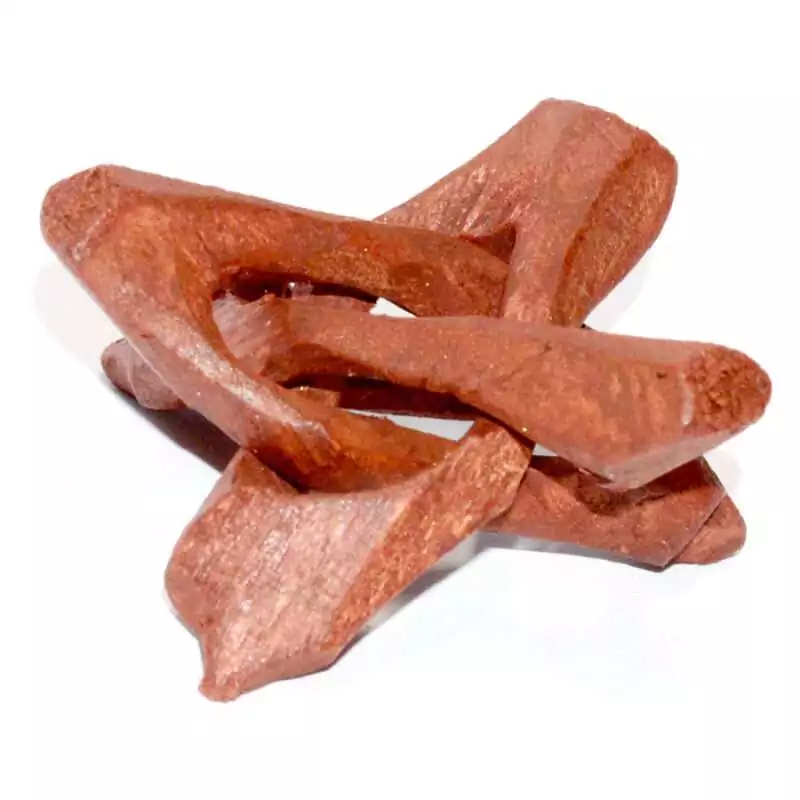
The stand is made of three curved pieces of wood that cross over one another. Each leg is cut with angled faces, so light breaks across it in flat planes, and the grain shows along the cut edges. Where the legs meet they overlap, and the three arms spread into a low, star-shaped base. The wood is a warm reddish brown, deeper in the recesses and lighter along the ridges. At 2 inches, this is the small size of a style that comes larger too, a three-legged, entwined holder made to cradle an abalone shell, a decorative bowl, a crystal ball, or a geode. A stand this size suits a small object with a modest base, such as a small sphere or a trinket dish, and it sits well on a desk, a shelf, or the corner of an altar. The three legs reach outward from a shared center, so an object sits over the middle with its weight shared among the legs. Wood varies from piece to piece, so the grain and color of each stand differ a little. Beside stones, shells, or a small plant, the warm tone of the wood fits easily with natural materials.
A tripod is a portable three-legged frame or stand that supports the weight of another object and keeps it stable. The three-legged, triangular stance resists gravitational loads and sideways forces well, and spreading the legs away from the center improves resistance to tipping. Many cultures have used tripods for far more than cameras: ancient China and Greece used them as ornaments, trophies, sacrificial altars, and cooking vessels. Chinese bronze tripods called dings usually have three legs, and Greek tripods held cauldrons for cooking and other uses. The word itself comes from Greek tripous, meaning three-footed, and the earliest form appears in Mycenaean Greek written in Linear B. Photographic and laboratory tripods apply the same geometry in modern form. A small wooden stand carries that long habit into the home. Its three legs are curved and entwined, so it looks more like a piece of carving than a tool, and it lifts a favorite object off the surface where it sits and gives it a place of its own on the shelf.
Practical Ritual Applications
Use the stand on a desk, a bookshelf, a windowsill, or an altar, anywhere a small object deserves a lift. A small crystal sphere looks different on a stand than flat on a tabletop, and a shell dish or trinket bowl gets the same treatment. My crystal ball stands collection has other stands for larger spheres. Check your object’s base against the 2 inch size, since the stand suits small pieces. For anything that burns, fire services advise a flat, heat-resistant surface such as a ceramic tile, so seat the stand on one and place a heat-resistant dish on top. Between uses the stand can hold a small stone or stay on the shelf as a piece of carving, and its low profile means it takes little room beside a candle or a deck of cards.
How to Set Up a 2 Inch Wooden Tripod Stand
A small tripod stand needs a flat surface, an object whose base suits its size, and a heat-resistant layer under anything that burns.
- Match the stand to your object
Hold your object next to the stand before you set anything down. The stand is 2 inches in size, so it suits a small sphere, a small shell, or a small dish with a modest base. Look at how the three legs cross, and check that the legs reach under the part of the object that carries its weight.
- Place the stand on a flat, level surface
Put the stand on a table, shelf, or altar that sits level, and press lightly on the three legs to see that each one touches the surface. A three-legged stance stays steady on any flat surface. Then lower the object so it rests across all three legs at once, with its weight centered over the middle.
- Keep heat on a heat-resistant surface
Wood is a material that burns, so seat the stand on a ceramic tile or a metal plate whenever a heat-resistant dish above it holds anything lit. Fire services advise a holder made of heat-resistant material that can catch falling embers, set on a flat, heat-resistant surface. Stay with anything burning, and keep it away from curtains and paper.
The Tarot Fellow Standard
I stock this stand for its form. The three curved legs cross in a way that reads as carving, and the 2 inch size fits the small pieces on an altar or a desk, where a large stand would crowd everything around it. It lifts a sphere, a shell, or a dish above the surface and gives the object a place of its own. If you collect shells or burning dishes, my shells, stands, charcoal, sand, and feathers collection has more to set beside it, from stands to sand to feathers for a tidy altar.
Frequently Asked Questions
Wooden tripod stands of this three-legged, entwined style hold abalone shells, decorative bowls, crystal balls, spheres, and geodes. The style is described as a simple, earthy way to lift an abalone shell or a sphere, and stands come in several sizes to match the object. The stand is a display piece, and the object on top decides the use.
A tripod's three-legged, triangular stance gives good stability against the weight of the object and against sideways forces. Spreading the legs away from the center improves resistance to tipping. Three points of contact make a stable base, which is why camera tripods, laboratory tripods, and ancient cauldron stands all use three legs.
Fire services advise using a holder made of heat-resistant material, sturdy enough to catch falling embers, on a flat, heat-resistant surface such as a ceramic tile or a metal plate. Wood is a combustible material, so set the stand on a tile and keep anything lit in a heat-resistant dish. Keep burning incense away from curtains, clothes, and paper, and out of reach of children and pets, and stay with it while it burns.

Reviews
There are no reviews yet