
Quick Specs
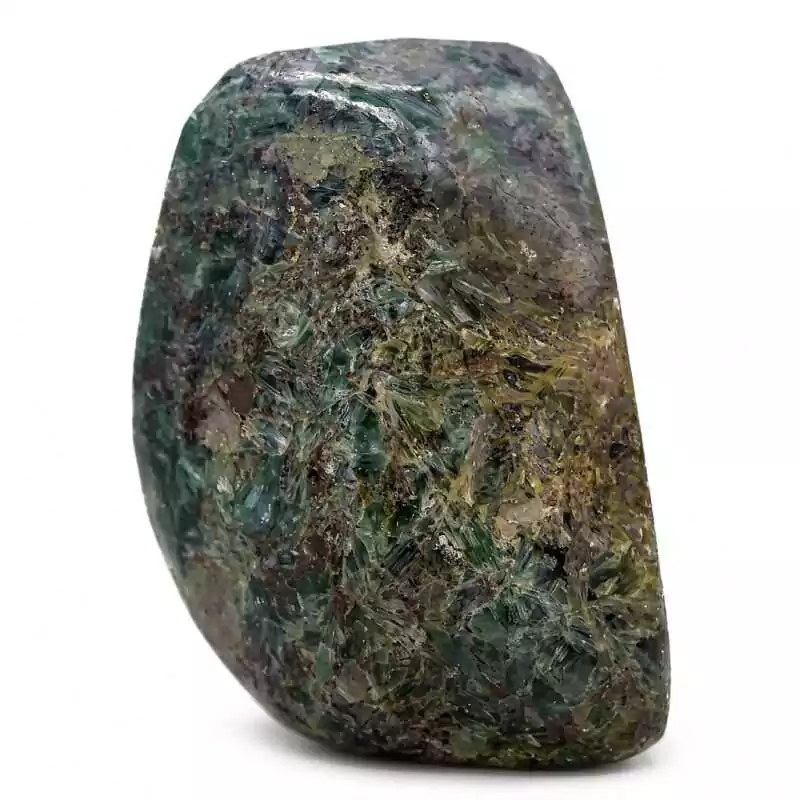
- Type: Blue kyanite free shape specimen
- Weight: 0.15 to 0.39 pounds per piece
- Chakra: Throat and third eye
- Best for: Altar work, meditation, chakra alignment, crystal grids
Blue Kyanite Natural Formation and Mineral Facts
Blue kyanite is an aluminosilicate mineral that forms in elongated blade-like crystals, a shape that follows from its triclinic crystal system and the extreme pressure conditions under which it develops. Found primarily in metamorphic rocks across Brazil, Nepal, Kenya, and the eastern United States, kyanite’s signature steel-blue to cornflower-blue coloration comes from trace amounts of iron and titanium within its lattice. One of its most unusual physical properties is anisotropic hardness: it registers around 4.5 on the Mohs scale along its length but jumps to 6.5 across the width, a quirk that makes it a genuine curiosity among collectors and lapidaries.
Among practicing crystal workers, kyanite is one of only a handful of minerals said to neither accumulate nor retain dissonant energy, meaning it is considered self-aligning without periodic clearing. This property distinguishes it clearly from selenite, the other commonly cited self-clearing mineral, though the two make natural companions on a working altar. These free shape specimens preserve the natural blade structure, so each piece arrives with that characteristic striated surface rather than a uniform tumbled face.
Throat Chakra, Third Eye, and Traditional Use Across Practices
In contemporary chakra work, blue kyanite is most strongly associated with Vishuddha, the throat chakra, where practitioners use it to address blocks around honest expression, public speaking, and communication in personal relationships. Its secondary association with Ajna, the third eye, makes it a dual-purpose tool for those who want to pair clarity of speech with sharpened intuition in a single session. Tibetan practitioners have historically used kyanite blades in what is sometimes described as spiritual surgery, passing the elongated edge through the aura to clear stagnant pathways, a technique that has carried forward into modern energy work.
Beyond formal spiritual traditions, writers, teachers, and public speakers sometimes keep kyanite on a desk during creative work, drawn to its traditional reputation for cutting through mental fog and supporting authentic self-expression. Because the stone is thought to align all chakras without deliberate programming, it functions as a low-maintenance companion for daily carry or altar placement. Pairing it with lapis lazuli or aquamarine deepens the throat chakra resonance; pairing it with amethyst extends the third eye work.
How to Use Blue Kyanite
Three practical ways to work with a blue kyanite free shape at the altar, in a grid, or during daily focus work.
- Set Up Your Meditation Placement
Hold the kyanite blade at throat level or lay it on the throat during supine meditation. Its elongated form fits naturally along the collarbone. Hold this position ten to twenty minutes, focusing on breath and honest inner expression throughout.
- Use It in a Crystal Grid
Place the kyanite free shape at the center of a crystal grid as the primary alignment stone. Because kyanite is self-clearing, it will not absorb energy from surrounding stones, making it a stable anchor that needs no cleansing between uses.
- Daily Carry and Desk Work
Tuck the specimen into a small pouch or set it beside your keyboard during writing sessions. The irregular free shape has a natural resting orientation, so find the face showing the blade formations most clearly and orient it toward you as you work.
The Tarot Fellow Standard
I stock kyanite in free shape form specifically because the raw blade structure is what makes this mineral visually and energetically distinctive. Tumbled kyanite exists, but the smooth finish conceals the striated surface that both collectors and practitioners want to see. Each piece in this weight range delivers a substantial specimen, not a chip or sliver, so it sits confidently on an altar or in the hand during meditation. If you’re building out a crystal-focused practice, browse my free shapes collection for similar natural-form pieces, and check my chakra and meditation tools for complementary supplies.
Frequently Asked Questions
Kyanite is one of the few minerals considered self-clearing, meaning it does not accumulate dissonant energy the way most stones do. Most practitioners skip routine cleansing entirely, though brief moonlight exposure is harmless if desired.
Blue kyanite primarily aligns with the throat chakra, supporting honest expression and communication. Its secondary resonance with the third eye makes it useful for pairing intuitive development with clarity of speech in a single sitting.
A free shape preserves the natural blade formations and striated surface of the mineral. Tumbled kyanite is rounded and polished, which softens the look. Most crystal workers prefer free shapes because the blade structure defines the stone.
Kyanite’s blade structure makes it water-sensitive, and prolonged soaking can cause delamination along crystal layers. Use the indirect method, placing the stone beside rather than inside the vessel, to make a kyanite-influenced water preparation.


Reviews
There are no reviews yet