


Quick Specs
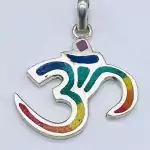
- Type: Metal pendant with colorful enamel or painted detail
- Size: 1.75″
- Size/Quantity: 1 3/8 inches, one pendant
- Best for: Yoga practice, meditation wear, crown and third eye chakra work, spiritual gifting
Om: The Primordial Sound in Hindu and Yogic Tradition
The syllable Om, also rendered Aum, appears in the Mandukya Upanishad as the sound from which all manifest existence arises. The three phonemic components, A, U, and M, correspond in that text to the waking state, the dreaming state, and the dreamless sleep state respectively, with the silence that follows the M pointing toward a fourth state beyond ordinary consciousness. This cosmological framework makes Om more than a mantra in the strict sense: it is described as the acoustic form of Brahman, the universal ground of being, which is why it opens and closes almost all Hindu prayers, and why it became central to yogic and meditative practice far beyond its Vedic origins.
The written form of Om in Devanagari script, the curved three-part glyph with a curved visor above and a dot called the bindu, is one of the most widely recognized sacred symbols in the world. The bindu represents the point of creation, the undifferentiated state from which the three states arise. Wearing the Om symbol is understood across Hindu, Jain, and yogic contexts as an alignment with that primordial frequency, a portable reminder of the resonance underlying everyday existence.
Wearing Om as a Daily Alignment Practice
At 1 3/8 inches, this pendant is large enough to read clearly as a statement piece while remaining proportional for daily wear without being heavy. The colorful metalwork or enamel detail gives it visual warmth beyond a plain silver casting, making it a practical gift for yoga practitioners, meditation students, and anyone drawn to Vedic or Hindu spiritual traditions. It pairs naturally with a plain silver or cord chain. You can find chain options in my neck chains and cords.
Practitioners who chant or use mantra as part of their practice often wear Om jewelry as a tactile complement to the vocal work, touching the pendant before beginning a session as a grounding gesture. For practitioners who do not chant, the symbol serves as a visual prompt for mindfulness throughout the day, a reminder of the contemplative dimension their practice is building toward.
How to Use Om Symbol Pendant
How to pair, wear, and use an Om pendant in daily practice and meditation.
- Choose a chain or cord that matches your practice
A plain sterling silver chain keeps the pendant’s spiritual character at the center. Cord necklaces in black or natural hemp are common for practitioners who prefer a less formal look. The pendant bail fits standard chain sizes.
- Wear it during meditation and yoga sessions
Place the pendant against the chest during seated meditation. Before beginning a session, touch the symbol briefly as an intention anchor. This small gesture connects the physical object to the contemplative state you are entering.
- Use it as a mantra support piece
If you work with Om as a chanted mantra, hold the pendant between thumb and finger while chanting, then release it when complete. This physical anchoring mirrors how mala beads function, giving the body a tactile role in the practice.
The Tarot Fellow Standard
I carry this pendant because the Om symbol has genuine depth in multiple living traditions, and a well-made pendant at this size communicates that depth without being ostentatious. The colorful detail makes it accessible to younger practitioners and gifting occasions without diminishing its symbolic weight. For complementary meditation tools and sacred jewelry, browse my chakra and meditation products.
Frequently Asked Questions
Om, also written Aum, is described in the Mandukya Upanishad as the primordial sound of creation, encompassing all states of consciousness. Its three phonemes represent waking, dreaming, and deep sleep, foundational to Hindu and yogic practice.
Om has moved beyond strictly Hindu practice into global yoga culture. Many practitioners outside Hinduism wear it as an alignment with its philosophical meaning rather than a religious statement. Respecting its origins is the standard most follow.
A 16 to 18 inch chain positions a 1 3/8 inch pendant at the collarbone or just below it, which is the standard wearing height. A 20 inch chain drops it to mid-chest, suiting taller wearers or those who prefer the pendant over the heart center.
Keep the pendant dry and avoid prolonged exposure to water, perfume, or body lotion, which can affect enamel or painted finishes over time. Store it in a pouch or box rather than loose in a jewelry tray to prevent surface scratching.


Reviews
There are no reviews yet