

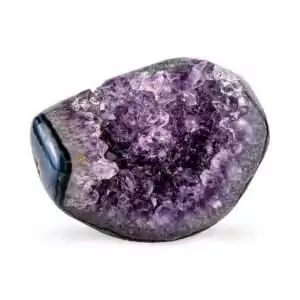
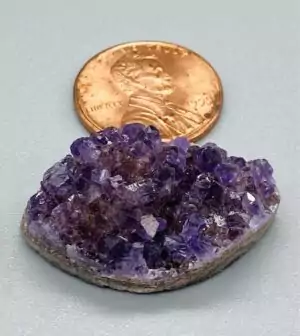
Quick Specs
- Size: Approximately 2 inches across (free-form shape, varies per piece)
- Type: Druzy Crystal Cabochon / Mineral Specimen
- Material: Natural amethyst (SiO2 quartz), Uruguayan origin
- Shape: Free-form organic outline, flat base, raw crystal face
- Best For: Altar display, meditation anchor, pendant making, crystal grids
A Crystal That Grew Into Its Own Shape
Amethyst has been a stone of spiritual weight since ancient Greece, where it was believed to keep the mind clear and sober, its name rooted in the Greek “amethystos,” meaning “not intoxicated.” These pieces come from Uruguay, one of the most respected amethyst-producing regions in the world, where volcanic basalt formations created the perfect gas cavities for long, slow crystal growth. What you’re holding is a section of that geode wall, shaped into a cabochon with a flat base and a raw druzy face.
The “free form” description here is specific and worth understanding. This isn’t a standard oval, teardrop, or round. The outline follows the natural contours of the stone. No two are the same, and that’s not a limitation, it’s the point. I carry these because the shape variation means each one has a character that a perfectly cut cab simply can’t replicate. The druzy surface, that carpet of tiny interlocked quartz crystals, catches light from every angle. It sparkles without being flashy. If you’re looking for something to browse in the geodes, clusters, and druse collection, this sits right in the middle of that family.
In crystal practice, amethyst is consistently paired with the crown and third-eye chakras, and tied to clarity, intuition, and restful sleep. Its purple tones range from pale lavender to deep violet depending on the iron content and degree of natural irradiation in the host rock. These Uruguayan pieces tend toward medium to deeper purple. If meditation and clarity work is what you’re after, you’ll also find a wider range of supporting stones in my meditation and clarity stone collection.
How to Use Your Amethyst Druse Cabochon
Three ways to work with your free-form amethyst druse cabochon.
- Observe the Crystal Surface
Set your cabochon on a flat surface with the crystal face upward. Spend a moment just looking at it. Each druzy peak is a tiny quartz crystal that formed over millions of years in a volcanic gas cavity in Uruguay.
- Use It in Meditation
Hold the piece in your palm during seated meditation. The irregular organic shape makes it easy to grip and focus on. Let your thumb trace the bumpy crystal surface while you breathe and clear your thoughts.
- Display It on Your Altar
Place the cabochon on your nightstand or altar as a display anchor. Its flat base keeps it stable, and the sparkling surface catches ambient light. Pair it with a candle or selenite slab to build a calming focal point.
The Tarot Fellow Standard
I stock this amethyst from a supplier whose Uruguayan material has been consistently reliable in color depth and crystal quality across multiple orders. The pieces arrive with natural variation, which is expected and desired, but the grade range is tight enough that you’re not going to get a washed-out lavender when the photo shows deep purple. What I look for in this format is clean druzy coverage with no large matrix gaps, a stable flat base, and no cracked sections along the free-form edge. Most pieces pass that test; the few that don’t get pulled from stock.
A practical note: because the outline is irregular, these don’t fit standard round or oval cab settings without modification. If you’re planning to wire-wrap or bezel-set one, account for the organic shape. The flat base does make them excellent for standing upright on a shelf or altar plate without a stand. These aren’t fragile, amethyst sits at 7 on the Mohs scale, but the tiny crystal tips on the druzy face can chip if you drop the piece on a hard surface, so treat it with reasonable care.
Frequently Asked Questions
Druzy refers to a layer of tiny crystals coating a stone surface. In a cabochon, the flat or shaped base is polished for display while the top face is left as raw sparkling crystal. It’s natural, not treated or dyed.
Each piece is cut and shaped by hand from Uruguayan amethyst. The outline is organic and irregular rather than a geometric form, so no two cabochons are alike in silhouette, color depth, or crystal cluster density.
Amethyst is a variety of quartz, SiO2, colored violet by iron impurities and natural irradiation. It rates 7 on the Mohs hardness scale, making it durable enough for display, altar work, and light everyday handling.
Cleanse it with sound, smoke, or moonlight. Avoid prolonged water soaking since the matrix rock under the crystals can be porous. A soft dry brush removes dust from the crystal points without scratching the surface.
Reviews
There are no reviews yet