
Quick Specs
- Stone: Carnelian
- Bead Size: 3mm
- Shape: Round
- Finish: Polished, glossy
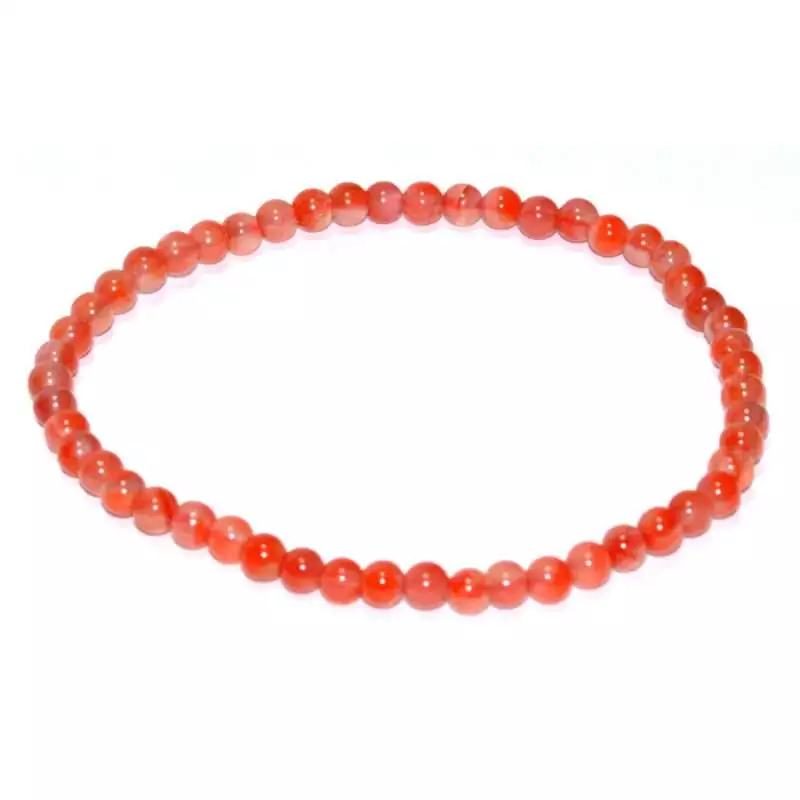
- Color: Translucent orange with pale cloudy zones
- Closure: None, one continuous loop of beads
Carnelian in Fine 3mm Beads
Carnelian is a variety of chalcedony, the translucent, fine-grained form of quartz, and iron oxide impurities give it a color that runs from pale orange to deep red-brown. The beads on this strand sit in the orange part of that range. Some are saturated tangerine, and others thin out to a pale peach with a cloudy, whitish zone where the color fades. That spread is normal for the stone, and it gives the strand a gentle gradient from the first bead to the last. At 3mm each bead is tiny, so the bracelet reads as a fine ring of warm color around the wrist, with the shifts in tone visible only up close. Chalcedony rates 6.5 to 7 on the Mohs scale, hard enough for everyday jewelry, though a sharp blow can still chip it. Because 3mm beads are small, a strand holds many of them, and the changes in tone arrive in tiny steps. People have worn carnelian as a gem since antiquity, and bead makers have drilled it for thousands of years. Carnelian is cut mainly as beads and cabochons, and the beads here are polished to a bright, even gloss.
In modern crystal practice, carnelian is associated with the sacral chakra, the orange center in the seven-chakra scheme, and crystal guides pair it with courage and motivation. Those links come from modern crystal lore, which took the chakra idea from Hindu and Buddhist traditions, and you can take them as symbolism. Symbolism like that works as a cue: a warm band of orange on your wrist gives you something to glance at when you start a task you have been putting off. The 3mm size suits that purpose well. Fine strands sit close to the skin, slip under a shirt cuff, and stack two or three deep without crowding each other. If you already wear a watch or a metal bangle, a thin carnelian strand adds a line of color beside it. Warm orange also sits well against neutral clothing, from navy and gray to black and cream, so the bracelet goes with most of what you wear day to day. One strand reads as a single thread of color, and two or three read as a soft band, so you can decide how much orange you want to show.
Practical Ritual Applications
Put the bracelet on at the start of a project you want to finish, such as a first chapter, a studio session or a tidy-up of the room you avoid. Touch one bead when you sit down, then get on with the work. On an altar, lay it in a loop around the base of a small orange or red candle, and let the light pass through the translucent beads. For a spoken intention, hold the strand between your palms while you say it once, then fasten it around your wrist and go about your day. A thin strand also travels well, tucked inside a pocket or a pouch. To build a stack, my 4mm and 6mm beaded bracelets collection holds other slim strands that sit comfortably beside this one.
How to Wear and Care for Your Carnelian Bracelet
Three steps cover looking the strand over, choosing a cue, and gentle cleaning.
- Look the beads over in daylight
Hold the bracelet near a window and turn it slowly. Find the deepest orange bead and the palest one, and notice where the cloudy zones sit. That spread is part of the stone, and knowing it helps you recognize the strand each time you wear it. Check that the beads sit snugly together all the way around the loop.
- Choose one small cue
Decide what the bracelet will mark, such as a morning routine, a creative hour or a task you have been avoiding. Put it on, rest your thumb on a single bead and take one slow breath. In crystal practice carnelian is tied to the sacral chakra and to courage, so the same bead can serve as your reminder each day.
- Clean it gently and store it flat
Wipe the beads with a soft cloth dampened in warm water with a little mild soap, rinse the cloth, wipe again and dry the strand. Keep it away from harsh chemicals and acids such as lemon juice or vinegar. Take it off before heavy work, since a sharp blow can chip a bead, and store it flat, apart from harder stones that could scratch it.
The Tarot Fellow Standard
I stock this bracelet for its fine scale: 3mm carnelian beads in a single loop, with the orange running from saturated to pale across the strand. Carnelian’s sacral chakra and courage associations come from modern crystal lore, and I offer them as symbolism you can take or leave. The beads vary in tone because the stone does, so no two strands look exactly alike. If you want to compare carnelian with other stones, my crystals, stones and gemstones collection sets them side by side, from tumbled pieces to jewelry.
Frequently Asked Questions
Both treatments are used on carnelian. Heating deepens the orange-red color and is a long-standing practice, and porous carnelian is often soaked in dye for several weeks. Dyed white chalcedony and lightly colored agate are also sold under the carnelian name. Some bead dealers record the treatment for each strand, which is how the trade tells heated, dyed and untreated material apart.
Both are fine-grained quartz colored by iron, and both can look red. Carnelian is translucent, so light passes into it, while jasper is opaque. Jasper carries more impurities such as clay minerals and iron compounds, and carnelian is the more glassy-looking of the two. Both rate about 6.5 to 7 on the Mohs scale.
India and Brazil head every list of carnelian localities. Uruguay is named on two lists, and Siberia and Germany on two others. Wikipedia singles out Yanacodo in Peru and Ratnapura in Sri Lanka as significant localities, and adds Indonesia and Iran to the places where the stone has been found.


Reviews
There are no reviews yet