
Quick Specs
- Material: Shell
- Bead Size: 4mm
- Shape: Round
- Finish: Polished, soft sheen
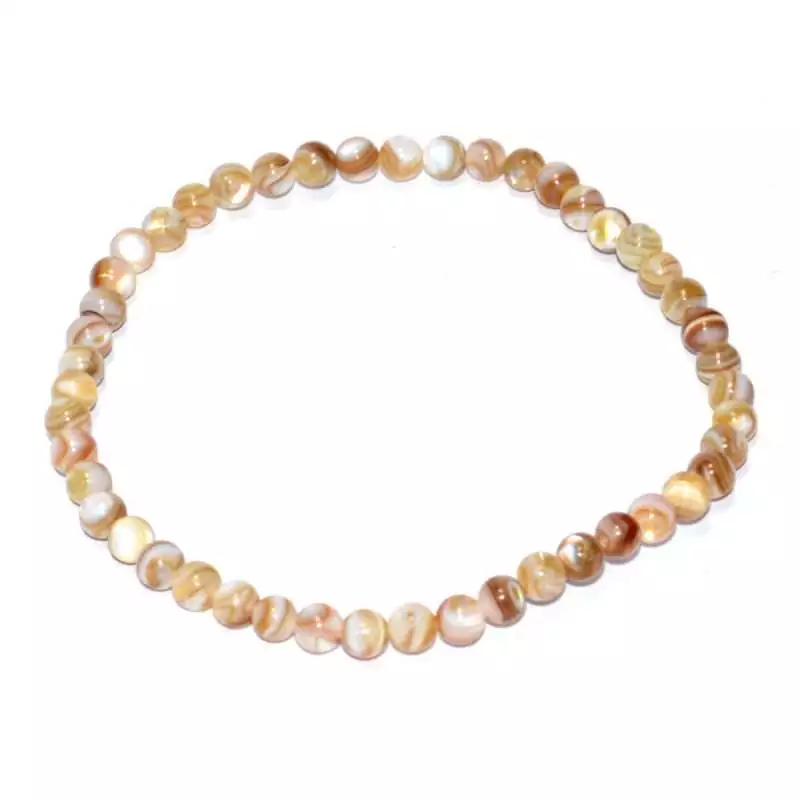
- Color: Cream, tan and brown banding
- Closure: None, one continuous loop of beads
Shell in Small 4mm Beads
Shell is the hard outer covering a mollusc builds for itself, and it is made mostly of calcium carbonate with a small share of organic material. The mollusc’s mantle lays it down in thin layers, first a framework of proteins and then calcium carbonate filling the structure. Bead makers drill and polish pieces of that material into small rounds, and these are 4mm across. Each bead shows its own swirls and bands of cream, tan and brown, and a soft pearly sheen moves across the surface as the strand turns. A few beads run nearly white, while others deepen to a chestnut brown at one edge. The strand reads as a gentle shift between warm neutrals. The polish is even from bead to bead, which gives the whole loop a consistent glow despite the differences in color. At 4mm the beads are small enough that the bracelet sits as a fine, even line around the wrist. The strand keeps to a single material in a single size, and the banding does all the decorating.
A 4mm bead gives a bracelet a light, delicate presence, and a single strand wears like a thin ring of pale color around the wrist. The cream and tan tones sit close to skin tones, so from a distance the bracelet blends in, and up close the banding shows as the beads catch the light. It pairs with silver, gold and rose gold chains, with leather cords and with other fine strands, and its narrow width sits comfortably beside a watch. The warm palette suits sand, driftwood and linen colors, and it also softens a dark outfit with a thin line of light. Shell has a quiet, organic look that fits a beach day as easily as a desk, and it needs no setting or metal to look finished. Because the beads are small and close in tone, the strand also works as a quiet spacer between bolder pieces in a stack, where it gives the eye a place to rest.
Practical Ritual Applications
Wear the bracelet as a slim marker for a stretch of time you want to remember: a trip to the coast, a season of rest, a week of slow mornings. On a shelf or altar of beach finds, coil it beside a small dish of sand or a collected shell and let the cream and tan stand for the shoreline. At a desk, keep it in a dish near the keyboard, and touch one bead when you want a short pause. It also makes a light gift for someone who likes soft neutral jewelry. For other fine strands to stack with it, my 4mm and 6mm beaded bracelets collection holds more small-bead styles. Remove the bracelet before swimming, cleaning or applying perfume.
How to Wear and Care for Your Shell Bracelet
Three steps cover checking the beads, wearing the strand with other jewelry, and cleaning and storing it.
- Look the beads over and check the fit
Hold the bracelet in daylight and turn it slowly. Find the palest bead and the darkest one; that spread is the banding in the shell. Slide the loop on your wrist and make sure it sits comfortably with room to move. Check the strand for gaps, chips or loose beads before each wear, since small beads are easy to lose.
- Wear it with care around harder pieces
Shell scratches more easily than most gemstones, so give it some room. When you stack bracelets, put the shell strand beside soft materials such as leather or cord, and keep it away from rough metal edges and stone beads. Take it off for gardening, lifting and sports, where a knock against a counter or doorframe can mark the beads.
- Wipe it clean and store it apart
When the beads need cleaning, use a soft cloth with mild soap and warm water, then dry the strand right away. Keep it out of ultrasonic and steam cleaners. Store the bracelet flat in its own pouch or a lined box, apart from harder stones and metal chains that can scratch the surface of the shell.
The Tarot Fellow Standard
I stock this bracelet for its simple, wearable look: one material, one 4mm bead size and a polished finish in warm neutral banding. Shell has a long history as an adornment, and a strand like this carries that history in a modern, slim form. You can give the bracelet whatever meaning suits you, whether that is a favorite coastline or a quiet habit. Every bead has its own pattern, so each bracelet balances its cream, tan and brown differently. For more bracelets across the shop, my bracelets and anklets collection gathers strands, chains and charms in one place.
Frequently Asked Questions
Shell beads are among the oldest jewelry known. Perforated shells found in Israel and Algeria were dated by researchers to around 100,000 years ago, and people have worn shell as adornment since prehistoric times. Shells can be drilled and strung as they are, which helps explain why shell has stayed a bead material in so many places for so long.
Mother-of-pearl, also called nacre, is the iridescent inner layer of the shells of certain mollusks, so it is one part of shell. Both are made mostly of calcium carbonate. Mother-of-pearl is known for the play of color that comes from its layered structure, and shell beads show patterning such as the cream, tan and brown banding on this bracelet.
Acids are the main concern, since calcium carbonate dissolves in even mild acids. Keep shell away from vinegar, citrus juice, acidic perspiration and perfumes that contain organic acids, and put perfume on before the bracelet. Steam and ultrasonic cleaning can separate the shell's layers, and shell scratches more easily than most gemstones.


Reviews
There are no reviews yet