

Quick Specs
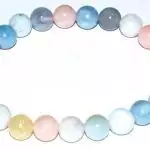
- Stone: Morganite (pink beryl)
- Type: 6-8mm round beaded stretch bracelet
- Color: Soft pink to peach-pink
- Best for: Heart chakra work, divine love, emotional healing, collector use
Morganite Mineral Origins and the Beryl Family
Morganite is the pink to peach-pink variety of beryl, the same mineral family that includes emerald (green beryl) and aquamarine (blue-green beryl). Chemically it’s beryllium aluminum silicate, and its pink coloration comes from trace amounts of manganese. It was first formally described in 1910 and named after J.P. Morgan, who was a significant gemstone collector. Major sources include Brazil, Afghanistan, Mozambique, and Madagascar.
Unlike rose quartz, which is widely available and forms in massive rather than distinct crystal structures, morganite forms in well-defined prismatic crystals and is considered a collector-grade gemstone. Its clarity, color depth, and relative scarcity place it in a different category from more common pink stones, both mineralogically and in the kind of work practitioners bring to it. Rose quartz is the accessible introduction to heart chakra work; morganite is what experienced practitioners often move toward for deeper emotional healing.
Morganite for Heart Chakra and Divine Love Practices
Morganite is consistently associated with the heart chakra and what crystal traditions call divine love, a quality of compassion that extends beyond romantic attachment to include self-love, forgiveness, and connection to something larger than personal desire. Practitioners working through grief, long-term relationship healing, or self-compassion practices often choose morganite over rose quartz because its energy is described as more refined and less diffuse.
The 6-8mm bead size reflects the natural range of these stones through the polishing process, and some variation in bead diameter is a characteristic of genuine morganite rather than a defect. For other heart chakra tools alongside this bracelet, my emotional support crystal collection includes compatible pieces for grief work and heart-centered meditation.
How to Use Morganite 6-8mm Bracelet
Three ways to work with morganite for heart chakra healing, compassion, and emotional depth.
- Heart-Centered Meditation
Hold the bracelet over your heart center. Focus on a specific area of emotional healing, whether forgiveness, grief, or compassion. Breathe slowly and let the stone’s stillness anchor your practice. Five to ten minutes is a useful starting point.
- Wear for Emotional Support
Morganite suits daily wear during grief, transition, or emotional recovery. Wearing it on your left wrist keeps heart chakra energy close all day. Many find it helps access self-compassion when self-criticism would otherwise dominate.
- Pair with Journaling for Deeper Work
After journaling on forgiveness, hold the bracelet and read back what you wrote. Morganite links to opening the heart to truth, making it useful for inner work and softening the judgment that arises when reviewing difficult emotional material.
The Tarot Fellow Standard
Morganite earns a place in my collection because it represents a level of heart chakra work that rose quartz doesn’t fully cover. Rose quartz is an excellent entry point, gentle and widely available. Morganite is for practitioners ready for something more precise. It’s a collector-grade stone in both mineral terms and spiritual application, and I stock it because serious practitioners ask for it by name. For additional heart chakra pieces in various formats, explore my full jewelry collection to find complementary items.
Frequently Asked Questions
Morganite is used for heart chakra work, divine love, and emotional healing. It’s valued for grief support and forgiveness work. Practitioners choose it for its refined, sustained energy compared to more diffuse heart stones like rose quartz.
Morganite forms distinct prismatic crystals; rose quartz is a massive variety. Morganite is collector-grade with focused heart chakra resonance. Rose quartz is gentle and accessible; morganite suits deeper, more targeted emotional healing work.
Morganite is the pink variety of beryl, the same family as emerald, aquamarine, and heliodor. Its pink color comes from trace manganese in the crystal. It was first described in 1910 and named after American financier and gem collector J.P. Morgan.
Natural morganite beads are cut from genuine crystals, and variation from 6mm to 8mm is a normal characteristic rather than a defect. Perfectly uniform beads often indicate synthetic stone. Some size variation signals you have authentic morganite.

Reviews
There are no reviews yet