

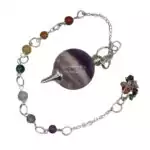
Quick Specs
- Primary stone: Amethyst
- Ball diameter: Approx. 15-18 mm
- Chakra stones: 7 (root to crown)
- Chain: Metal chain with lobster clasp
One Tool, Seven Conversations
Amethyst is a variety of silicon dioxide (SiO2) – the same mineral family as clear quartz – whose violet color comes from trace iron impurities (Fe3+) locked inside the crystal lattice and activated by natural background radiation. That process gives it a Mohs hardness of 7, which means it handles everyday use without chipping. I find the color range on amethyst balls particularly honest: lighter lilac pieces and deeper plum tones come from the same geological process, just different iron concentrations and irradiation levels. Neither is more “powerful” than the other; they are simply different expressions of the same stone.
The seven chakras – Muladhara (root), Svadhisthana (sacral), Manipura (solar plexus), Anahata (heart), Vishuddha (throat), Ajna (third eye), and Sahasrara (crown) – are described first in the Vedas as early as 1500 BC and codified later in texts like the Yoga Upanishads around 600 BC. Each center corresponds to a nerve plexus along the spine, and the classical stone assignments map to color resonance within that system: red jasper at the root, carnelian at the sacral, citrine at the solar plexus, green aventurine at the heart, sodalite at the throat, lapis lazuli at the third eye, and amethyst at the crown. This pendulum strings all seven along its chain, with the amethyst ball serving as the weighted focus at the bottom.
A ball or sphere pendulum moves differently from a pointed one. The round weight distributes its mass evenly in all directions, producing a smoother, more circular swing rather than the crisp directional pull you get from a faceted or conical tip. That rounded motion is well-suited to energy assessments and aura work, where you are reading circular patterns rather than pointing at a spot on a map. The movement itself is explained by the ideomotor effect: unconscious micro-contractions in the muscles of your hand and fingers, triggered by focused thought, create motion that feels externally generated but originates in your own nervous system. Research published in Neuroscience of Consciousness confirms that pendulum users show less conscious response bias than verbal guessing – which is one reason I think the tool is genuinely useful as a reflective practice, whatever you believe about the mechanism.
How to Use a 7 Chakra Ball Pendulum
Establish your yes/no baseline, hold with focused intent, and read the swing pattern to complete a session with your 7 Chakra Ball Pendulum.
- Set Your Baseline
Hold the chain between your thumb and forefinger, keeping your elbow anchored on a flat surface. Let the pendulum hang still. Ask it to show you 'yes' – note the direction. Ask for 'no' – note that too.
- Hold and Focus
Rest one elbow on a table and suspend the pendulum 1 to 2 inches above the surface. Breathe slowly. Quiet your thoughts, then form your question clearly in your mind before speaking it aloud.
- Read the Response
Watch the pendulum's movement without trying to control it. A clockwise circle, a back-and-forth swing, or a side-to-side motion each carry meaning based on the baseline you set in step one.
The Tarot Fellow Standard
I source chakra pendulums from suppliers I have worked with long enough to see consistency across multiple shipments – which, for beaded and assembled pieces like this one, means checking that the stone order is correct (root to crown, not randomly strung), that the chain moves freely without kinking, and that the amethyst ball is genuine stone rather than dyed glass. This particular pendulum comes from a supplier whose quality control I have verified across dozens of SKUs over several years. That is the honest version of why I stock it.
One practical note: the ball will vary slightly in shade from piece to piece. That is not a defect – it is natural amethyst. If you receive a pale lavender ball instead of a deep purple one, the mineral composition is identical; only the iron concentration differs. The chain length is standard for dowsing work, about 6 to 8 inches from fingertip to weight, which gives enough swing arc for clear reading without being unwieldy. If you want to pair this pendulum with a mat for structured yes/no or directional work, browse our full pendulums collection for boards and accessories. For candles, statues, and tools that round out a chakra practice, the chakra and reiki products collection has everything in one place.
Frequently Asked Questions
Common order root to crown: red jasper (root), carnelian (sacral), citrine (solar plexus), green aventurine (heart), sodalite (throat), lapis lazuli (third eye), amethyst ball (crown).
Yes. Amethyst is silicon dioxide (SiO2), identical in structure to clear quartz. Iron impurities and natural irradiation create the purple color. Its Mohs hardness is 7, making it durable for daily use.
The motion comes from the ideomotor effect – tiny, unconscious muscle contractions in your hand and fingers. Your own nervous system generates the swing in response to focused thought.
Yes. The 7 stones correspond to the classical chakra column. You can hold the pendulum at each energy center during meditation, or simply keep it in hand while focusing on a specific chakra.


I absolutely LOVE love love this pendulum.