
Quick Specs
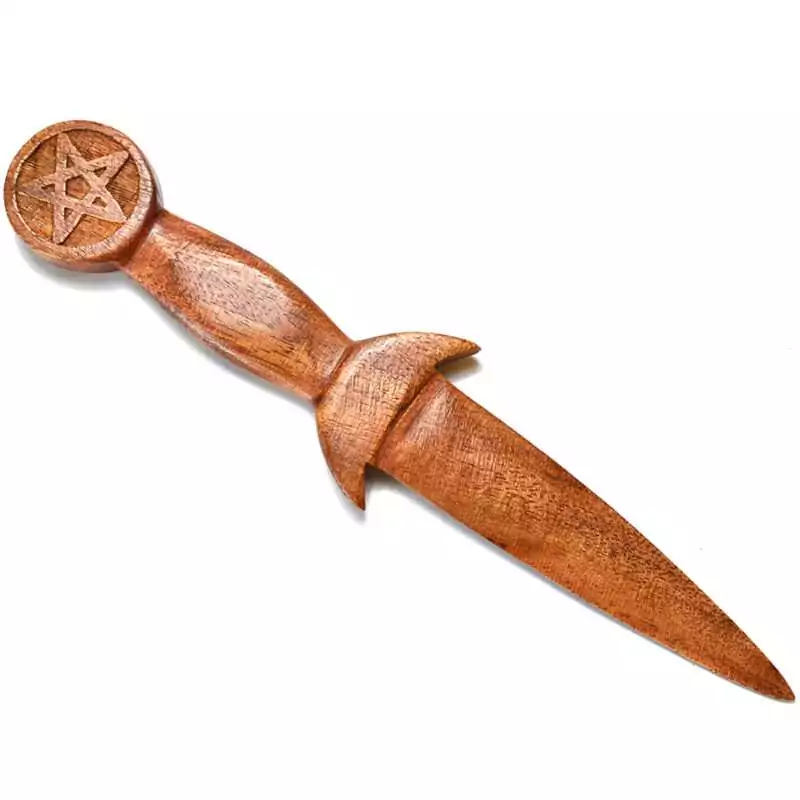
- Material: Wood
- Length: 8 1/2″
- Weight: 0.1 lb
- Design: Carved pentagram
- Blade Type: Ceremonial, not sharpened
- Use: Altar and ritual tool
A Blade Made to Direct, Not Cut
An athame is a witch’s most personal ritual tool, but it’s rarely meant to do any actual cutting. In Wiccan and ceremonial practice, the blade is used to cast a circle, direct energy, and mark boundaries in the air rather than on anything physical, and many practitioners deliberately keep the point dulled so there’s no risk of it doing what a normal knife does. A wooden blade, like the one on this piece, takes that idea a step further. It simply can’t cut, which some witches see as a limitation and others see as the whole point: a tool built for symbolic work stays symbolic.
The pentagram carved into this athame is the same five-pointed star found across Wiccan and pagan altars, standing for the four classical elements, earth, air, fire, and water, gathered under a fifth point representing spirit. Paired with a traditional dagger shape, the design keeps this athame recognizable as a ritual tool at a glance, whether it’s sitting on an altar or standing in for the element of fire or air in a working circle.
Practical Ritual Applications
Most people use an athame to trace the boundary of a circle before a ritual and to close it again afterward, or to direct focus during spellwork the way a wand does in other traditions. Since this one is carved from wood rather than forged from metal, it’s a natural fit if you keep an all-natural altar, if you’re not comfortable having a bladed metal tool in the house, or if you simply want a lighter, more affordable way to start building your ritual kit. It works equally well as a straightforward altar piece if you’d rather display it than handle it.
Bringing a New Athame Into Your Practice
However you use an athame day to day, most witches start a new one the same general way.
However you use an athame day to day, most witches start a new one the same general way.
- Cleanse it before first use
Clear whatever energy the athame picked up before it reached you, whether that means passing it through incense smoke, leaving it in moonlight overnight, or whatever method already fits your practice. This step is less about the tool itself and more about starting your relationship with it on a clean footing.
- Consecrate it as your own
Dedicate the athame to ritual use in whatever way matches your tradition, so it’s marked as a tool you use for circle casting and energy work rather than a general object. This distinction matters more than it might seem, since a consecrated tool tends to feel different in hand once you’ve committed to using it that way.
- Store it on or near your altar
Keep it somewhere it won’t get mixed in with ordinary household items. A wooden athame is light and easy to knock around, so a dedicated spot on the altar protects both the tool and its carved detail from everyday wear.
Tarot Fellow Standard
A wooden ritual blade lives or dies on the carving. If the pentagram is shallow or the dagger shape is lopsided, it looks like a craft-store prop instead of something you’d actually set on an altar. I look for clean carving and a shape that holds up under a closer look, and this one does.
Frequently Asked Questions
An athame is the primary ritual tool in Wiccan and ceremonial witchcraft practice. It’s used to cast and close a magic circle, direct energy during spellwork, and sometimes to consecrate other ritual tools, but it’s not used for physical cutting.
No. Since the blade is meant to direct energy rather than cut anything, many practitioners deliberately keep it dull, and some traditions recommend blunting the point specifically to avoid accidental injury during ritual.
That comes down to personal practice and preference rather than a fixed rule. Some witches favor the traditional iron or steel blade with a wooden handle, while others prefer an athame carved entirely from wood because it physically can’t cut anything, which keeps its purpose purely symbolic. Neither material is considered more correct than the other.
The pentagram is a five-pointed star that stands for the four classical elements, earth, air, fire, and water, together with a fifth point representing spirit. It’s one of the most common symbols in Wiccan and pagan practice, often shown inside a circle.
No. This is a ceremonial tool carved from wood, shaped like a traditional dagger but not sharpened or intended for cutting. For any task that needs an actual cutting edge, use a regular knife or a boline instead.


Reviews
There are no reviews yet