

Quick Specs
- Type: Polished freeform crystal
- Size/Quantity: Approximately 0.8 lb, single unique piece
- Best for: Third eye work, altar display, communication and wisdom rituals
Lapis Lazuli Freeform: A Stone of Ancient Wisdom
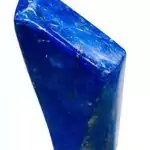
Lapis lazuli is not a single mineral but a metamorphic rock composed primarily of lazurite, calcite, and pyrite, and it has been one of the most prized ritual and luxury materials in human history for over six thousand years. The most historically significant deposits come from the Badakhshan province of Afghanistan, where lapis has been mined since at least 4000 BCE and traded across ancient Mesopotamia, Egypt, and the Mediterranean world. The deep royal blue carries natural inclusions of golden pyrite that catch the light, creating the characteristic starfield appearance that made the stone sacred across multiple civilizations.
In metaphysical practice, lapis lazuli is the quintessential stone for wisdom, truthful communication, and psychic development. It corresponds to both the throat and third eye chakras, making it particularly useful in practices that involve speaking truth, seeking divine guidance, or sharpening intuitive perception. Witchcraft and Wiccan practitioners use lapis in divination work, journaling rituals, and communication spells. In ceremonial and Egyptian-inspired practice, it is associated with the goddess Maat, representing cosmic order and truth.
Working with a Polished Freeform Piece
A freeform, also called a freeform shape or organic shape, is a polished piece that retains its natural outline rather than being cut into a defined geometric form. Each lapis freeform is therefore a genuinely unique object with its own silhouette and its own distribution of deep blue lazurite and golden pyrite. This makes it more suitable for altar display and contemplative use than for applications requiring a predictable footprint, and the smooth polish makes surface features more visible than on a raw specimen.
At approximately 0.8 pounds, this is a mid-size display piece with enough presence to anchor an altar layout or serve as the centerpiece of a third eye grid. Browse my free shapes collection for comparable pieces in other stone types, and explore my full crystal range to find complementary stones for communication and wisdom rituals.
How to Use a Lapis Lazuli Free Shape
Three ritual approaches for working with a polished lapis lazuli freeform in meditation, intention setting, and crystal layouts.
- Third Eye Meditation Focal Point
Place the lapis lazuli freeform on a natural cloth at eye level during seated meditation, gazing softly at its surface to use the deep blue as a visual anchor that draws awareness toward the third eye center.
- Overnight Intention Ritual
Write a question or intention on paper and tuck it beneath the lapis piece overnight, allowing the stone to rest atop the written intention as a focal object for whatever clarity you are seeking by morning.
- Crystal Body Layout
Position the lapis freeform at the throat of a prone figure during a crystal layout session, pairing it with sodalite chips at the brow to create a dual-stone communication and intuition activation for the practitioner.
The Tarot Fellow Standard
I stock lapis lazuli freeforms because a well-chosen display stone serves ritual and aesthetic purposes simultaneously, and lapis is one of the few stones where the historical depth genuinely adds to the practice. Knowing that the same mineral appeared in Egyptian temple paintings and was traded along ancient Silk Road routes gives the stone a grounded significance that supports serious contemplative work. Each piece is a unique specimen rather than a manufactured form, which means no two pieces in my inventory are the same.
Frequently Asked Questions
Lapis lazuli is a metamorphic rock containing lazurite, calcite, and pyrite, the last of which is responsible for the gold flecks visible in high-quality pieces. Mines in Badakhshan, Afghanistan, have been active for over six thousand years.
Ancient Egyptians used ground lapis as the pigment ultramarine in royal cosmetics and sacred paintings. The stone corresponded to Isis and Maat, and was placed in tombs as an offering of wisdom and divine truth.
This freeform weighs approximately 0.8 pounds. Each piece is unique in shape and pattern, so the exact proportions and distribution of pyrite flecks will vary. Dimensions are not guaranteed to match any single reference image.
Lapis lazuli corresponds to the throat and third eye chakras in most traditions, making it a preferred stone for communication work, journaling rituals, truth-seeking divination, and opening or deepening psychic practice.

Reviews
There are no reviews yet