
Quick Specs
- Stone: Flame stone
- Bead Size: 8mm
- Shape: Round
- Finish: Smooth, polished
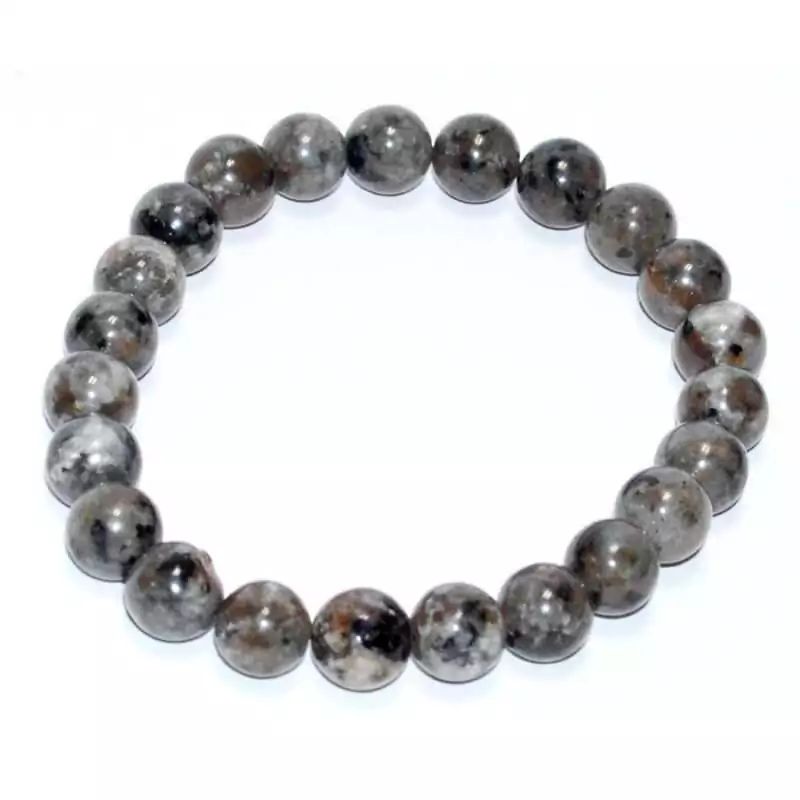
- Color: Slate and charcoal gray with black flecks and brown patches
- Closure: None, one continuous loop of beads
Flame Stone in Round 8mm Beads
These 8mm beads are round and smooth, in a gray that runs from slate to charcoal, flecked with black and warmed here and there by patches of brown. Look closely and each bead is its own small landscape of grain and speck, with some beads dark and glossy and others a paler, flatter gray. Flame stone is the name sellers give to Yooperlite, a syenite, which is a coarse-grained igneous rock, that carries patches of sodalite. Sodalite is best known in blue, but it also occurs in gray and other colors, and it gives the rock its gray look in ordinary light. The mineral takes its name from its sodium content and rates 5.5 to 6 on the Mohs scale, so sodalite sits below quartz at 7. Because the beads are cut from a rock made of several minerals, each bead carries a different mix of fleck, patch and grain, and a strand reads as a family of related grays and browns. The 8mm size gives each bead enough surface to show its own pattern, and the polished surface catches a soft highlight that makes the black flecks stand out against the gray.
The rock’s reputation comes from what it does in the dark. In June 2017 a Michigan rockhound named Erik Rintamaki was scanning a Lake Superior beach at night with an inexpensive UV flashlight when stones began to glow. Analysis at Michigan Technological University identified the glowing mineral as sodalite in syenite, and he called the stones Yooperlites, from Yooper, the local word for a resident of Michigan’s Upper Peninsula, and lite, for the light. Most sodalite fluoresces orange under ultraviolet light, and the lite in the name points to that glow. By day the stones look like ordinary gray rock, and a UV flashlight is typically needed to pick them out of a beach full of pebbles. Retail crystal guides link flame stone with the throat chakra and with speaking one’s truth. That is modern crystal lore, and the chakra scheme comes from Hindu and Buddhist traditions, with the gemstone pairings added in the West much later, so you can take it as symbolism. At 8mm the bracelet sits comfortably in a stack, and the neutral gray goes with silver, black, denim and leather.
Practical Ritual Applications
Some days call for plain speaking: a presentation, a family conversation you have been putting off, a reading you are giving at a table. This bracelet is a quiet companion for them. If you own a long-wave UV flashlight, you can hold it over the bracelet in a dark room to see how the sodalite responds, and wear eye protection around UV lights. Between wears, a small dish near the door keeps the bracelet where you will see it on your way out. On a small altar, lay the bracelet on a dark cloth beside a white or silver candle. To find other stones that share this bead size, browse my 8mm beaded bracelets collection, where the strands stack evenly.
How to Wear and Care for Your Flame Stone Bracelet
Three steps cover studying the pattern, wearing the bracelet as a speaking cue, and caring for a rock-based bead.
- Study the pattern in daylight
Hold the bracelet near a window and turn it slowly. Compare the darker, glossier beads with the paler gray ones, and find the brown patches and the black flecks. Each bead is a different mix of minerals, which is why a strand of flame stone never shows the same pattern twice.
- Wear it as a speaking cue
Put the bracelet on before a conversation or a reading you want to handle with care. Turn it once around your wrist and say the first sentence you plan to speak, quietly, to yourself. In crystal practice flame stone is tied to the throat chakra and to speaking your truth, so the bracelet works as a cue to slow down and say what you mean.
- Store it apart and wipe it clean
Wipe the beads with a soft cloth after wearing them. Sodalite rates 5.5 to 6 on the Mohs scale, so quartz and other harder stones can scratch it; keep the bracelet in its own pouch or dish. Take it off before heavy work or sports.
The Tarot Fellow Standard
I stock this bracelet for its look and its story: 8mm beads in speckled gray with brown and black, in a stone the trade sells as flame stone and as Yooperlite. The glow the rock is known for belongs to the sodalite inside it. The throat chakra link is modern crystal lore, and I offer it as symbolism you can take or leave. The beads vary because the rock does, so no two strands match. For more jewelry made from stones, browse my crystal and stone jewelry collection, where bracelets, pendants, rings and earrings sit together.
Frequently Asked Questions
It is a rock. Yooperlite is syenite, a coarse-grained igneous rock, with sodalite and feldspar among its minerals, and geology references describe it as a mixture of minerals. Because several minerals share each bead, the pattern of grain, fleck and patch varies from one bead to the next, and the sodalite is the part that fluoresces.
Long-wave ultraviolet light does. Rockhounds found the stones with a long-wave UV flashlight, and a 365 nanometer light makes the sodalite show up bright yellow. One geology reference gives the long-wave range as 365 to 395 nanometers, with the sodalite patches glowing orange to yellow-orange, and advises eye protection when you use a UV light.
The stones were first found on the Lake Superior shore of Michigan's Upper Peninsula. One mineral collector's write-up notes that no source of sodalite-bearing syenite is known in Michigan, and it names an igneous complex near Marathon, Ontario, as the most likely source, with glaciers carrying the rock south. Other pages describe the stones as glacial erratics, rocks moved far from where they formed.


Reviews
There are no reviews yet