
Quick Specs
- Material: Angelite (blue anhydrite)
- Mineral: Calcium sulfate, CaSO4
- Form: Single slice
- Weight: About 0.3 lb
- Mohs Hardness: 3.5
Angelite: Pale Blue Anhydrite From Peru
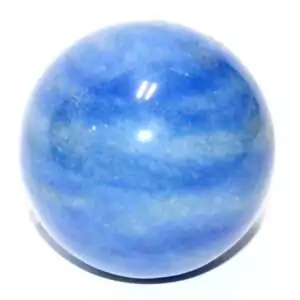
Angelite is a trade name for blue anhydrite, and the mineral underneath is calcium sulfate. Anhydrite is the water-free counterpart of gypsum: its formula is CaSO4, where gypsum is CaSO4 with two water molecules attached. Plain anhydrite is usually white, sometimes greyish, bluish or purple, and clear crystals run from colorless to pale blue or violet. The blue material sold as angelite ranges from pale sky blue to medium blue-grey and lilac-blue. It is slightly milky and translucent, and white flecks or a whitish center are common. Angelite reached the market from Peru in the late 1980s, and Peru is still its main source. A slice is cut flat from a larger piece of rough, so it has two broad faces and an edge, which makes it easy to prop on a stand, lean on a book or lay flat on a cloth. This one weighs about 0.3 lb. Because the stone is soft and brittle, with a hardness of 3.5, a slice is a piece for display and quiet handling.
Anhydrite takes up water from its surroundings and slowly turns into gypsum, the water-bearing form of calcium sulfate, swelling by roughly 60 percent as it changes. The reaction runs the other way when gypsum is heated to about 200 degrees C (400 degrees F), which makes anhydrite again. In everyday conditions the change to gypsum runs slowly enough that specimens stay stable under normal storage, and it explains why dealers and jewelers advise keeping angelite dry. It also scratches easily and splits along flat planes, since anhydrite cleaves perfectly in three directions, so a hard knock or a fall can chip it. Some guides also call it angel stone. In modern crystal practice, angelite is linked with the throat chakra and with communication, and one crystal guide adds the third eye and crown chakras. Those are crystal-lore associations. A flat slice gives that symbolism something to sit on, a quiet stone you can set beside a journal or lean against a candle jar, in a dry room, away from steam and sinks.
Practical Ritual Applications
Set the slice on a dry shelf or desk where you do your writing, and let it stand for the words you want to find. Crystal guides connect angelite with communication, so it suits the table where you draft a letter, plan a difficult conversation or prepare to read for someone. Lay it flat beside your deck as a visual anchor while you shuffle, or lean it against a book to give a spread a pale blue backdrop. One suggestion for a Tarot spread about a conversation: place the slice beside the card that stands for what you want to say. Keep it away from bowls of water, plant misters and bathroom shelves. For more stones linked with speech and messages, browse my communication, telepathy and angels stones.
How to Care for and Use an Angelite Slice
Three steps for keeping a soft blue slice dry, safe and in use.
- Choose a Dry Place
Pick a shelf, altar or desk in a room that stays dry, away from sinks, steamy bathrooms, humidifiers and plant misting. Dryness is the whole care routine. Lean the slice against a book or set it on a small stand on a flat surface, out of the path of elbows and pets. A square of felt or cloth under it protects both the slice and the surface.
- Handle It With Dry Hands
Pick the slice up by its edges with clean, dry hands, and work over a soft surface such as a cloth or your lap. At 3.5 on the Mohs scale it is soft and brittle, and it splits along flat planes, so a drop onto tile or wood can chip it. Keep it apart from harder stones, including quartz, which can scratch it. Set it back where it lives when you finish.
- Dust With a Dry Cloth and Store It Wrapped
Wipe the slice with a soft, dry cloth. Skip ultrasonic and steam cleaners, acid cleaners and household sprays. When you travel or tidy up, wrap it alone in soft cloth and keep it in a box or pouch of its own, with no other stones inside. A dry drawer is a good home between sessions.
The Tarot Fellow Standard
I stock this slice for people who want a mineral piece with a story and a calm blue look. A flat slice is easy to display, whether you lean it on a shelf, rest it on a small stand or lay it beside your deck, and it sits well next to books, wood and candles. At about 0.3 lb it is light enough to move between a desk and an altar wherever your practice needs it. If you enjoy collecting minerals and want to see what else I carry, browse my crystal and mineral specimens.
Frequently Asked Questions
No. Anhydrite absorbs water and slowly transforms into gypsum, and prolonged water or high humidity should be avoided. Crystal and gem references recommend cleaning angelite with a soft, dry cloth.
Anhydrite most often forms in evaporite deposits alongside gypsum and is common in salt basins. When calcium sulfate comes out of water, it usually becomes gypsum. Anhydrite forms when the solution holds extra sodium or potassium chloride and the temperature is above 40 degrees C (104 degrees F). It also forms as cap rock on salt domes and as nodules in tidal flats of the Persian Gulf.
Gem references suggest pendants, earrings and brooches in protective settings, and they advise against rings and bracelets because the stone is soft and scratches easily. Angelite should also stay off skin that is wet or sweating, since anhydrite turns to gypsum in water, so remove it before bathing, swimming or exercise. Store each piece wrapped apart from harder stones.


Reviews
There are no reviews yet