

Quick Specs
- Type: Wall plaque
- Subject: Baphomet (Eliphas Levi’s 1856 Sabbatic Goat illustration)
- Format: Flat wall-mount relief plaque
- Best for: Occult home decor, esoteric altar wall piece, study of Western esoteric symbolism
Eliphas Levi’s Baphomet: The 1856 Sabbatic Goat Illustration
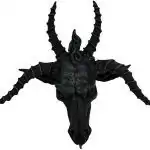
The Baphomet image that appears on this wall plaque derives from the 1856 illustration created by French occultist Eliphas Levi (born Alphonse-Louis Constant) for his landmark work “Dogme et Rituel de la Haute Magie” (Dogma and Ritual of High Magic). Levi’s Baphomet, which he called the Sabbatic Goat, was not a traditional religious figure but a deliberately constructed symbol designed to represent the synthesis of opposites, the reconciliation of dualities that he considered the central project of Western occult philosophy. The figure combines male and female attributes, human and animal forms, celestial and chthonic elements, all united in a single figure that Levi intended as an image of the Astral Light, the universal magnetic fluid he believed underlay all magical phenomena.
The specific symbolic elements in Levi’s illustration carry precise meanings in his system. The arms display the Latin inscriptions SOLVE and COAGULA (dissolve and coagulate), the alchemical maxim describing the breaking down of existing forms and the building of new ones, presented as the fundamental rhythm of all magical and natural processes. One arm points upward and one downward, referencing the Hermetic axiom “as above, so below.” The torch between the horns represents the Astral Light itself. The pentagram on the forehead points upward, indicating spirit’s dominance over matter. The caduceus in the lap references Mercury, transformation, and communication between worlds.
Wall Plaque vs. Statue: Different Format, Different Purpose
A Baphomet wall plaque occupies a fundamentally different function than a three-dimensional statue. Where a statue creates a three-dimensional presence in space that invites circumambulation and a sense of an entity occupying the room, a wall plaque presents the image as a fixed visual field, more like a painting or diagram than a figure. This is appropriate for Baphomet specifically because Levi’s original was a two-dimensional illustration, a deliberate design to be read and studied rather than encountered as a presence. Mounting this plaque in a study, library, or working space treats it as the symbol-diagram Levi intended: an object of contemplation and a reminder of the alchemical principles it encodes.
The format also means it integrates into a wall without requiring shelf or altar space, making it practical for practitioners who want the Baphomet symbolism present in their working environment as ambient context rather than as a focal altar piece. Browse my wall hangings collection for companion occult and esoteric wall pieces.
How to Use the Baphomet Wall Plaque
Three ways to use the Baphomet wall plaque in occult study, ritual, and contemplative practice.
- Mount as a Study or Working Space Symbol
Hang the plaque at eye level in your study, ritual room, or library. The Solve/Coagula arms and the Astral Light torch serve as visual anchors for alchemical thinking, useful in spaces dedicated to esoteric study, writing, or ceremonial working.
- Use as a Contemplation Focus
Sit before the plaque and read each symbolic element in sequence: the upward pentagram, the torch between the horns, the Solve and Coagula inscriptions on the arms, and the caduceus. Levi designed this image to be read as a philosophical diagram.
- Incorporate into Ceremonial Altar Decor
Mount the plaque on the wall behind or above an altar to set symbolic context. Its flat format functions as a backdrop rather than a competing three-dimensional presence, keeping other altar objects as the active ritual focal points of the working.
The Tarot Fellow Standard
I stock this Baphomet wall plaque because the flat format serves a different purpose than a three-dimensional statue, and most listings treat the two as interchangeable. Levi’s Baphomet was designed as a two-dimensional philosophical diagram, and a wall plaque honors that original intent in a way a statue does not. For practitioners working with Western ceremonial magic, left-hand path traditions, or alchemical symbolism, having the image present as wall art creates a different relationship than having a statue: ambient, conceptual, always in the visual field without dominating a ritual space. For other esoteric home decor, explore my home decor collection.
Frequently Asked Questions
Baphomet in Levi’s 1856 illustration encodes the synthesis of opposites: male and female, human and animal, celestial and earthly. The Solve and Coagula inscriptions on his arms express the alchemical rhythm of dissolution and reconstitution.
Solve means dissolve; Coagula means build up. Together they express that transformation requires dissolving what exists before reconstituting it in new form. Levi placed these inscriptions on Baphomet’s arms as a deliberate alchemical statement.
A wall plaque presents Baphomet as a flat image for reading and contemplation, true to Levi’s original two-dimensional illustration. A statue creates three-dimensional presence. The plaque functions as ambient wall art rather than an altar figure.
In Levi’s tradition, Baphomet is a philosophical symbol encoding alchemical and Hermetic principles, not a deity. Later traditions adopted the image with different framing. The original 1856 Levi context is philosophical and esoteric in character.
Reviews
There are no reviews yet