


Quick Specs
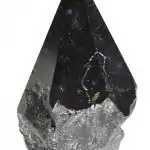
- Type: Crystal point, top polished with natural raw sides
- Stone: Black tourmaline (schorl variety)
- Base: Flat bottom for freestanding display
- Size: Each piece varies in height and weight (natural stone)
- Best for: Altar display, protection grids, directional energy work
Black Tourmaline Top Polished Point: The Altar Format of a Protection Classic
Black tourmaline, the schorl variety of the tourmaline group, is a complex boron silicate mineral with a trigonal crystal system. Its characteristic deep black color comes from high concentrations of iron, manganese, and titanium in the crystal lattice. Unlike many black minerals, tourmaline forms in distinct prismatic columns with clearly defined vertical striations along the prism faces, the signature visual of a raw or lightly processed piece: long parallel ridges running the length of the crystal. These striations are caused by the alternating positive and negative charge distribution that makes tourmaline one of the few naturally piezoelectric minerals, meaning it generates an electric charge under mechanical stress. This property is part of what gives tourmaline its long-standing association with energetic boundaries and protective function.
A “top polished” point means the apex or termination is polished to a smooth, faceted point while the lateral sides remain in their natural raw state, preserving the visible striations and prismatic faces. This is a different preparation from a fully polished tower, which smooths out the surface completely. The hybrid finish gives these pieces both the directional geometry of a point and the visual character of raw tourmaline. A flat base is cut into the bottom so the piece stands upright without a holder, making it suitable for altar placement, shelf display, and crystal grid work.
Protection and Grounding in Crystal Tradition
Black tourmaline has been one of the most consistently popular protection stones across modern crystal healing, pagan, and Wiccan practice for decades. Its traditional applications fall into three categories: personal protection (carried or worn against negative energy and electromagnetic fields), home protection (placed at thresholds, in corners, or buried at property lines as a perimeter ward), and altar work (used in grids to anchor protective intention or placed at cardinal points). The point format specifically is associated with directed intention, the geometry of the apex focuses energy along the vertical axis, upward when the point faces up or outward when directed toward a specific target on a grid.
This top polished point is a distinct format from the other black tourmaline options I carry. Raw bulk is for large-scale grid work or distributing pieces across a space. Chips are for sachets, mojo bags, and loose grid scatter. Tumbled pieces are for pocket carry or body placement. The bracelet is for daily wear. This point, with its flat base and polished apex, is the display and altar piece, the format you choose when you want a standing, directional focal piece for a permanent altar installation. Browse my full crystal collection for other formats and complementary stones.
How to Use the Black Tourmaline Top Polished Point
Three ways to work with the black tourmaline top polished point in altar practice, crystal grids, and stone pairings.
- Place It on the Altar as a Standing Protection Anchor
Set the point on your altar with the polished apex facing upward. Practitioners associate this with drawing protective energy downward and grounding it through the flat base. The standing format makes it a permanent focal piece that needs no holder.
- Use It as a Grid Anchor or Directional Corner Point
Place the point at a cardinal corner of a crystal grid, apex facing inward toward the center or outward toward the perimeter. The flat base keeps it stable without a stand, and the polished tip marks the directional axis clearly for grid work.
- Pair It with Complementary Stones for Layered Protection
Black tourmaline pairs with selenite for purification alongside protection, obsidian for stronger boundary work, and clear quartz to amplify the field. Set the point at center and arrange companion stones around it for a layered protection grid.
The Tarot Fellow Standard
I carry this point because the top polished format fills a gap that neither raw bulk nor tumbled black tourmaline covers. If you want a permanent altar piece with presence, visual character, and directional geometry, this is the format. The raw striations on the sides give it authenticity and show the natural crystal structure; the polished apex gives it the clean termination you need for grid and altar work. Each piece is unique in height, width, and the distribution of natural inclusions. Find protection and grounding crystal companions in my tumbled stones collection.
Frequently Asked Questions
A top polished point has its apex smoothed to a termination while the sides stay raw and striated. A fully polished tower is smooth on all surfaces. The top polished format shows the crystal's natural texture while giving a precise directional tip.
Each piece varies in size because these are natural specimens, not standardized items. Height and weight differ. Expect individual variation in proportions and inclusion patterns; no two are identical, which is typical of natural tourmaline points.
On an altar, the point stands apex-up as a focal anchor. In a grid, place it at a cardinal position with the apex angled toward or away from the center stone to direct the protective energy either inward to the grid or outward toward the perimeter.
In crystal practice, a point aimed upward draws energy toward the crown; aimed outward it pushes energy toward the perimeter. For protection grids, practitioners often face the apex outward to establish the boundary of the space being protected.



Reviews
There are no reviews yet