
Quick Specs
- Material: Chiastolite (andalusite variety)
- Quantity: 1 lb lot of tumbled stones
- Stone Size: 15-30mm (about 0.6 to 1.2 inches)
- Finish: Tumbled and polished
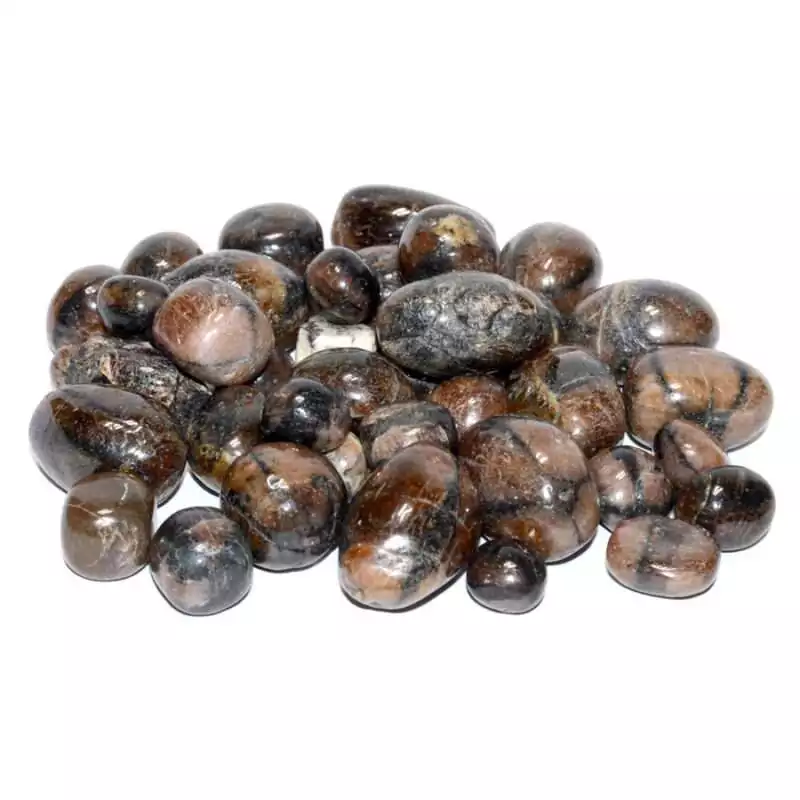
- Color: Pink-brown to grey-black, with dark cross marks
- Mohs Hardness: 6.5 to 7.5
Chiastolite: The Cross Stone in Tumbled Form
Chiastolite is a variety of andalusite, an aluminum silicate with the formula Al2SiO5, and its name comes from the Greek chiastos, meaning cross. Older mineralogy books list it as lapis crucifer, the cross-bearing stone. It shares its formula and hardness with plain andalusite, and the dark cross is what marks the variety. The cross is the reason people collect it, and it forms inside the crystal as the crystal grows. From the sixteenth century, pilgrims returning from Santiago de Compostela in Spain carried chiastolite across Europe as an amulet or a souvenir, and it was sold to them along the pilgrim route. Today chiastolite is found in Spain, California and China, among other places. The ground color ranges widely, from pale grey and yellow to pinkish, reddish-brown and olive, and the cross itself is very dark brown or black. Andalusite is fairly hard, rated 6.5 to 7.5 on the Mohs scale, with the figure shifting a little depending on the direction in the crystal.
These stones are tumbled and polished, each 15 to 30mm, roughly 0.6 to 1.2 inches, and the lot mixes small pebbles with larger ovals. The pound is a blend of warm pink-brown, chocolate and grey-black pieces, and many show a dark cross or X marked across the face, with others carrying bands, patches or a mottled surface. Tumbling cuts each crystal at a random angle, and a cross appears on the stones where the original crystal was cut across its length. Some stones are so dark that the cross reads as a faint mark on a black ground, while the pink-brown pieces show it as a clear dark line, and a few pale or grey pieces sit among the brown ones. The polish is glossy, which makes the dark crosses stand out against the lighter ground. Rural households in England and continental Europe kept chiastolite in the home as a charm. In modern crystal practice, guides link chiastolite with protection, and one pairs it with the root and crown chakras, themes from crystal lore.
Practical Ritual Applications
Sort the pound by cross and lay the clearest ones in a row on your altar cloth, each stone a small marker for a decision you are weighing. Put one in a travel pouch before a trip, a nod to the pilgrims who carried chiastolite home. Rest a stone at the center of a Tarot spread, with a card at each side, to give the layout a point of focus. Hold one in your hand while you reread a letter or a note you are answering. Keep one in your pocket on a day when you are choosing between two paths, and swap it for another when the choice is made. For other tumbled stones gathered around protection, browse my tumbled stones for protection and energy shifting.
How to Work With Chiastolite Tumbled Stones
Three steps for turning a pound of cross stones into a working set.
- Look for the Crosses
Pour the stones onto a light cloth beside a window and turn each one slowly. Look for dark cross or X shapes and for stones where the pattern is split into bands or patches. Set aside six to eight stones with the clearest crosses, and leave the others in a bowl.
- Center a Layout on One Stone
Place the stone with the boldest cross in the middle of a flat cloth or tray. Set four smaller stones around it at the points of a square, and put a candle, a card or a written intention nearby. Leave the layout in place while you work on a decision, then lift the stones one at a time from the outside inward. Return the center stone to the bowl last.
- Carry One on a Trip
Slip a stone into a small pouch and take it with you on a journey, an echo of the way pilgrims carried chiastolite home from Santiago de Compostela. Keep it in a pouch of its own, apart from heavy objects that could chip it. When you return, set the stone back with the rest of the pound and choose another for the next trip.
The Tarot Fellow Standard
I stock chiastolite by the pound for people who like a stone with a clear pattern and a long history behind it. The 15 to 30mm size lets you sort for the best crosses and still have enough stones to hand out. The cross is part of the natural crystal, and each stone carries its own version, so no two look quite alike. Pink-brown and grey-black stones sit well beside candles, dark Tarot cloths and wooden bowls. For other stones sold by the pound, browse my bulk tumbled stones collection.
Frequently Asked Questions
No, though both are called cross stones. Chiastolite is a variety of andalusite, an aluminum silicate, and its cross is a flat pattern seen when the crystal is cut across its length. Staurolite is an iron aluminum silicate whose cross comes from twinning, where two crystals grow through each other. It is also denser than chiastolite and rates 7 to 7.5 on the Mohs scale.
Graphite and other carbon-rich impurities. As an andalusite crystal grows, the impurities collect at its fast-growing corners and along its central axis, and the buildup repeats as growth continues, leaving a pattern with four radiating arms. The cross shows when the crystal is sliced across its length, so each tumbled stone shows it differently, depending on how the crystal was cut.
Yes. Clean it with warm water and mild soap, brush it gently if needed and dry it with a soft cloth. Chiastolite rates 6.5 to 7.5 on the Mohs scale, which makes it harder than many popular stones, and its good cleavage in two directions means a hard knock can chip it. A cloth-lined dish keeps the stones from banging together.


Reviews
There are no reviews yet