
Quick Specs
- Material: Lemon quartz (quartz)
- Quantity: 1 lb lot of tumbled stones
- Stone Size: 15-40mm (about 0.6 to 1.6 inches)
- Finish: Tumbled and polished
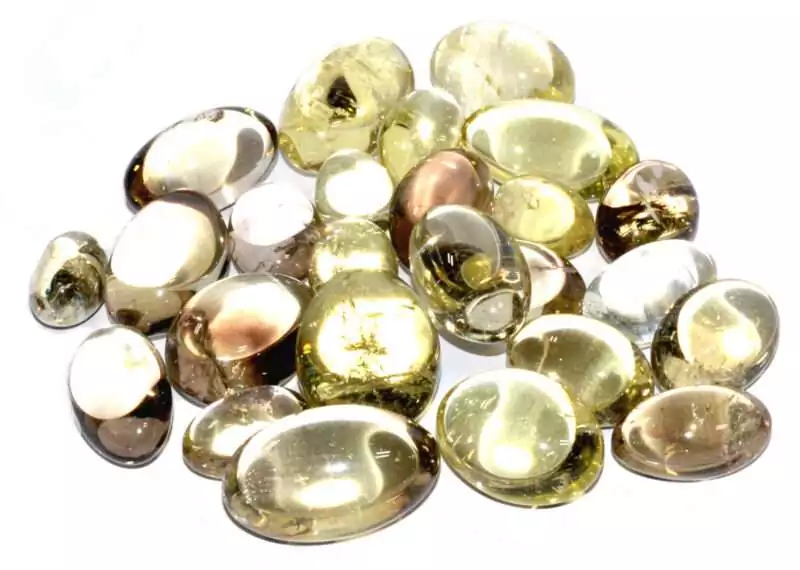
- Color: Pale lemon and yellow-green, with smoky brown, rosy brown and clear stones
- Color Origin: Irradiation followed by heat, standard for lemon quartz
- Mohs Hardness: 7
Lemon Quartz: Treated Quartz in Pale Yellow-Green
Lemon quartz is a trade name for see-through quartz in a bright greenish yellow, and it is quartz all the way through: silicon dioxide, 7 on the Mohs scale, with no cleavage, from the second most common mineral group in the Earth’s crust. The color is produced by treatment. Producers start with natural quartz, such as clear quartz or amethyst, expose it to gamma radiation to create color centers in the crystal, and then heat it, which stabilizes the color and tunes it toward yellow-green. Naturally colored quartz in a similar hue is rare, and the stones on the market come from treated material. Citrine, the best-known yellow quartz, is usually made by heating amethyst or smoky quartz. Lemon quartz is also sold as Ouro Verde quartz. Quartz takes a bright, glassy polish and breaks along smooth, curved surfaces, which makes tumbling a natural way to finish it, and the rounded stones show the color from every side.
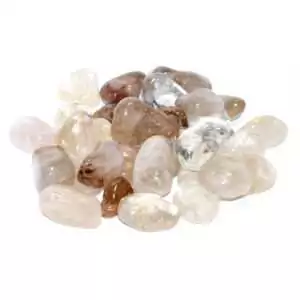
These stones run 15 to 40mm, about 0.6 to 1.6 inches, from narrower than a penny to about the width of a walnut. A stone near 40mm fills the palm, and the smallest, near 15mm, sits easily between thumb and finger. They are plump ovals and rounded pebbles with a high, glassy polish that throws bright window-shaped highlights. Most are pale lemon to yellow-green and see-through. Mixed in are stones of smoky brown, a few in a rosy brown, and some nearly colorless pieces, and many hold fine fractures or feathery inclusions inside that catch the light. Hold two stones side by side and the difference between a pale lemon and a golden green shows at once. Hold a stone to a window, and light passes through it in a soft, even glow. Quartz is hard, at 7 on the Mohs scale, so the polish stays bright through ordinary handling.
Practical Ritual Applications
Pour the stones into a clear glass bowl on a desk or reading table, where lamplight turns them into a warm pile of yellow and green. Crystal guides link yellow quartz with clarity and communication, which makes a stone a natural companion for a morning planning session or a quiet moment before a reading. Hold one while you write your question for a Tarot spread, then set it beside the cards. Four stones at the corners of a cloth mark a small, bright workspace, and a few in a dish beside a lamp bring some of the color of daylight to a dim corner. For more stones associated with brightness, browse my happiness, joy and compassion tumbled stones.
How to Work With Lemon Quartz Tumbled Stones
Three steps for choosing, using and displaying a pound of lemon quartz.
- Sort the Pound by Color
Spread the stones on a white cloth and look at them in daylight from a window, away from direct sun. Place the clearest yellow-green stones in one dish, the smoky and rosy-brown ones in a second, and the nearly colorless ones in a third. Set aside the three or four with the brightest color for a grid or a desk dish. Sorting once makes it easier to choose by eye each time you reach for a stone.
- Lay a Small Grid
Place a large stone, near 40mm, at the center of a plate or cloth, and surround it with four or six smaller stones in a ring. Put a written question, a Tarot card or a candle in its own holder in the middle, depending on your practice. Build the grid on a flat surface where nothing will knock it, and take it apart when the moment has passed.
- Display Out of Direct Sun
Lemon quartz can fade with prolonged strong sunlight or heat, so keep the stones on a shaded shelf, in a lidded dish or on a desk lit by a lamp. Avoid placing them on a sunny windowsill or near a radiator. A shaded spot keeps the yellow-green at its best.
The Tarot Fellow Standard
I stock this lot for people who like quartz in a warm, light color and want a pound of it to sort through. At 15 to 40mm the stones are big enough to read the color at a glance, and the mix of lemon, green, smoky brown and clear pieces makes a pound feel like a small collection. The polish is bright, and the rounded shapes feel pleasant in the hand. For more stones sold by the pound, browse my bulk tumbled stones collection.
Frequently Asked Questions
Lemon quartz is natural quartz whose color has been produced by treatment. Producers irradiate clear quartz or amethyst with gamma rays and then heat it, which gives the greenish-yellow color. Quartz of a similar color is rare in nature, and the market's supply comes from treated stones. Treatment is standard for lemon quartz, and the usual trade practice is to disclose it.
Mild soap, warm water and a soft cloth or brush are enough, followed by drying. Harsh chemicals are best avoided. Store them in a soft pouch or a cloth-lined dish to keep them from scratching one another or other stones.
Crystal guides pair yellow quartz with the solar plexus chakra, the third center in the modern chakra system, and one guide lists the third eye, solar plexus and crown chakras for lemon quartz. These are crystal-lore associations, offered as themes for reflection.
Reviews
There are no reviews yet