
Quick Specs
- Material: Golden sheen obsidian (volcanic glass)
- Quantity: 1 lb lot of tumbled stones
- Stone Size: 20-30mm (about 0.8 to 1.2 inches)
- Finish: Tumbled and polished
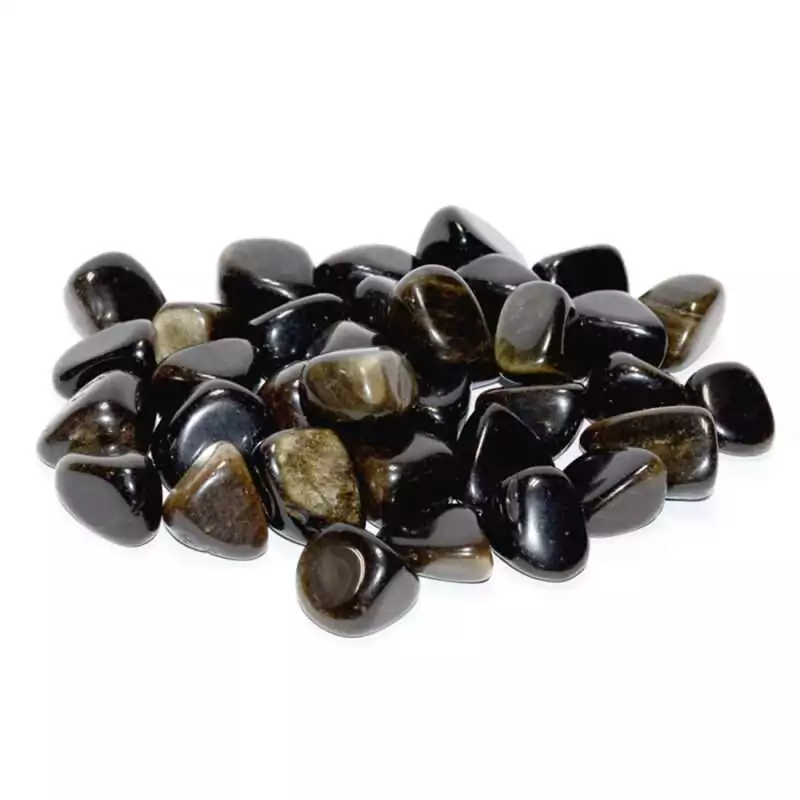
- Color: Glossy black with a gold to olive shimmer
- Mohs Hardness: About 5 to 6
Golden Sheen Obsidian: Volcanic Glass With a Gold Shimmer
Obsidian is volcanic glass, an igneous rock that forms when silica-rich lava cools so quickly that its atoms never arrange themselves into crystals. A broken piece therefore has smooth, curved surfaces and very sharp edges. People chipped it into blades and arrowheads in the Stone Age and polished it into early mirrors. Most obsidian is black, its color set by trace elements and inclusions, and it sits at about 5 to 6 on the Mohs scale. Golden sheen obsidian is the variety with a metallic glow inside the black. Sources trace the glow to tiny gas bubbles that were stretched flat and lined up along the flow layers of the lava as it cooled, and those layers throw light back as gold. The effect depends on the angle, so a stone can look plain black from one side and glow when you turn it. Sheen obsidian is cut into cabochons, spheres and carvings, and Mexico yields an abundance of it.
These stones are tumbled, which rounds the rough pieces and polishes them until they shine like wet glass. Each is 20 to 30mm, about 0.8 to 1.2 inches, which runs from a little narrower than a quarter to nearly an inch and a quarter across, so two or three together fill the palm of a hand. The shapes are rounded and a little irregular, like river pebbles, and the polish throws bright highlights from a window or a lamp. The sheen varies from one stone to the next. Some pieces show a golden to olive-brown shimmer across one broad face, and others are plain glossy black. A full pound gives you a spread to sort through, and each stone has its own pattern of dark and bright patches that changes as the light moves across it. Obsidian is brittle, and a hard knock can chip it. Give the stones a soft landing if they slip, and keep them apart from harder stones such as quartz, which can scratch the glass.
Practical Ritual Applications
Keep a few stones on your reading table, where the gold shimmer catches candlelight and the black glass gives your eye a still surface. Crystal guides tie obsidian to protection and grounding, so you might set one at the corner of your cloth or hold one while you shuffle your deck. One crystal guide says practitioners consider golden sheen obsidian well suited to scrying, which makes a stone resting on a dark cloth a natural focus for a quiet evening. Four stones at the corners of a square make a simple grid around a candle, and a handful in a shallow dish gives an altar a dark, glossy base. For more stones in the same family of associations, browse my protection tumbled stones.
How to Work With Golden Sheen Obsidian Tumbled Stones
Three steps for finding the sheen, putting it to use and keeping the glass unscratched.
- Find the Sheen
Pour the stones onto a dark cloth and stand under one lamp or beside a window. Pick up each stone and tilt it slowly. The shimmer is a reflection from layers inside the glass, so it appears at certain angles and fades at others. Sort the stones with the strongest gold into one dish and the plainer black ones into another, so you can choose by look whenever you want a different stone.
- Try a Dark-Glass Gaze
Dim the room, rest one stone on a dark cloth and place a candle a little to the side. Look at the surface of the stone and let your eyes follow the gold as it shifts, for as many quiet minutes as you like. Polished obsidian has been used as a mirror since early times, and some people still use it for gazing. Keep the flame well clear of the cloth and your cards.
- Wipe, Dry and Store Gently
Household dust is harder than obsidian, so wipe the stones with a lint-free cloth or a soft brush. For a deeper clean, use mild soap and warm water, then dry them. Skip ultrasonic and steam cleaners. Store the stones in a cloth bag or a lined dish, apart from harder stones that can chip or scratch them.
The Tarot Fellow Standard
I stock this lot for people who like obsidian with some life in it. At 20 to 30mm the stones are large enough to read the sheen at a glance and small enough to carry in a pocket or a pouch, and a pound gives you plenty to sort, share and set out on a reading table. The black glass sits well beside a deck and a candle, and the gold appears whenever the light moves. For more stones sold by the pound, browse my bulk tumbled stones collection.
Frequently Asked Questions
The shimmer comes from tiny gas bubbles trapped in the glass. As the lava flowed and cooled, the bubbles were stretched nearly flat and lined up in layers, and light reflecting off those layers gives the stone its gold glow. Because the layers reflect light at particular angles, the glow comes and goes as you turn a stone.
No. Obsidian is volcanic glass, an igneous rock that forms when lava cools too fast for its atoms to arrange into a crystal structure, and that is also why it breaks with a conchoidal fracture, leaving curved surfaces and very sharp edges. It is brittle, with a hardness of about 5 to 6, so it chips if it takes a hard knock.
A quick wipe with mild soap, warm water and a soft cloth is fine, followed by drying. Soaking, ultrasonic cleaners and steam cleaners are best avoided, since obsidian can hold inclusions that may expand when heated. Prolonged sun is also worth avoiding, so a shaded shelf or a lidded dish suits these stones better than a bright windowsill.
Crystal guides give obsidian the root chakra. One guide says golden sheen obsidian is affiliated with the root chakra and has applications to the solar plexus and third eye chakras, and another lists root as the traditional chakra for obsidian in general. These are modern crystal-lore associations, offered as themes for reflection.
Reviews
There are no reviews yet