
Quick Specs
- Material: Sold under the trade name Dragonblood
- Also Called: Dragon blood stone, dragon’s blood jasper, dragon stone
- Quantity: 1 lb lot of tumbled stones
- Stone Size: 12-25mm (about 0.5 to 1 inch)
- Finish: Tumbled and polished
- Color: Olive and forest green with red, brown and pale veining
Dragonblood: Green and Red in One Polished Stone
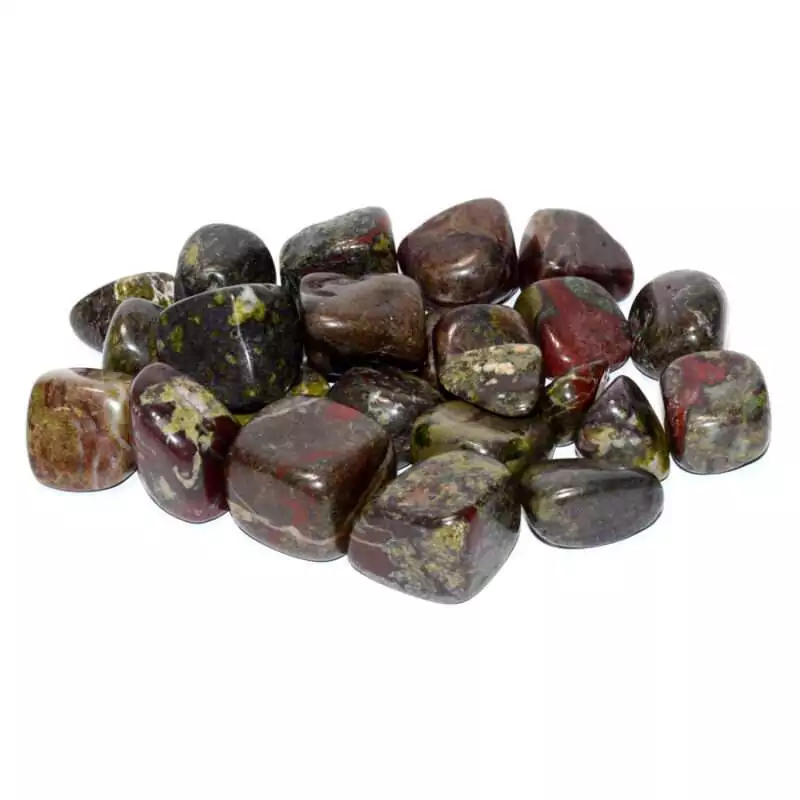
These are polished tumbles in a mix of dark olive and forest green, rust red, brown and grey-black. Many stones carry two colors at once, with red splashed across green, and a pale vein or fleck often runs through the pattern. Some stones are mostly red and brown, a few are nearly solid dark green, and the proportions change from stone to stone, so a pound looks like a varied handful of different pieces. The darkest stones, nearly black, often carry flecks of bright yellow-green. Each stone measures 12 to 25mm, from about half an inch to about an inch, which runs from narrower than an American dime to just wider than a quarter. That is small enough to fit in a closed hand or a pocket and large enough to show the pattern clearly. The lot mixes sizes across that range, so you get both slim pebbles and bolder pieces. Tumbling rounds the rough rock into smooth shapes, and the polish brings out the colors at their richest. Shapes range from rounded pebbles to blockier, squared-off pieces, and a few stones show pale specks or small dull spots in the surface.
Dragonblood is a marketing name, and it travels under several versions: dragon blood stone, dragon’s blood jasper and dragon stone. The names come from the color pattern, with green like the skin and scales of a dragon and red like spilled blood. A trade name tells you how a stone is sold, so the look of the stones carries more weight than the label. The stone is also young by the standards of the trade. Dealers describe it as a recent discovery, and a company that tumbles it notes that it was almost unknown before about 2015. That recent history shapes its lore. Crystal guides call Dragonblood a stone of courage, tied to strength, vitality and grounding, and link its green and red coloring with the heart chakra. Because the stone is new, so are these associations. They come from modern crystal practice, so treat them as ideas to try.
Practical Ritual Applications
Use the stones as grounding pieces. Before a ritual, stand with both feet on the floor and hold one stone in each hand, a simple way to settle your attention before you begin. Keep a stone in a pocket or pouch on days you want a reminder to stay steady. The green-and-red coloring suits a dragon or earth altar: set a handful in a dish between a green candle and a red one, or ring the base of a candle holder with them. Place one stone at each corner of an altar to mark the space, or line a few along a shelf where you keep your Tarot cards. For more stones associated with earth and steadiness, browse my grounding and earth energy stones.
How to Work With Dragonblood Tumbled Stones
Three steps for putting a pound of Dragonblood to use.
- Sort the Greens from the Reds
Spread the stones on a plain cloth in good light and group them by dominant color: mostly green, mostly red or brown, and mixed. Some crystal guides read the green as grounding and the red as passion and drive, so the groups give you a quick way to choose a stone for the day's purpose. Keep a few of each in a small dish and put the rest away, then return to the cloth whenever you want a different stone.
- Hold a Pair for a Grounding Minute
Stand or sit with your feet flat on the floor. Take one stone in each hand, rest your hands on your thighs or at your sides, and breathe slowly through ten full breaths while you feel the weight of the stones and the pressure of your feet. Notice the colors in each stone as you go. Set both stones down where you can see them. Use the same pair each time if you want a repeatable cue before a reading or a ritual.
- Carry One and Keep the Rest Handy
Choose one stone for a pocket, pouch or bag, and set another on a window shelf or at the corner of your altar. At 12 to 25mm the stones are small enough to slip into a gift pouch or a spell bag without bulk. Keep the rest in a shallow dish within reach, so you can swap stones whenever the day's purpose changes. When dust builds up, wipe them with a soft, slightly damp cloth and dry them afterward.
The Tarot Fellow Standard
I stock Dragonblood because the pattern is easy to recognize and the 12 to 25mm size travels well. A pound gives you a handful for your own altar and plenty to pass along to friends, and the green-and-red coloring sits well beside candles and potted plants. A lot this size also lets you compare many stones before you choose favorites, since no two carry the same balance of green and red. For more tumbled stones sold by the pound, browse my bulk tumbled stones collection.
Frequently Asked Questions
Dealers describe Dragonblood as a recent find whose makeup is still debated: one view holds that it is a rock of green epidote and red piemontite, another that it is bastite, a serpentine-type pseudomorph, and no published analysis has settled the question. Other references call it a chalcedony or jasper. Because the name is a trade label, composition, hardness and origin vary with who is describing it, and the stones are best judged by their color and polish.
No. Bloodstone is a dark green chalcedony spotted with red iron oxide, usually hematite, and it has been a gem material since antiquity. Dragonblood is sold under a trade name and has no such long record. The two share a green-and-red look, which is why the names get mixed up, and one reference warns against confusing bloodstone with dragon's blood, listing them as different ornamental stones.
No. Dragon's blood resin is a bright red plant resin collected from several trees and palms, including Dracaena trees and Calamus rattan palms, and it has been used as incense, varnish, dye and pigment. Dragonblood stone is a polished stone sold under a similar name. The old name also covered a poisonous mineral, cinnabar, which the ancient Romans often confused with the resin, so check which material a seller means before you handle it.


Reviews
There are no reviews yet