
Quick Specs
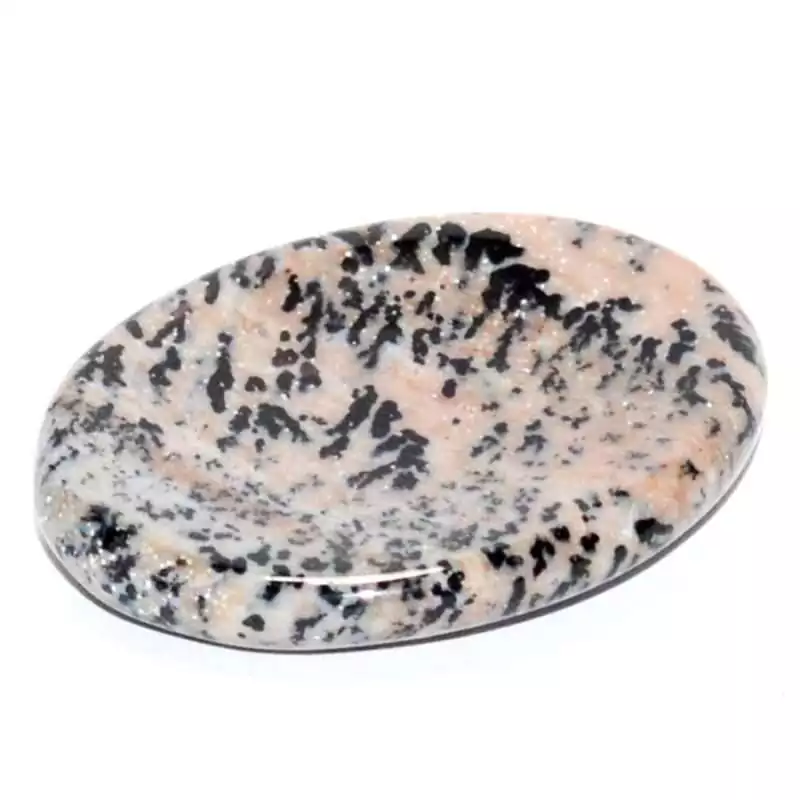
- Material: Dendritic agate (chalcedony)
- Shape: Oval worry stone with a thumb dip
- Size: About 1 1/4 to 1 1/2 inches long and 3/4 inch wide (approximate)
- Finish: Polished
- Color: Peach and cream with black branching marks
- Quantity: Single stone
Dendritic Agate: Fern-Like Marks in Polished Stone
Dendritic agate is chalcedony, a microcrystalline form of quartz, that carries branching, tree-like or fern-like inclusions. Dendritic describes the branching shape of the markings, and the marks themselves are minerals: manganese oxides such as pyrolusite and romanèchite, which give black and dark grey figures, and iron oxides, which give brown, reddish-brown and ochre ones. They form when mineral-rich water percolates through fine cracks in the stone and leaves oxide crystals along its path. The results look so much like plants that people once mistook such patterns for fossils, and geologists call them pseudofossils. True agate is banded, and dendritic agate is unbanded chalcedony that the trade sells under the agate name. Polishing the stone gives the marks a clean backdrop, and each branching mark sits in the surface like a small drawing in black ink. Lapidaries cut dendritic agate into cabochons, beads and shaped pieces, and the worry stone is one of the simplest and most tactile forms.
This worry stone is a smooth oval with a shallow dip in the center that fits a thumb. It is about 1 1/4 to 1 1/2 inches long and 3/4 inch wide, roughly the size of a large coin, so it rests in the curl of your fingers. The base color is peach and cream, and black marks scatter across the surface in clusters, some spreading like fern fronds and others forming small dotted trails. Tiny glittering flecks catch the light across the polish, and the surface is smooth with a glossy sheen. A worry stone is held between the index finger and thumb, with the thumb moving back and forth across the dip. The edge is rounded all around, with no corners to catch on fabric, and a stone this size slips into a pocket or a pouch. At about 3/4 inch wide it sits comfortably under a thumb, and the oval outline lets you turn it without looking. The black marks differ from stone to stone, so each worry stone is a one-off.
Practical Ritual Applications
Crystal guides link agate with grounding and the root chakra, and one encyclopedia pairs gray dendritic agate with the root chakra. Keep the worry stone in a pocket and turn it over with your thumb when you want something to hold during a long phone call or a quiet wait. Place it on your desk beside a notebook, or set it in a small dish on your altar next to a plant. One stone on your reading table gives your hand something to do between cards. Hold it while you think through a question for the deck, or give it as a small gift with a note about the pattern you like. For other stones in this shape, browse my worry and palm stones.
How to Use a Dendritic Agate Worry Stone
Three steps for making the worry stone part of your day.
- Find the Thumb Dip
Hold the stone between your index finger and thumb and rest your thumb in the shallow dip. Slide your thumb slowly back and forth across it and notice how smooth the surface feels. Tilt the stone in good light and look at the branching marks. Spend a minute learning the shape, so that you can find the dip by feel later without looking at the stone.
- Choose Where It Lives
Pick one regular spot for the stone, such as a coat pocket, the corner of your desk or the edge of your altar. A stone that lives in one place is easy to find when you want it. When you carry it, keep it in a pocket apart from keys and coins so the polish stays smooth, and set it back in its spot at the end of the day.
- Make It a Pause Cue
Pair the stone with one small daily moment, like the first minute at your desk or the pause before you draw a Tarot card. Rest your thumb in the dip, take three slow breaths and notice the marks under your thumb before you begin. Repeating the routine turns the stone into a cue for a pause.
The Tarot Fellow Standard
This worry stone fits in a hand and a pocket, and the branching marks make each one different. At about 1 1/4 to 1 1/2 inches it suits daily carry, a desk, a reading table or a gift pouch. The peach and cream ground with black fern-like marks looks quiet and graphic at the same time, and the thumb dip is shallow enough to feel natural from the first touch. For stones that suit grounding practice, browse my balance and grounding stones.
Frequently Asked Questions
They are close relatives. Both are unbanded chalcedony with inclusions of metal oxides, while true agate is banded. Dendritic agate carries fern-like inclusions of manganese or iron oxide that form on the surface or between layers. One reference describes moss agate as the three-dimensional form of dendrite that develops in fissures in quartz. In both, the markings are inorganic mineral growths.
Yes. The marks are natural mineral growths. Dendrites form when mineral-rich water, carrying manganese and iron, flows through fine fissures in rock and deposits crystals as it goes. The result looks like a fossil plant, and such patterns are classed as pseudofossils. A dealer adds that dye could not make them, since added color would show as uniform staining and the marks have the branching form of oxide crystals.
Crystal guides link agate in general with stability, grounding and the root chakra. One crystal encyclopedia pairs gray dendritic agate with the root chakra, white dendritic agate with the crown chakra and green tree agate with the heart chakra. These are modern crystal-lore associations.



Reviews
There are no reviews yet