
Quick Specs
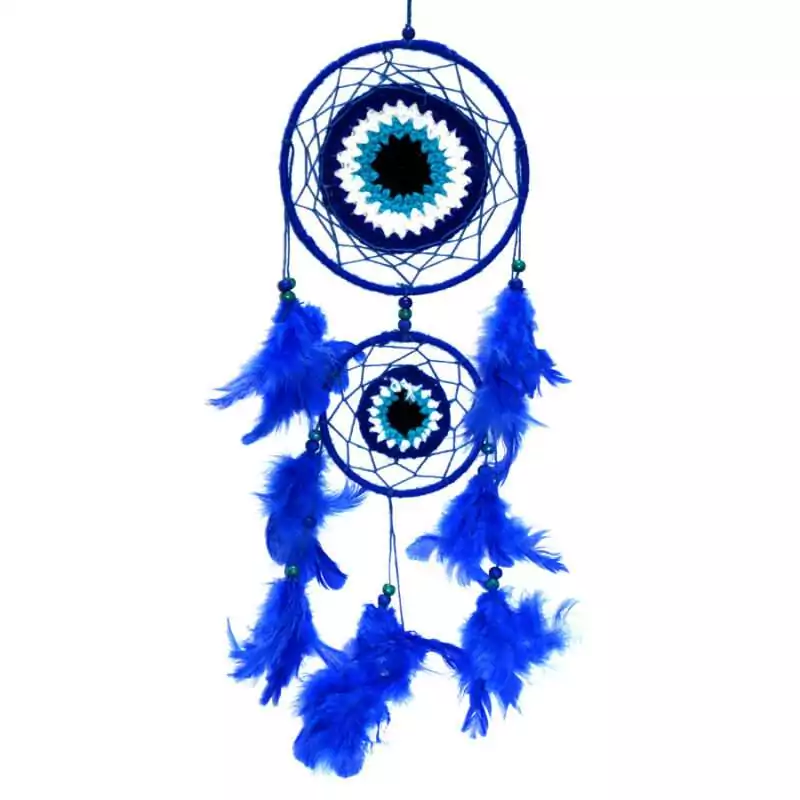
- Type: Evil eye dreamcatcher wall hanging with two hoops
- Size: 6 inches in diameter, 15 inches long
- Hoops: 2 blue-wrapped hoops with blue thread webs, linked one below the other
- Eyes: A stitched eye at the center of each web, in navy, white, light blue and black
- Trim: Fluffy blue feathers and small blue and green beads
Two Hoops, Two Eyes, One Blue Fall of Feathers
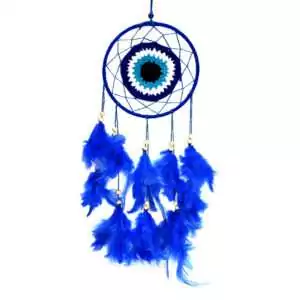
Two blue-wrapped hoops hang one above the other, joined by a short length of cord. A web of blue thread crosses each hoop in a spoked pattern, and at the center of each web sits a stitched eye. The upper eye is the larger: a navy outer ring, a scalloped white ring, a ring of light blue and a black center. The lower eye repeats those colors on a smaller scale. Fluffy blue feathers fall on short strands at both sides of the upper hoop and on longer strands beneath the lower one, with small beads in blue and green sitting on the cords above them. The strands hang at different lengths, so the feathers overlap in a loose cascade. The piece is 6 inches in diameter and 15 inches long, which gives it a tall, narrow outline, and the second hoop divides that length into two rounds so the eye appears twice, once large and once small. Blue runs from the hoop to the feather tips, and the white and light blue rings stand out against it. A short cord at the top hangs it from a nail or hook.
A dreamcatcher is a hoop with a web, a form that comes from Anishinaabe culture. Reference works place its origin with the Ojibwe, whose word for it is asabikeshiinh, and describe the traditional piece as a willow hoop with a woven net. The eyes belong to another custom, the evil eye belief: the idea that a malevolent glare, usually inspired by envy, can bring harm. That belief is found across the Mediterranean, the Balkans, West, Central and South Asia, Africa, the Caribbean and Latin America. Traditional nazar beads are handmade glass in rings of dark blue, white, light blue and black, and the stitched eyes here follow that sequence, once in each web. A museum catalogue notes that amulets worn or carried against the evil eye share one feature, an eye-shaped design that may be realistic or highly stylised. A web with an eye at its center fits that description. The hanging brings the two together as a decorative piece, and each part keeps the history of the tradition it comes from.
Practical Ways to Hang It
Choose a wall, a window frame or the back of a door with room for the full 15 inches, and let the feathers hang clear of furniture. A bedroom wall beside or above the bed suits it, as do a reading corner, a stairwell and a doorway you pass every day. One nail or hook takes the cord at the top, and the two eyes make a natural focal point on a plain pale wall, where the blue shows well. Leave a few inches on both sides so the feathers sway in a draft, and keep the cords and feathers away from candle flames and incense. It also works as a gift for a new home, since a single hook is all it needs. Browse my dream catchers collection for more pieces in this style.
How to Hang and Care for the Double Eye Dreamcatcher
Three steps cover choosing a wall, hanging the cord and protecting the feathers.
- Choose the Wall
Hold the dreamcatcher against the wall and step back to judge where the full 15 inches will hang. Pick a spot with clear space beneath the lower hoop so the feathers can swing without brushing a shelf, a headboard or a door frame, and a plain background so the eyes show up. Keep it a good distance from heaters, stoves and candles.
- Hang It Straight
Set a small nail or hook into the wall and slip the cord at the top over it. Let the dreamcatcher settle for a minute, then check that both hoops hang level and the lower hoop sits directly beneath the upper one. If the piece twists, turn the cord a half turn on the hook until both eyes face forward.
- Protect the Feathers
Conservation guidance says brightly colored feathers fade quickly under strong light and that dampness harms them, so hang the piece out of direct sun and away from steamy rooms. Feathers bend and lose color when rubbed, so handle them gently and hold the piece by a hoop. Looking the feathers over once or twice a year for moths or carpet beetles takes only a minute.
The Tarot Fellow Standard
I stock this hanging because it gives a dreamcatcher’s hoop two stitched eyes in the colors of the nazar, at a length that suits a window or a bedroom wall. The dreamcatcher comes from Anishinaabe culture and the evil eye belief from many peoples around the Mediterranean and beyond, and both are living traditions. This piece is a decorative reference to them, an entry point and never a stand-in for the teachings of the people who keep them. If you want to understand what a dreamcatcher means and how one is made and given, start with Anishinaabe teachers and writers. If the nazar is part of your family’s customs, follow the ones you were taught. For more pieces that carry the eye, see my evil eye collection.
Frequently Asked Questions
Reference works trace the dreamcatcher to Anishinaabe culture, with the Ojibwe as the people in the recorded origin account, and give the Ojibwe word as asabikeshiinh. A Canadian college page describes an Anishnabek teaching about a spider's protective gift, a web that lets good dreams pass through and catches bad ones. Dreamcatchers now appear in many Indigenous cultures across North America in various forms, so the people who make and give them are the best guides to their meaning.
Turkish belief treats blue as a shield against evil that absorbs negativity. A second account says people with light eyes, especially blue ones, were believed able to curse with a look, so blue amulets were thought to answer that gaze. Reference works also record a strong cultural association between the evil eye and the color blue in Trinidad and Tobago.
Traditional dreamcatchers were hung over a cradle or bed. One account says they were usually hung from the hoop of a child's cradleboard, and the Anishnabek spider teaching says the web should hang above the sleeper's bed. A spot over a bed echoes that placement, and a window or a doorway also shows the piece well.






Reviews
There are no reviews yet