
Quick Specs
- Material: Epidote with quartz
- Quantity: 1 lb lot of tumbled stones
- Stone Size: 20-30mm (about 0.8 to 1.2 inches)
- Finish: Tumbled and polished
- Color: Olive and pistachio green on cream, pale pink and grey
- Mohs Hardness: 6 to 7
Epidote and Quartz: Green Silicate in a Pale Stone
Epidote is a calcium aluminum iron silicate, and its usual color is pistachio or yellowish green, with olive, brownish and black material also found. It is an abundant rock-forming mineral that grows in metamorphic rocks such as marble and schist, and wherever hot fluids break down the minerals of igneous rock. Crystals are usually long, slender prisms that can fan out in radiating or columnar groups, and clear crystals can look greenish from one angle and brownish from another. Quartz, which is silicon dioxide, is among the minerals that commonly occur beside epidote, so the two often share a piece of rock. The name comes from the Greek epidosis, meaning increase. On the Mohs scale epidote measures 6 to 7 and quartz measures 7, which makes both firm enough to be shaped and polished. Quartz has no cleavage and breaks along curved, shell-like surfaces, which helps a tumbled piece keep a smooth outline. Tumbling does that work: the stones roll in a barrel with grit that wears down their edges, and later stages with finer grit leave the rounded, pebble-like shapes and the shine you see on these stones.
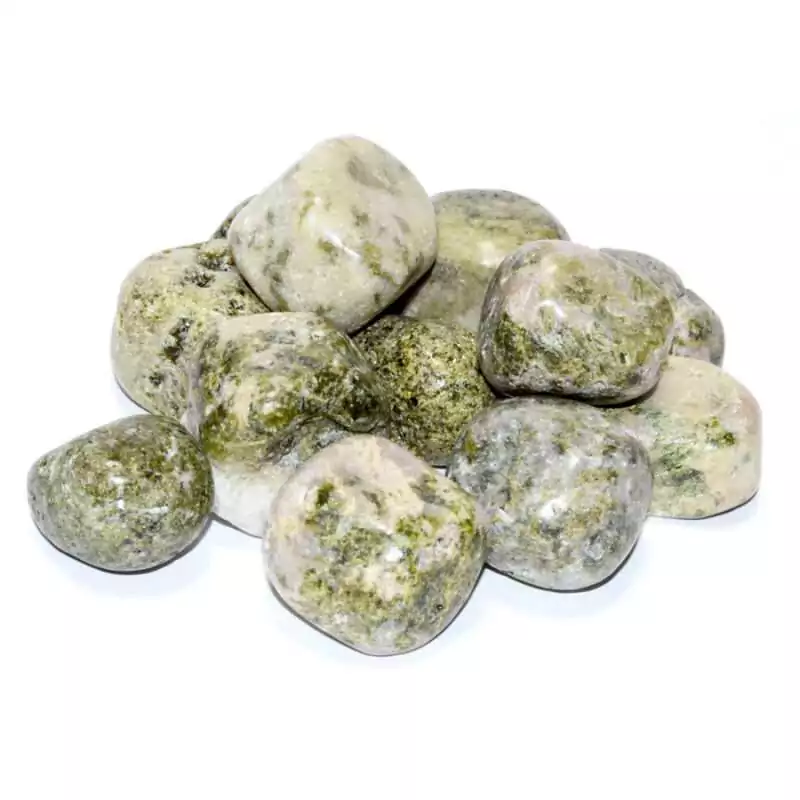
Each stone in this pound measures between 20 and 30mm, or roughly 0.8 to 1.2 inches, enough to fill the center of a palm without crowding it. Each one is a rounded, glossy pebble with a pale body in cream, pale pink and grey, and olive-to-pistachio green gathers in flecks, veins and cloudy patches across the surface. Some stones lean mostly green, others carry only a scatter of green on a pale ground, and the rest sit somewhere between, so the pound reads as a varied handful. The shapes run from squat, blocky pebbles to longer ovals, and every edge is softened. A few stones carry a faint pink cast, and a few lean cool grey. The green gathers in patches, so turning a stone in your hand gives a new view each time: a broad green field on one face, a fine speckle on the next. Natural stone differs from piece to piece, and a pound shows the whole range. A bowl of these on a shelf looks like river pebbles gathered in muted greens and creams.
Practical Ritual Applications
Epidote sits with the heart chakra in modern crystal practice, and crystal guides tie it to personal growth and abundance. The greenest stones make good centerpieces for a small grid: set one at the middle, ring it with four paler stones, and rest a slip of paper with a goal written on it underneath. A stone also suits a dish of tumbled pebbles beside a potted plant or a green candle in its holder. Hold one while you write in a journal or lay out a Tarot spread about growth, and keep it on the table beside your cards afterward. A single stone slips into a pocket or a small pouch for travel. For other stones that crystal guides associate with abundance, browse my abundance, luck and prosperity stones.
How to Work With Epidote and Quartz Tumbled Stones
Sort, build a small grid, then carry one stone and rotate the rest.
- Sort the Pound by Green
Tip the pound onto a cloth by a window and fan it out. Turn each stone over and sort them into three loose groups: mostly green, evenly mixed, and mostly pale. Daylight shows the olive and pistachio shades that lamp light flattens. Keep a handful from each group in a dish for display, and return the rest to a bag or jar so you can come back to the cloth whenever you want a different stone.
- Lay a Five-Stone Grid
Set the greenest stone in the middle and arrange four others around it, one at each corner of a square about a hand-width across, on a surface that stays undisturbed. Write a goal such as a new skill, a garden or a friendship on a small slip of paper and tuck it under the center stone. Leave the grid in place as long as the goal stays current, and rebuild it with different stones when you begin a new one.
- Carry One and Rotate the Rest
Tuck a single stone into your bag for a week and leave the others in a bowl on your desk. On the weekend, trade it for another from the bowl, so every piece gets its turn in your hand. When you travel with the whole lot, wrap the stones in a soft cloth or a padded pouch, and wipe each one with a soft dry cloth before it returns to the bowl.
The Tarot Fellow Standard
This lot suits anyone who likes a stone with a visible pattern: green epidote threaded through a pale, speckled body, polished into a pebble that fits the hand. At 20 to 30mm the stones are large enough to anchor a grid or fill a shallow bowl and small enough to carry, and a pound leaves plenty to share. The muted greens suit a shelf of plants, a green candle or a wooden altar. The heart chakra and abundance meanings are crystal-lore themes you can take or leave as prompts for reflection. Many other stones come by the pound too, and you will find them in my bulk tumbled stones collection.
Frequently Asked Questions
Epidote is a calcium aluminum iron silicate that is usually pistachio green, and quartz is one of the minerals that commonly grows beside it. A rock made of quartz and epidote together is called epidosite, and unakite adds pink feldspar to the pair. Tumbled stones sold as epidote with quartz show the green mineral in flecks and patches across a paler body, and the mix changes from stone to stone.
Epidote is an abundant rock-forming mineral, found in metamorphic rocks such as marble and schist and in altered igneous rocks. Collectors prize well-formed crystals from places such as Austria, Pakistan and Alaska, and clear green crystals are occasionally faceted as collector's gems. Rocks that mix epidote with quartz are cut into cabochons, beads and tumbled stones, with unakite the best-known example.
Crystal guides place epidote with the heart chakra, called Anahata in Sanskrit and drawn in green in the modern seven-chakra scheme, and connect it with personal growth and abundance. The pairing is modern crystal lore. The chakras themselves come from Hindu and Buddhist tantric traditions, where texts count anywhere from four to seven major centers.
Reviews
There are no reviews yet