
Quick Specs
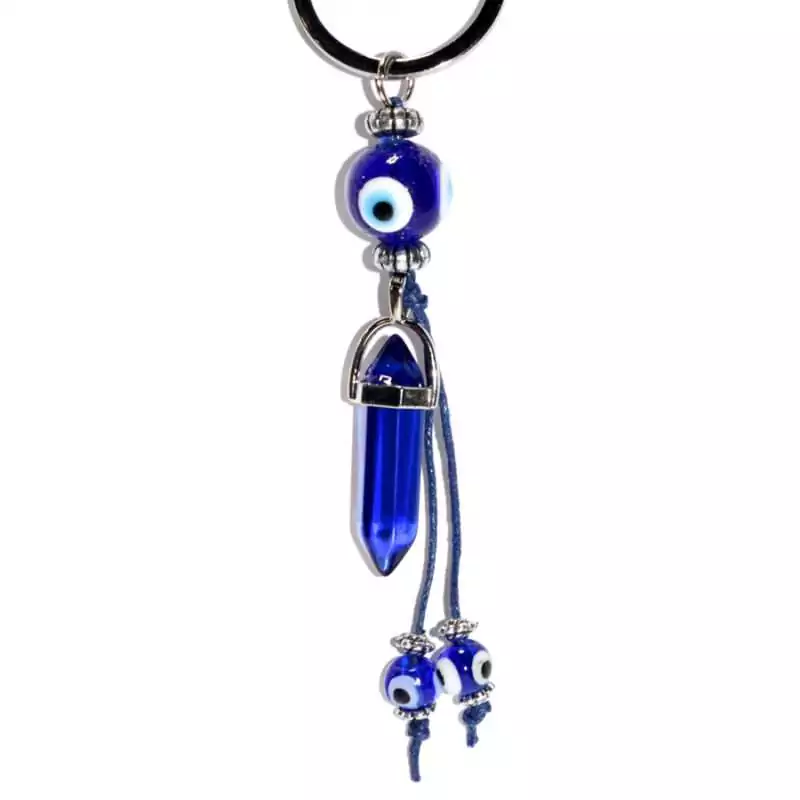
- Type: Keychain with eye beads and a blue point
- Eye beads: 3 round beads in deep blue, white and light blue: one large bead at the top and one small bead at the end of each cord
- Point: Translucent cobalt blue point in a silver-toned cap with an arched bail
- Cords: 2 dark blue knotted cords at different lengths
- Spacers: Silver-toned ribbed spacer rings above and below each eye bead
Three Eye Beads Around a Cobalt Point
The strand begins at the key ring with a round eye bead, the largest piece in the design, held between two ribbed silver-toned spacers. The bead is deep blue with a white ring, a light blue center and a black pupil. Below it, a translucent cobalt blue point hangs from a silver-toned cap with an arched bail, its flat sides tapering to a tip. Two dark blue cords hang alongside the point at different lengths, each tied off in a small knot and ending in a smaller eye bead set between silver-toned spacers. Those two small beads swing below the point like a pair of tassels, and the larger bead above them anchors the top of the keychain. All the pieces sit in one range of blues, from the dark cords to the cobalt point to the pale ring in each bead, and the silver tone of the spacers and the cap ties them together. The ribbed spacers add a row of small silver highlights between the beads and the point. The long, narrow shape suits a bag strap or a hook, where the cords can hang straight down.
All three beads follow the nazar, the eye bead of Turkey. A typical nazar is handmade glass in concentric circles of dark blue, white, light blue and black, according to a University of Kansas page and Wikipedia, and these beads carry that sequence from the outer ring inward. The Science Museum Group lists glass eye beads, also called nazars, among the commonest forms of evil eye amulet, worn or carried, and found especially around the Mediterranean, Central Asia and the Middle East. Wikipedia adds that disks of concentric blue and white circles are common talismans in West Asia and the Balkans, found on the prows of boats and elsewhere. A bead on a key ring is a modern way to carry one, and three eyes on one ring make a repeated motif, a large eye above and two small ones below. The point adds a vertical line to a keychain built from round beads, and because the point, the cords and the beads share one color family, the three eyes read as the focus and the point as their companion.
Practical Ways to Carry It
A set of keys is the natural home for it. The long drop also swings from a bag strap, a backpack loop or a rear-view mirror, and a hook beside the door keeps it in view at home. A bag clip shows all three eyes at once, with the point in the middle. Give the cords a little room so they hang free of the point. It also works as a small gift tucked into a card for a friend who carries a lot of keys. At a desk, loop the ring over a drawer pull or a lamp chain, where the blue stays within sight while you work. For other pieces that carry the eye, see my evil eye collection.
How to Attach and Care for the Blue Point Keychain
Three steps cover checking the cap and cords, hanging the keychain and storing it.
- Check the Cap and Cords
Hold the ring and let the keychain hang. Look at the silver-toned cap holding the point, the knots at the ends of the two cords and the spacers around each eye bead, and give the point and each bead a light tug. If a knot has loosened, retie it before the keychain goes on your keys.
- Let the Cords Hang Free
Thread the ring onto your keys or a bag clip, then lift it so the cords fall beside the point. A strap or a zipper pull gives the cords room to swing. When they tangle, hold the point by its cap and slide each cord loose with your fingers.
- Dust and Store
Wipe the point, the beads and the spacers with a soft dry cloth, and brush dust from the cords with a dry brush. Hang the keychain from a hook at home, or lay it flat in a small pouch so the two cords lie beside the point and keep their shape.
The Tarot Fellow Standard
I stock this keychain for its single color story: three eye beads and a blue point, all in blues, on one ring. The nazar is a living folk custom in Turkey, Greece and many other places, and the beads here refer to it as decorative charms, a pointer toward a tradition and never a substitute for it. People who grew up with the nazar already know how it’s gifted, hung and replaced, and newcomers can start by listening to those who keep the custom before deciding what the eye means in their own lives. For more things to hang from a ring, see my key chain and ash chamber collection.
Frequently Asked Questions
Wikipedia says amulets against the evil eye have been found dating to around 5,000 years ago, and texts from ancient Ugarit, a port city in what is now Syria, attest to the concept. Greek authors from Hesiod to Plutarch refer to it as well. The Science Museum Group describes the belief as culturally very widespread with a long history.
Wikipedia says nazar comes from an Arabic word meaning sight, surveillance or attention, and a University of Kansas page ties it to an Arabic verb for watching. In Turkey the eye bead is called nazar boncuğu, where boncuk means bead, and in Greece it is called mati, which means eye.
Wikipedia says the Turkish eye bead likely originated in the Mediterranean and is associated with the development of glassmaking. It adds that glass beads were widely made across the ancient world, from Mesopotamia and Egypt to Carthage, Greece, Phoenicia and Persia, with documentation and surviving beads dating from as early as the sixteenth century BCE. The Science Museum Group places glass eye beads around the Mediterranean, Central Asia and the Middle East.
Reviews
There are no reviews yet