
Quick Specs
- Type: Hamsa (Hand of Fatima) wall hanging with eye beads
- Size: 8 1/2 by 4 1/2 inches
- Colors: Blue, red and white on a silver-toned body
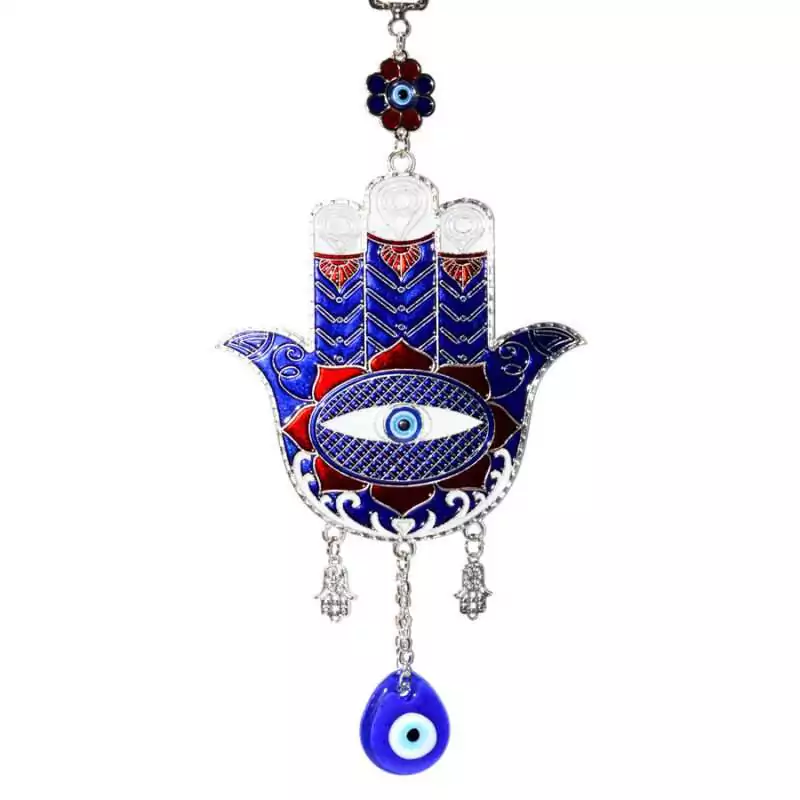
- Palm: Oval eye motif framed by red lotus-style petals
- Hanging details: Small eye flower above; two miniature hamsa charms and a blue teardrop eye bead below
A Silver-Toned Hamsa With an Eye in the Palm
The body of this hanging is a hand-shaped plaque in silver-toned metal with a finely serrated edge. Three upright fingers rise from the palm, each topped in white with a teardrop pattern and filled below with blue chevrons above a red fan. A curving point sweeps out to each side. In the center of the palm, a crosshatched oval frames a white eye with a blue iris and a black pupil, and red petals open around it like a lotus, with white scrollwork curling along the lower edge. Above the hand, a small flower of blue and red petals holds a tiny eye at its center and joins the hand to the loop that hangs it. Below, a chain drops from the base of the palm to a blue teardrop eye bead, with a miniature silver-toned hamsa dangling on a short chain at either side. At this size it’s small enough for a hallway or the side of a door and large enough to read from a few steps away. Blue, red and white keep the palette tight, and the silver outline ties them together.
The hand is called a hamsa, from khamsa, the Arabic word for five, and this hanging’s three fingers and two side points make five. The symbol is popular across North Africa and the Middle East. In English it’s often called the Hand of Fatima, and in Jewish use it’s the Hand of Miriam. Muslim and Jewish communities both attach meaning to it, and reference works describe it as a defense against the evil eye, an envious stare believed to bring harm. Many hamsas carry an eye in the palm, as this one does. Where the symbol began is debated, and open-hand motifs are widely attested in the ancient Near East. The blue teardrop bead and the small flower at the top bring in a second emblem of the same belief: the eye amulet known as the nazar in Turkey and mati in Greece. The hanging combines the two, a hand with eyes at its top, center and bottom. Customs for hanging a hamsa vary between families and communities.
Practical Ways to Display It
Hang it where you’ll pass it every day: beside a front door, in a hallway, over a doorway or on a bedroom or office wall. It’s a light piece, so a small nail or hook will hold the loop at the top. The chain and bead below move in a draft, so give the bottom edge clear space from curtains, shelves and furniture it could knock against. If you keep other eye pieces, a nazar bead or a keychain, the hamsa makes a good center for a small grouping on one wall, with the blue and red echoing across the pieces. It also works as a gift for a new home, since it needs no setup beyond a hook. For more pieces made to hang, see my wall hangings collection.
How to Hang and Care for the Hamsa Wall Hanging
Three steps cover where to hang it, how to mount it and how to keep it clean.
- Pick the Spot
Hold the hanging against the wall and step back to check the height and the angle. The fingers point up, and the piece reads best at eye level or just above, where the eye in the palm and the blue bead below are both visible. Check that nothing sits close enough to touch the bead or the small charms as they swing.
- Mount It
Set a small nail or hook into the wall at your mark and slip the loop at the top over it. Let the piece hang free for a minute, then check that the chain below hangs straight. If it tilts, adjust the loop on the hook until the fingers point straight up.
- Dust and Wipe
Dust the hand with a soft dry brush or cloth every few weeks, working around the small charms and the bead. Skip sprays and soaking, since the colored areas and the hanging parts are small. Wipe fingerprints from the bead with a dry cloth, and take the piece down before any painting or wall cleaning.
The Tarot Fellow Standard
I stock this hanging as a decorative or protective charm that borrows from the hamsa and the nazar. The hamsa belongs to living Muslim and Jewish traditions, and it carries meaning for those communities that a wall hanging can only point toward. This piece is a reference to that tradition, never a substitute for community, teachers or practice. If the hamsa is part of your family’s faith, you already know how it’s hung and honored. If it’s new to you, start by learning its names and history from the communities that keep it. For other eye pieces, see my evil eye collection.
Frequently Asked Questions
Both. Reference works say the hamsa carries significance for Jews and Muslims, and it's used against the evil eye in each. In English it's often called the Hand of Fatima, and in Jewish use the Hand of Miriam. Because it belongs to living faith communities, this wall hanging is a decorative reference, and the best guides to how a hamsa is used and what it means are people within those communities.
Both orientations are in use. Sources read fingers pointing up as warding off evil and fingers pointing down as welcoming blessings, and a Judaica retailer calls both styles acceptable. This hanging has its fingers up. If your family or community has its own custom for hanging a hamsa, follow that.
An eye set in the palm is common on hamsas and answers the evil eye belief the hand is meant to turn aside. One Jewish source says people might have used the hamsa to invoke the hand of God, or to counteract the evil eye with the eye embedded in the palm. This piece also carries eye motifs above and below the hand, in the style of the nazar bead.


Reviews
There are no reviews yet