
Quick Specs
- Set: 12 wall hangings
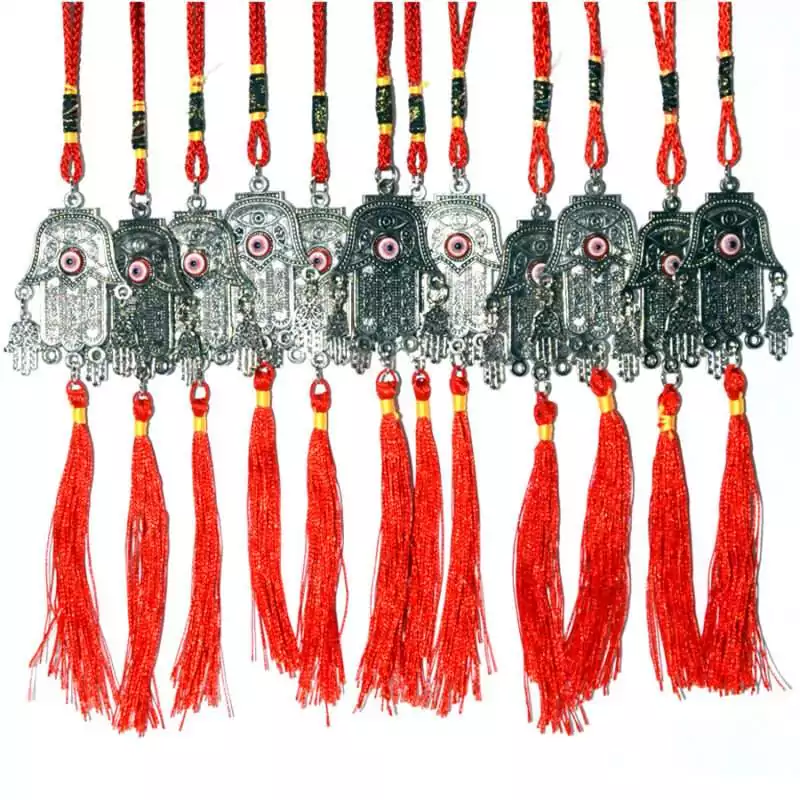
- Plaque: Silver-toned hamsa with a dotted edge, an engraved eye and filigree patterns
- Eye bead: Round red and white bead with a dark center in each palm
- Charms: Small hamsa charms hang below each plaque
- Cord and tassel: Red braided cord with a loop; red tassel with a yellow thread wrap
- Finish: Plaques range from bright silver tone to darker antiqued tone
Twelve Hamsas on Red Cords With Tassels
Every hanging in the set is built the same way. A red braided cord doubles back into a small loop at the top, with a dark barrel-shaped bead flecked with gold and bound in yellow thread sitting just above the loop. From the loop hangs a hand-shaped plaque in silver-toned metal with a dotted edge. An eye is engraved across the upper part of the hand, and below it a round eye bead with a red outer ring, a white band and a dark center sits in the middle of the palm, framed by a V-shaped border. The lower part of the plaque is filled with fine dotted and scrolled patterns and ends in rings from which small hamsa charms and a red tassel with a yellow thread wrap hang. The plaques range from a bright silver tone to a darker, antiqued tone. With twelve in the set you can hang them as a row or spread them through a home, and the red cords and tassels stay constant from one hanging to the next.
The hamsa is a protective hand symbol found across the Middle East and North Africa. Reference works describe the hand as protection from the evil eye, the belief in a curse brought about by a malevolent glare, usually inspired by envy. A museum curator says hand amulets of this kind may have been used to ward off the eye of envy, and that belief in the protective power of hand amulets goes back millennia. The small hamsa charms below each plaque repeat the hand at a smaller size, so every hanging holds a large hand and several tiny ones. Each plaque also carries two eyes of its own: the engraved eye near the top and the round bead at the center. The hanging puts the hand, the eye and the red cord together as a piece of wall decoration. Customs for hanging a hamsa differ between families and communities, and the people who use it are the best guides to what it means.
Ways to Use a Set of Twelve
Twelve matching hangings leave plenty of room to spread them out: one beside each door, one in a window, one over a desk, and the rest as small gifts for new homes. Each cord loop slips over a nail, a cup hook, a doorknob or a drawer pull. They also work together in a row, with a hook for each plaque along a porch rail, a long wall or a shelf edge, where the red tassels make a line of color. Hang them clear of heat and open flame, since the tassel thread is fine. For more things to hang, see my wall hangings and chimes collection.
How to Hang and Care for the Hamsa Hangings
Three steps cover checking the set, hanging each cord and wiping the plaques.
- Check the Set
Lay the hangings out and look at each cord, ring and tassel. Give every small charm a light tug and check where each ring joins the plaque. A link that has opened is easier to close before the piece is hung. Choose which hangings go where, since the plaques range from bright silver to a darker antiqued tone.
- Hang Each Cord
Slip the loop at the top of each cord over a nail, a cup hook or a doorknob. Let the plaque settle and check that it hangs straight, with the eye bead in the palm facing out. A row of hooks about a hand's width apart gives each tassel room to swing without touching its neighbor.
- Wipe the Plaques
Dust each plaque with a soft dry brush every few weeks, working into the filigree and around the small charms. Wipe fingerprints from the eye bead with a dry cloth. Take the hangings down before you paint or clean the wall around them, and hang them back once the surface is dry.
The Tarot Fellow Standard
I stock this set because twelve matching hamsa hangings let you hang a row, spread them through a home or give a few away. The hamsa belongs to living Muslim and Jewish traditions, and it carries meaning for those communities that a wall hanging can only point toward. These hangings are a decorative reference to that tradition, never a substitute for community, teachers or practice. If the hamsa is part of your family’s faith, you already know how it’s hung and honored. If it’s new to you, start by learning its names and history from the communities that keep it. See my evil eye collection for more pieces that carry the eye.
Frequently Asked Questions
Both. A Jewish learning site says the hamsa carries meaning for Jews and Muslims, and a museum curator says hand amulets of this kind may have been used by Muslims or Jews. Wikipedia describes widespread Jewish use, especially among Sephardi and Mizrahi communities, and use across Muslim cultures. Because it belongs to living faith communities, this set is a decorative reference, and people within those communities are the best guides to what a hamsa means.
Hamsa comes from khamsa, the Arabic word for five, which refers to the five fingers of the hand. Wikipedia, a Jewish learning site, a museum entry and an Oxford reference entry on encyclopedia.com all give that meaning. In English the symbol is often called the Hand of Fatima, and in Jewish use the Hand of Miriam.
The hand is used against the evil eye, and an eye set in the palm is a common feature. A Jewish source says people might have used the hamsa to invoke the hand of God, or to counter the evil eye with the eye embedded in the palm, and Wikipedia says hamsas often contain an eye symbol to ward off the evil eye. On these plaques an engraved eye sits above the palm and a round bead sits at its center.


Reviews
There are no reviews yet