

Quick Specs
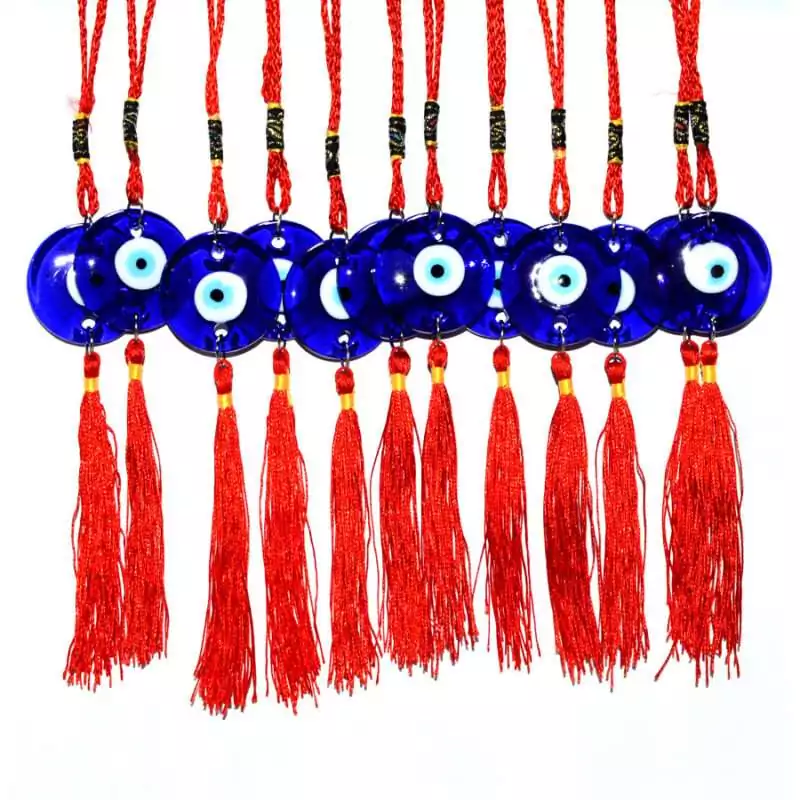
- Set: 12 wall hangings
- Eye bead: Flat round disc in deep blue with a white ring, light blue center and black pupil
- Cord: Red braided cord with a loop, and a dark gold-flecked bead bound in yellow thread
- Tassel: Red tassel with a yellow thread wrap
- Fittings: Small metal rings join each bead to its cord and tassel
A Dozen Blue Eyes on Red Cords
Each hanging in the set is one bead on one cord. The bead is a flat, round disc of deep blue with a white ring, a light blue center and a black pupil, and it has a hole at the top and another at the bottom. A small metal ring at each hole links it to the rest of the piece. Above, a red braided cord doubles back into a hanging loop, with a dark barrel-shaped bead flecked with gold and bound in yellow thread sitting just above the loop. Below, a red tassel with a yellow thread wrap hangs from the lower ring. Red, blue and a touch of yellow make up the whole palette, and the twelve hangings match one another. The design is spare, with one eye, one cord and one tassel on each piece, and the deep blue of the disc sets off the bright red above and below it. With twelve to a set, you can hang a row of identical eyes or share the dozen among several rooms.
Each bead follows the nazar, the eye bead of Turkey. The evil eye is a belief in a curse brought about by a malevolent glare, usually inspired by envy, and a museum catalogue lists glass eye beads among the commonest amulets against it, adding that such amulets are worn or carried. In Turkey the bead is called nazar boncuğu, and its typical colors are dark blue, white, light blue and black, the same colors that make up the discs in this set. A set of twelve can put that circle of colors at many points around a home: a disc by each door, one in each window or a row along a wall. Each hanging is plain, with the eye as the whole subject and the red cord and tassel framing it above and below. The matching pieces read as a single design when hung together, and as twelve separate small accents when spread around a home.
Ways to Use a Set of Twelve
A dozen small hangings invite more than one use. Hang a row along a window frame with a hook for each cord, so the blue discs catch daylight, or place one beside every door in the house. A few can go to friends as housewarming gifts and a few can stay with you. The cord loops slip over a nail, a cup hook, a doorknob or a cabinet pull, and the tassels swing in a draft, so leave a hand’s width between hooks. Keep the tassels clear of open flame and heat, since the thread is fine. For more pieces that carry the eye, see my evil eye collection.
How to Hang and Care for the Evil Eye Set
Three steps cover checking the set, hanging each cord and wiping the beads.
- Check Each Hanging
Lay the twelve hangings on a table and look at each one. Check the small rings at the top and bottom of every bead, and the knots where the cord and the tassel meet the rings. A ring that has opened is easier to close before the piece is hung. Set aside the ones you plan to give away.
- Hang the Cords
Slip the loop at the top of each cord over a nail, a cup hook or a doorknob. Let each bead settle so the eye faces out. If you hang a row, space the hooks a hand's width apart so the tassels and the discs have room to swing without touching their neighbors.
- Wipe the Beads
Wipe fingerprints and dust from each bead with a soft dry cloth, and brush the tassels lightly with a dry brush every few weeks. Take the hangings down before you paint or clean the wall around them, and hang them back once the surface is dry.
The Tarot Fellow Standard
I stock this set as a dozen simple versions of the eye bead, with one bead, one cord and one tassel on each, so you can hang a row, spread them through a home or give a few away. The evil eye belief is a living folk custom in Turkey, Greece and many other places, and these hangings are decorative references to it, never a substitute for the customs of the people who keep it. If the nazar is part of your family’s tradition, you already know how it’s gifted, hung and replaced. If it’s new to you, learn those customs before you decide what the eye means in your home. See my protection and cleansing collection for more.
Frequently Asked Questions
In Turkish belief, blue acts as a shield against evil and absorbs negativity, according to a university page on the nazar and to Wikipedia. Wikipedia adds that blue disks with concentric circles are common talismans in West Asia and the Balkans.
Accounts describe nazars hung in homes, cars and shops, pinned to a newborn's clothing and tied to horses, which are considered especially vulnerable. Wikipedia says the nazar is most often seen in Turkey, hung in or on homes and vehicles or worn as beads. Customs differ between families and regions, so a family's own practice is the best guide to where one belongs.
In Turkish accounts a bead that breaks is understood to have taken in a particularly strong negative force, and the advice is to replace it as soon as possible. Wikipedia tells the same story: the bead absorbs the harm and breaks so the wearer is spared. These are folk beliefs, and customs vary by family and region.
Reviews
There are no reviews yet