
Quick Specs
- Stone: Labradorite
- Form: Irregular chips
- Color: Gray and white, with flashes of blue and gold
- Closure: Lobster clasp with extender chain
- Hardware: Silver-toned
Labradorite Chips and Their Flash
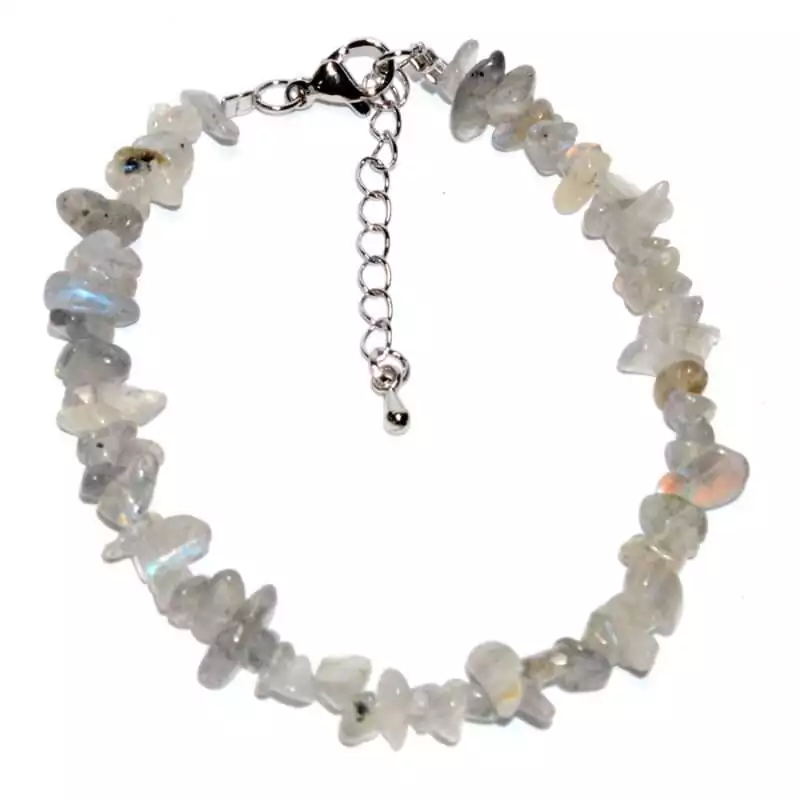
Labradorite is a feldspar, and what sets it apart is labradorescence, an iridescent flash of color that appears inside the stone. The flash comes from light reflecting within the crystal, and it depends on how the stone is oriented, so a chip can look plain gray-white from one side and light up in blue, green, gold or orange from another. These chips show that behavior. The body color is a soft gray that runs from translucent and glassy to milky, and a few pieces flash electric blue while one glows gold-orange when the light finds the right angle. Others stay quiet, which gives the strand its rhythm of dull and bright. Because chips are small irregular fragments, each carries only a patch of flash, and the whole strand glints from many angles at once. Dark gray pieces add contrast, and tiny dark specks show in a few chips. Reference pages note that labradorite from Canada and Madagascar mostly flashes in blue, gray and green tones. The irregular outline gives the strand a loose, pebbled look.
Crystal guides most often link labradorite with the third eye chakra, and with intuition, protection and transformation. Those associations belong to modern crystal lore, and the chakra scheme behind them comes from Hindu and Buddhist tantric traditions, so you can take them as symbolism. A stone that seems to hold a hidden light suits that kind of story, and it gives you something to look at when your attention drifts. The bracelet closes with a silver-toned lobster clasp, and the short extender chain lets you choose where the clasp catches, so the fit adjusts to your wrist and your sleeves. A small teardrop at the end of the chain finishes the loose end neatly. Gray stones and silver-toned metal make a cool, low-contrast pairing that goes with black, white and denim, and it sits comfortably beside other silver jewelry. The flash is the point of the piece, so wear it where light can reach it, and let your hand move so the colors travel from chip to chip.
Practical Ritual Applications
Wear the bracelet on days when you read cards, journal about a hunch, or sit down to meditate, and tilt your wrist now and then to see which chips flash. At home, lay it on a dark cloth under a lamp to see the colors move as you turn it. It can rest beside a mirror or a bowl of water on an altar, with the chips arranged in a loose circle. Before a reading, hold the strand in your open hand for a breath and set one question. If you like layering strands with an uneven, pebbled outline, my stone and crystal chip and nugget bracelets collection shows more stones cut in the same style. Take the bracelet off before heavy work so the chips stay clear of knocks.
How to Wear and Care for Your Labradorite Bracelet
Three steps cover finding the flash, using it as a pause, and storing the bracelet safely.
- Find the flash
Stand near a window or under a lamp and tilt your wrist slowly. Some chips light up in blue, gold or orange at one angle and fade to gray at another, and the flash may jump from one chip to the next as you turn. Note the chip that flashes strongest, because it makes a good starting point for the next step.
- Use the flash as a pause
When you notice a chip flash, stop for one breath and look at it. In crystal practice labradorite is linked with intuition, so use the moment to ask what you already suspect about a decision or a card you drew. A few seconds is enough, and the bracelet becomes a cue you can repeat through the day.
- Store it apart from harder stones
A bead retailer's care guide advises storing labradorite separately in a soft pouch or cloth wrap, away from harder gemstones that could scratch it. Close the clasp before you put the bracelet away, and keep it out of hot cars and off radiators, since the same guide cautions against high heat and sudden temperature changes.
The Tarot Fellow Standard
I stock this bracelet because the labradorite does the work: soft gray chips, a few bright flashes and a clasp with an extender chain that makes sizing simple. The flash differs from chip to chip, and some chips show more of it than others, which belongs to the stone. The third eye connections are modern crystal lore that I offer as symbolism, with the chakra idea itself rooted in Hindu and Buddhist traditions. If you collect bracelets, my bracelets and anklets collection gathers the shop’s wrist pieces in one place.
Frequently Asked Questions
The name comes from Labrador, Canada, where the stone was first identified. Wikipedia gives Paul's Island near Nain as the type locality, and a geology reference says it was discovered there in 1770. Labradorite is also mined in Finland, where the strongest-flashing material is sold under the name spectrolite, and in Madagascar, Australia and other countries.
Labradorite rates 6 to 6.5 on the Mohs scale and has two directions of perfect cleavage, so a sharp knock can chip or split it. The International Gem Society advises avoiding rough handling, and a crystal encyclopedia advises avoiding impact along the cleavage planes. One bead retailer's guide adds that designers often choose labradorite for earrings and necklaces, since bracelets and rings take more knocks. Removing the bracelet for heavy work protects the chips.
Mild soap, lukewarm water and a soft cloth are the usual choices, followed by drying. A crystal encyclopedia rates labradorite as safe for water and recommends a soft cloth. A bead retailer's guide advises skipping ultrasonic cleaners, steamers and high heat, and avoiding sudden temperature changes and harsh chemicals.

Reviews
There are no reviews yet