
Quick Specs
- Stone: Malachite
- Form: Irregular polished chips
- Color: Deep green with darker and lighter bands
- Hardness: 3.5 to 4 on the Mohs scale
- Closure: Lobster clasp with extender chain
- Hardware: Silver-toned
Banded Green Malachite in Chip Form
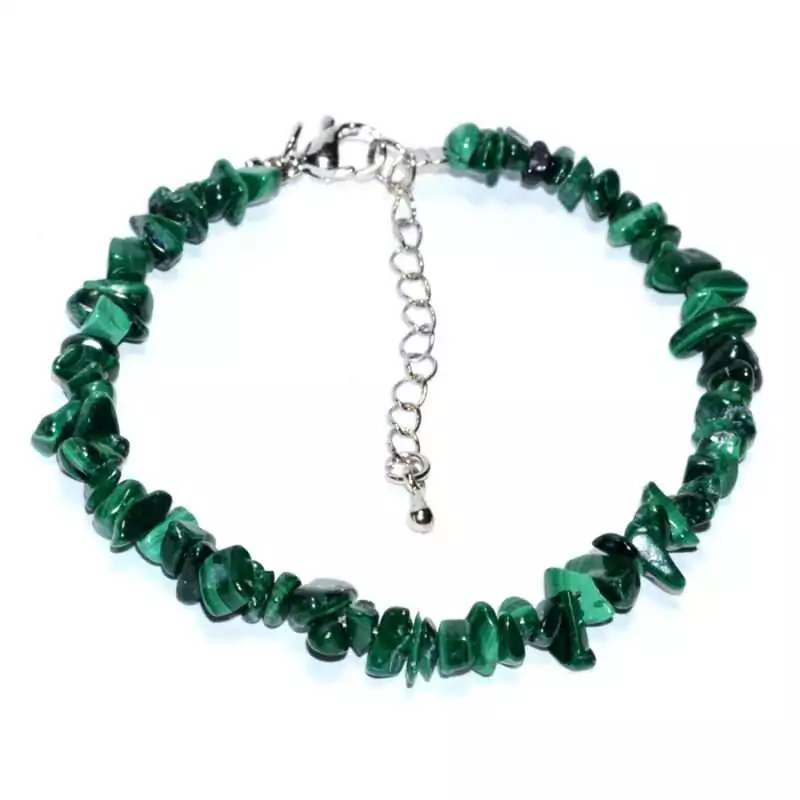
Malachite is a copper carbonate, Cu2CO3(OH)2, and the copper is what gives it its green. It forms in the oxidized upper zone of copper deposits, often beside blue azurite, from solutions that change over time, and the changes are recorded as layers. Cut or break a piece and those layers show as tight parallel stripes, swirls and rings in several shades of green. The chips on this strand carry that pattern. Several show fine stripes running across one face, and others show wider curved bands where the layers ran another way. The shades range from deep forest green to a brighter mid-green, and the darkest chips read close to black, which gives the strand depth. Every chip is an irregular fragment with a smooth, glossy face, set side by side in an uneven line, so the strand has a pebbled outline and no two pieces match. Malachite is soft for a gemstone, about 3.5 to 4 on the Mohs scale, so it rewards a gentle touch and a soft cloth. The name comes from the Greek word for mallow, a plant with green leaves.
Crystal guides pair malachite with the heart chakra, transformation and protection. The chakra scheme comes from Hindu and Buddhist traditions, and the stone pairings are a later layer of modern crystal lore, so they read best as symbols. Malachite itself has long been used as an ornamental stone and a gemstone, carved into boxes and figures and cut into beads, and these chips keep the stone in its simplest form. The strand closes with a silver-toned lobster clasp, and the short extender chain ending in a small teardrop lets you choose the link where the clasp catches. That makes the fit easy to adjust from one day to the next. Deep green against silver-toned metal makes a cool, quiet pairing, and the bracelet sits comfortably beside a watch or a slim bangle. The glossy faces sit at different tilts, so some chips flash light while their neighbors stay dark. Because the chips are small and uneven, the strand catches light from many angles and reads as a soft band of green from across a room, with the stripes showing up close.
Practical Ritual Applications
Wear the bracelet while you work through a change: a new routine, a move, a different job. Touch one chip each morning and say the change in a sentence, so the bracelet becomes a daily marker for it. On an altar or desk, lay it on a green cloth beside a green candle or a small plant and let the glossy chips catch the light. If you keep a journal, set the strand across the open page while you write about what you are leaving behind and what you are building. For a layered look, my stone and crystal chip and nugget bracelets collection shows more strands with the same uneven outline, in other stones and colors. Fasten the clasp whenever you put the bracelet away, so the chain stays untangled and the chips lie flat.
How to Wear and Care for Your Malachite Bracelet
Three steps cover the fit, a daily cue, and gentle care for a soft, copper-based stone.
- Set the fit with the extender chain
Close the lobster clasp on the chain link that sits comfortably, snug enough to stay on your wrist and loose enough to slide a little. Turn the strand until the best-striped chips face up, then check that nothing pinches at the clasp. Put the bracelet on after you finish cleaning, because dealer care guides list acids and ammonia among the things that harm malachite.
- Pair it with a daily cue
Hold the bracelet in your open hand and run a thumb along a few chips. In crystal practice malachite stands for transformation, so choose one change you want to follow and say it in a single sentence. Touch the same chip each morning as a reminder. After a few weeks the bracelet becomes a marker for that change, and the sentence returns whenever you glance at your wrist.
- Clean it gently and store it apart
Wipe the chips with a soft cloth, barely damp if needed, and dry them right away. Keep the bracelet away from hot water, ultrasonic cleaners and steam, and take it off before showers, swimming and dishes. Malachite scratches easily, so store it in a pouch away from harder stones and other jewelry.
The Tarot Fellow Standard
I stock this bracelet for the stone: banded green malachite in chip form, each piece showing its own part of the pattern, on a clasp that adjusts. The heart chakra and transformation links are modern crystal lore, and I offer them as symbolism you can take or leave. Malachite is soft and contains copper, so I recommend it to people who will keep it away from acids and rough wear. For other stones in wearable form, my crystal and stone jewelry collection gathers bracelets, pendants, rings and earrings in one place.
Frequently Asked Questions
Take it off first. Dealer care guides list acids, ammonia and hot water among the things malachite is sensitive to, and one advises avoiding prolonged water exposure. The stone also scratches easily. One dealer recommends a soft, slightly damp cloth for cleaning, followed by a quick dry.
Yes. The International Gem Society says finished malachite jewelry, carvings and specimens are considered safe to wear or display. The hazard it names is dust from grinding or cutting, which is toxic to breathe because of the copper, so cutters wear protective respiratory gear and keep the rough wet. Crystals.com adds that malachite is toxic if swallowed, so keep loose chips away from small children and pets.
Malachite forms in the oxidized zone of copper deposits, built up from solutions whose makeup changed over time, and the bands record those changes. Banded masses are dense intergrowths of tiny fibrous needles, and concentric ring patterns are the ones collectors prize most. Each chip shows whichever part of the pattern it was cut or broken from.
Malachite occurs wherever copper deposits weather. The Democratic Republic of the Congo is a leading source of banded material, and the Ural Mountains of Russia were historically a major gem source. Other sources include Namibia, Australia, Zambia, Mexico and the American Southwest, especially Arizona. The mineral often grows alongside azurite, and it can replace azurite crystals while keeping their shape.


Reviews
There are no reviews yet