
Quick Specs
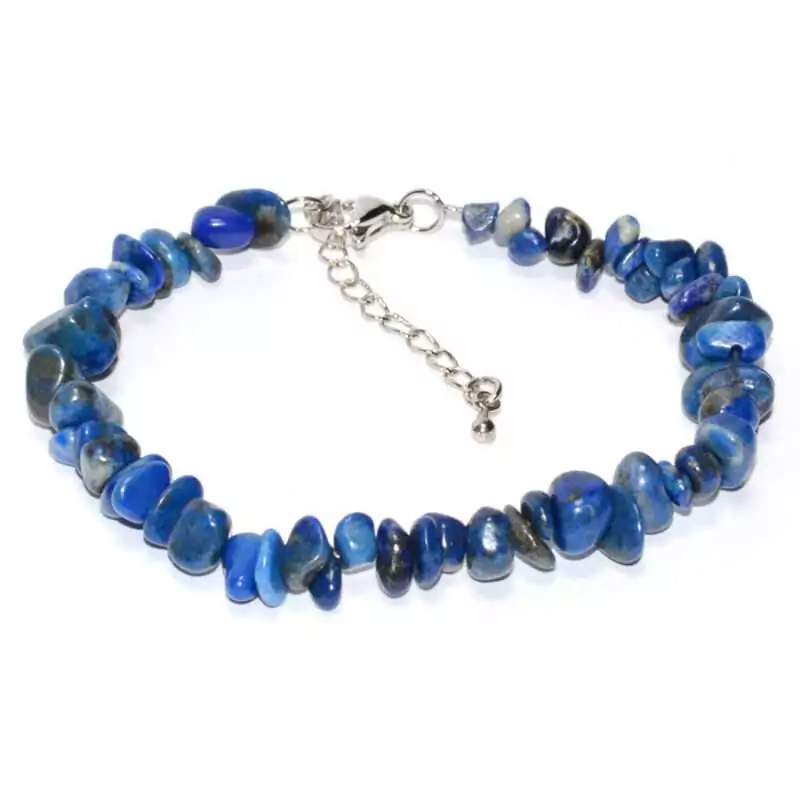
- Stone: Lapis lazuli
- Form: Irregular chips
- Color: Deep blue with lighter blue and gray patches
- Closure: Lobster clasp with extender chain
- Hardware: Silver-toned
Deep Blue Lapis in Chip Form
Lapis lazuli has been prized for its blue since antiquity. The name reaches English through Medieval Latin from the Persian lazward, the same root that gave English the word azure. Ground lapis once made ultramarine, the pigment painters kept for the most important blues in a picture, and ancient Egyptians cut the stone into scarabs and amulets and set it in the funerary mask of Tutankhamun. These chips bring that blue down to a small, irregular scale. The color is a deep, saturated blue that runs from near navy to a brighter cobalt, with lighter blue patches and gray-black areas on some pieces, and the surfaces are smooth and polished. Lapis rates between 5 and 6 on the Mohs scale, softer than quartz, so the chips pick up scratches more readily than harder stones do. Gem references list dyeing, wax and oil among treatments used on lapis, and note that lighter stones are sometimes dyed a deeper blue. The outline of the strand is uneven and pebbled, because no two chips share a shape, and the polish gives each face a soft shine that deepens the blue.
In modern crystal practice, lapis lazuli is associated with the third eye chakra, and in some guides with the throat chakra, along with truth, wisdom and self-expression. Those links belong to modern crystal lore, and the chakra scheme behind them comes from Hindu and Buddhist tantric traditions, so you can read them as symbolism. A stone with a long history in Egyptian jewelry and painters’ pigment lends itself to that kind of story. The bracelet closes with a silver-toned lobster clasp, and a short extender chain lets you choose where the clasp catches, so the fit adjusts to your wrist and your sleeves. Deep blue and silver-toned metal make a crisp pairing that suits white shirts, black knits and denim, and the chips catch light along their polished faces. Because the chips are small and irregular, the strand has a loose, hand-gathered look that fits easily beside other jewelry. Stacked with a thin silver chain or a pale stone strand, the deep blue becomes the anchor of the stack, and it reads boldly against a white cuff.
Practical Ritual Applications
Wear the bracelet on a day when you want to say something that matters: a hard conversation, a speech, a letter you have been drafting. Touch one chip before you start, as a cue to speak clearly and at your own pace. For study or journaling, lay it across the page while you work, so the blue stays in view. On an altar it can rest on a white cloth beside a blue candle, or curl around the base of a candle holder. Before a reading, hold the strand in your open hand and set one question about something you want to see more truthfully. If you like layering chunky strands, my stone and crystal chip and nugget bracelets collection shows other stones cut in the same irregular style.
How to Wear and Care for Your Lapis Bracelet
Three steps cover fastening and fitting, a truth-telling pause, and protecting the color.
- Fasten it and find your length
Close the lobster clasp on the link of the extender chain that gives a comfortable fit, snug enough to stay on and loose enough to move. Turn the strand until the deepest blue chips face up, and check that nothing pinches where the clasp meets the chain.
- Pair it with a truth-telling pause
Before you speak or write about something that matters, rest a thumb on one chip and take two slow breaths. In crystal practice lapis is tied to truth, wisdom and self-expression, so decide on the one true sentence you most want to say. Say it or write it, and the chip becomes a small reminder of the moment.
- Keep it dry and apart from other jewelry
Store the bracelet dry and separate from other jewelry, so each piece stays free of scratches. Lapis contains calcite, which is sensitive to pressure, heat, household cleaners and abrasives, and prolonged direct sunlight can fade the color. A cloth pouch on a shelf away from the window suits it well.
The Tarot Fellow Standard
I stock this bracelet because it shows lapis lazuli in an easy, wearable form: deep blue chips, a lobster clasp and an extender chain that makes sizing simple. The patches of lighter blue and gray belong to the stone, and every chip differs. The third eye connections are modern crystal lore, with the chakra idea rooted in Hindu and Buddhist traditions, and I offer them as symbolism. For more jewelry made from stones, browse my stone and crystal jewelry collection.
Frequently Asked Questions
It is a rock. Lapis lazuli is made of several minerals, chiefly lazurite, which gives the blue, together with white calcite and brassy flecks of pyrite. Wikipedia puts lazurite at roughly 30 to 40 percent of the rock, and the International Gem Society describes calcite and pyrite as the usual companions of lazurite in lapis.
Afghanistan is the classic source. Wikipedia says the Sar-i Sang mine in the Kokcha River valley of Badakhshan has been worked for more than 6,000 years. Chile, near Ovalle in the Andes, and Russia, west of Lake Baikal, also have commercial deposits, and smaller amounts come from other countries, including Pakistan and the United States.
Keep water contact brief. A bead retailer's guide notes that lapis is porous, advises against soaking it for long, and suggests lukewarm soapy water for undyed pieces with a water test first on dyed ones. The International Gem Society recommends a soft brush and mild soap and warns against steam, ultrasonic cleaners and chemical solvents, and a crystal encyclopedia says not to submerge it.



Reviews
There are no reviews yet