
Quick Specs
- Type: Stick incense holder
- Size: About 5 inches across
- Shape: Round
- Design: Mandala pattern of layered petals around a center flower
- Finish: Painted in purple, blue, and teal, with gold highlights and rim
Rings of Petals Around a Flower That Holds the Stick
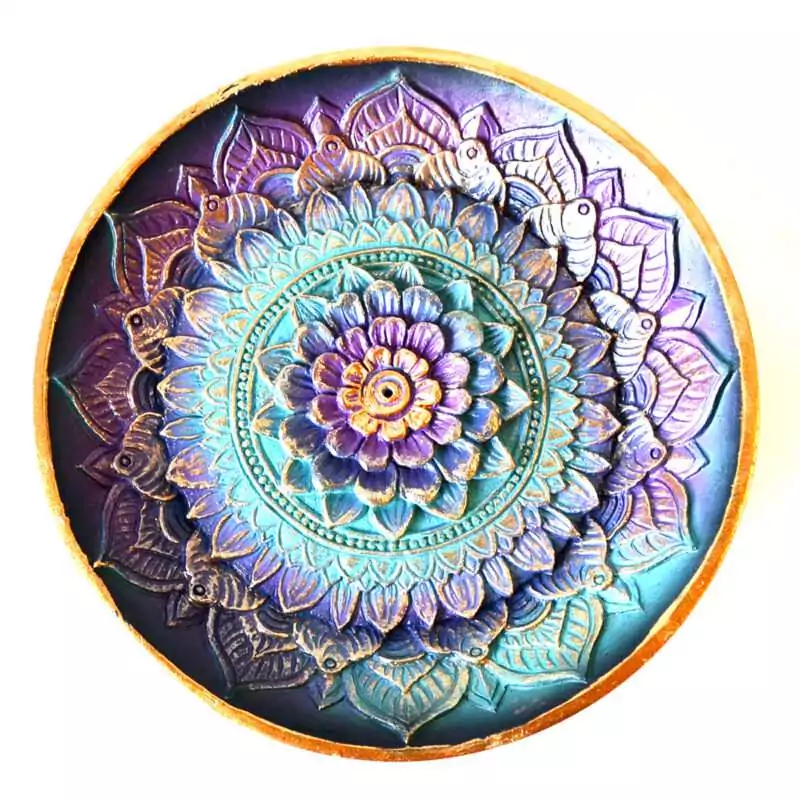
Look from the rim inward and the pattern opens like a flower. A gold edge circles the plate like a frame. Inside it, broad pointed petals rise in violet on one side and deep indigo on the other, each ridged with fine lines. A ring of rounded buds sits between those petals and the next ring, and every bud carries a small dot. Further in, a ring of narrower petals turns teal and pale blue, and a circle of tiny beads encloses the middle. At the very center, a flower of tight, overlapping petals glows in violet, blue, and orange-gold, and a small round hole sits in its heart. Gold paint brushed along the petal edges catches the light and gives the ridges a worn, metallic shine, and the sculpted relief gives each petal its own small shadow, so the pattern keeps its depth even under flat light. Seen from above, every ring stays centered on the hole where the stick stands, so the burning stick marks the middle of the design, and the colors move from purple at one edge to teal at the other.
Mandalas come from Indian religions, and the word itself appears in the Rigveda as the name for the sections of that text. In Himalayan Buddhism the mandala is one of the most ubiquitous symbols, created as an artistic aid for meditation. It depicts a realm that is both complex and sacred, and it works as a visualization tool for practitioners. This holder takes the radial order of that tradition as its pattern: concentric rings of petals, a ring of beads, and a flower at the center, all drawn around one point, so the eye travels inward from the rim to the burning stick. The pattern is decorative, and it carries the shape of a mandala into everyday rooms, where the center of the design is the place the incense burns. Each sculpted petal has its own ridges and highlights, which gives the plate a surface worth a closer look, and the gradient from purple to teal gives it color from every angle, so the holder reads well from across a room as well as up close.
Practical Ritual Applications
Set the holder on a desk, a shelf, a mantel, or an altar, on a flat, heat-proof surface. The round plate sits well under a lamp, beside a small plant, or at the center of a low table where it can be seen from every side. Burn a stick when you sit down to read, sketch, or begin your own meditation, and let the plate stand as decoration between sticks. Pick a scent from my stick incense collection, and keep the area around the holder clear so nothing leans over it. The purple, blue, and teal palette makes it a colorful gift for anyone who collects mandala art or likes a bright accent on a plain shelf. It also pairs well with a small bowl of stones or a candle, since the purple and teal sit comfortably beside both.
How to Burn a Stick of Incense in Your Mandala Holder
A round stick holder needs a heat-proof surface, a stick standing straight in the center hole, and time to cool.
- Find a flat, heat-proof spot
Place the holder on a ceramic tile or a metal plate, away from curtains, clothing, and paper. Choose a spot out of reach of children and pets, where nobody will bump the stick. A flat, stable, heat-resistant surface keeps falling embers from reaching anything that burns.
- Stand the stick in the center of the flower
Push the unlit end of a stick into the small hole at the heart of the flower until it stands straight. Hold a flame to the tip until it glows, then blow the flame out. Watch the stick for a minute or two to see that it stays upright and that the ash drops onto the petals below.
- Let it burn out and cool
Let the stick burn down completely and wait until the plate is cool to the touch. Tip the ash into a dish or bin. If you leave the room or go to sleep before the stick finishes, put it out first and check that nothing is still smoldering.
The Tarot Fellow Standard
I stock this holder as a decorative piece that uses the mandala’s circular pattern. Mandalas are sacred forms in Hindu and Buddhist practice, and temples, monasteries, and teachers are where that practice is taught, so treat this holder as an entry point and let the people who live the tradition tell you what a particular mandala means. The piece itself needs only a tile under it and a stick in the hole. Browse my home decor collection for more pieces to set beside it.
Frequently Asked Questions
The Sanskrit word mandala means circle. A mandala is a geometric configuration of symbols that originates in Indian religions. In Hinduism, Buddhism, and Jainism it is used as a map representing deities, and in various spiritual traditions it may serve for focusing attention, as a spiritual guidance tool, for establishing a sacred space, and as an aid to meditation. To learn what a particular mandala means, a monastery, a temple, or a teacher in the tradition is the best source.
The circle is the most common form, but a mandala may also be a square enclosing a circle, a series of circles, a circle enclosing an image such as a star or a flower, or a rectangle enclosing a circle. In Hinduism a basic mandala, also called a yantra, takes the form of a square with four gates containing a circle with a center point.
No. Fire services say burning incense needs someone watching it, and they advise putting it out when you leave the room or go to sleep. Place the holder on a flat, heat-resistant surface such as a ceramic tile or a metal plate, keep it away from curtains, clothes, and paper, and keep it out of reach of children and pets. Check that the stick is out and nothing still smolders.
Reviews
There are no reviews yet