

Quick Specs
- Type: Small seated deity figure
- Size: 1 inch
- Material: Brass
- Finish: Gold-toned, with darker metal in the recesses
- Form: Elephant head, four arms, conical crown, seated on a round base
- Inscription: Devanagari script around the base
A Seated Ganesha in One Inch of Brass
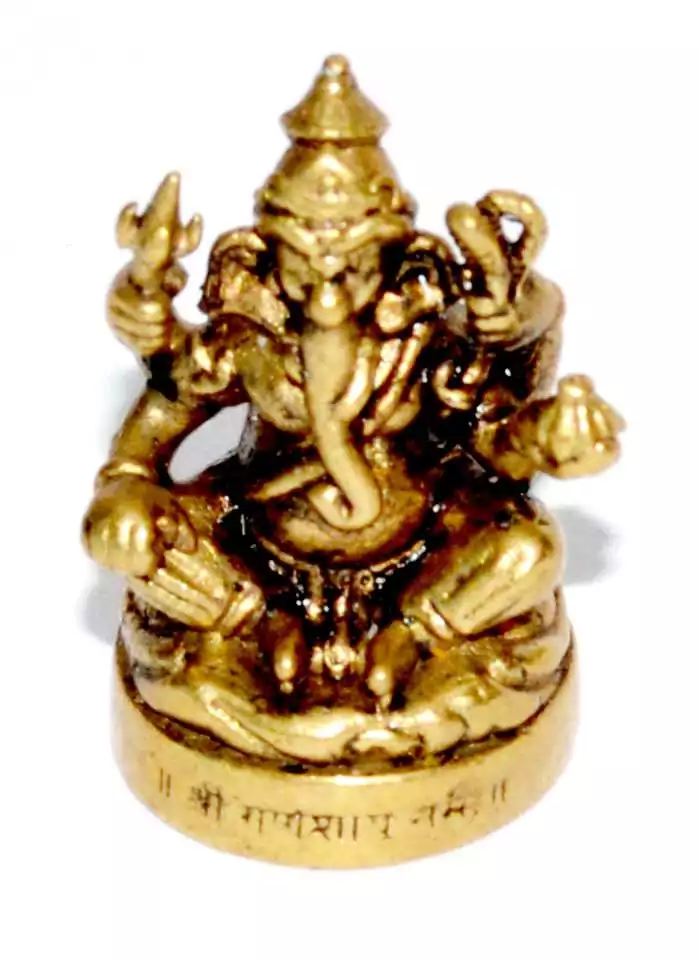
He is small enough to close inside your hand, and the figure still holds a good deal of detail. Ganesha sits on a short round base with his knees spread to either side and a tall conical crown rising from his forehead, topped with a small knob. His elephant head fills the middle of the figure: broad ears fold back against his cheeks, and a trunk curves down over his round belly. He has four arms. Two are raised, one holding a pointed implement and the other a curved one; a third hand rests on his knee, and a fourth holds out a rounded object. The brass is gold-toned and bright on the raised surfaces, while darker metal settles into the recesses under the ears, between the arms, and along the trunk, which gives the tiny form depth. A line of Devanagari script runs around the base between two vertical strokes. It appears to read Shri Ganeshaya Namah, a salutation to Ganesha. He faces straight forward in a balanced seated pose, with the raised hands framing his head and the plain base carrying no other decoration.
Ganesha is a Hindu deity known as the remover of obstacles. Hindus of all denominations invoke him at the start of rites, prayers, and important undertakings, and he is also honored as a patron of learning, writing, and the arts. He is the son of Shiva and Parvati, and his elephant head is the feature by which he is recognized in images across India. Beyond Hindu worship, he also appears in Jain and Buddhist settings and is widely honored in Thailand and Cambodia. Many Hindu households and temples keep his festival, Ganesh Chaturthi, a ten-day observance that begins in late August or early September and ends with clay images immersed in water. The most common form shows him with four arms, a large belly, and implements in his hands, which is the form this figure follows. On a piece this small, the implements are too tiny to name with certainty. Ganesha is easily recognized by his elephant head and human body, and an image of any size keeps that outline.
Practical Display Applications
At one inch, he fits the corner of a desk, the end of a bookshelf, a windowsill, or a small shelf of your own. Choose a clean, raised surface, since Hindu guidance on commercial images of deities treats items meant to be stepped on, such as doormats and footwear, and anything placed in toilet spaces as inappropriate. A shelf beside books on Hindu philosophy or Indian art gives him a fitting setting, and a desk suits the tradition that honors him as a patron of learning and beginnings. Keep the arrangement simple, because the detail on a figure this small reads best against a plain background. Set him where you can see him at the start of your day, a reminder of beginnings. For other figures, browse my gods and goddesses collection, and give each the same care.
How to Place and Care for the Brass Ganesha
Three steps for giving a small Hindu figure a respectful home.
- Choose a Clean, Raised Place
Pick a clean, dry, raised surface such as a shelf, a desk, or a small altar, and keep him off the floor and away from shoes, doormats, and bathrooms. Set him on a flat spot where a bump won't tip him over, with a few inches clear around him. At one inch he is a small part, so keep him out of reach of young children and pets.
- Learn From Hindu Sources
Before you decide what a figure like this means to you, read about Ganesha in sources written by Hindus, such as a temple's own pages or a Hindu organization's festival guides. A local temple that welcomes visitors can show you how he is honored, including how Ganesh Chaturthi is kept in your area. Hindu traditions differ by region and family, so one temple's answer may not match another's.
- Dust the Brass Lightly
Dust him with a soft-bristled brush, using no pressure, and hold him by the base rather than by the crown or raised hands. Skip metal polishes and commercial cleaners; museum conservators advise against most of them for objects in their care, and the darker metal in the recesses is part of what shows his detail.
The Tarot Fellow Standard
I stock this Ganesha as a small reference piece: a one inch brass figure of a deity who is central to Hindu tradition, with a line of Devanagari script around the base. Ganesha is worshipped by Hindus, so I’d ask you to treat the figure with respect and to see it as a way in, not a replacement for a temple, a teacher, or a family tradition. Hindu practice varies by region and household, and the people who live it can say what a figure like this means far better than I can. If he draws you toward the religion itself, a local temple that welcomes newcomers is the place to start. Browse my statues collection for more figures.
Frequently Asked Questions
One Hindu American advocacy group's guidelines for retailers list wall hangings and decorations as generally acceptable and name what to avoid: images meant to be stepped on, footwear, bathmats, and anything placed in spaces for defecation. The guidance covers products, not who owns them, and it stresses that intent matters. Hindus also differ on whether a consecrated image is a symbol or the deity present, so keep the figure clean and raised, and ask a local temple if you're unsure.
Devotees use this short phrase, often written with Om at the front as Om Shri Ganeshaya Namah, to begin a prayer, a period of study, or an important activity with reverence. The words are written in Devanagari, the script used for Sanskrit and Hindi, and the base of this figure carries a line of Devanagari script that appears to read the same phrase.
Accounts differ in small ways but agree on the main objects. In the common four-armed form, one upper hand holds a goad (some images show an axe) and the other a noose, and a lower hand holds a modak, a sweet dumpling that Hindu tradition counts as his favorite. The fourth hand is described as holding his broken tusk in some sources and as raised in blessing in others.
Most stories say he received it after birth, and the details vary by text. In the version told most often, Parvati creates him to guard her, Shiva beheads him when he comes between them, and Shiva then gives him an elephant's head. Another account says he was formed from Shiva's laughter, and some texts say he was born with the head. A temple or a priest can say which telling a family follows.
Reviews
There are no reviews yet