
Quick Specs
- Material: Carnelian (chalcedony)
- Quantity: 1 lb lot of tumbled stones
- Stone Size: 15-40mm (about 0.6 to 1.6 inches)
- Finish: Tumbled and polished
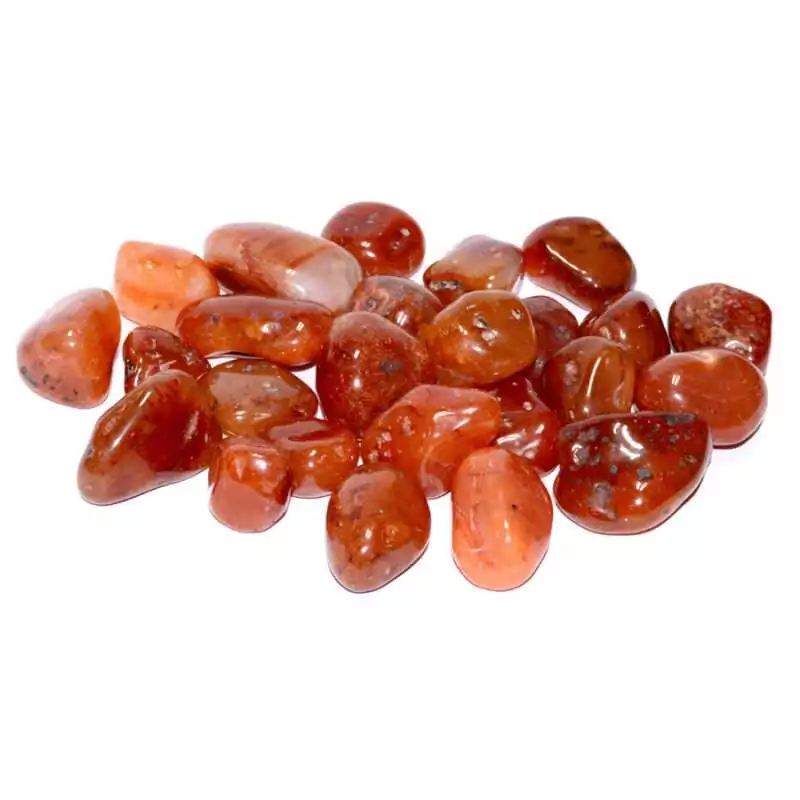
- Color: Translucent peach-orange to brick red, with dark flecks
- Grade: Sold as EX quality
- Mohs Hardness: 6.5 to 7
Carnelian: Orange and Red Chalcedony in Glossy Pebbles
Carnelian is the orange to red variety of chalcedony, the fine-grained form of quartz, and its color comes from iron oxide. It is translucent, and the paler peach stones let the most light through while the brick-red ones show a deep, glassy red. Dark grey flecks speckle some of the stones, and a few show faint banding. Carnelian’s color runs from pale orange to nearly black, and this lot sits in the bright middle of that range. The lot ranges from 15 to 40mm, about 0.6 to 1.6 inches, so the biggest stones fill the palm and the smallest slip into a coin pocket. Tumbling gives each one a rounded shape and a high gloss. Heat treatment is common in the carnelian trade and brings out the orange and red in pale material, and dyed white chalcedony and lightly colored agate are also sold under the name. The name goes back to the medieval Latin corneolus, from the cornel cherry, whose red fruit the stone resembles.
Carnelian has a long record. It turns up in Minoan layers at Knossos from about 1800 BC, etched carnelian beads were made in the Indus Valley in the third millennium BCE, and ancient Egypt used it for beads, seals and amulets. Roman engravers carved carnelian into seal rings, since the stone releases cleanly from hot wax. In modern crystal practice, crystal guides link carnelian with the sacral chakra, creativity and passion, and with courage and motivation. Those are crystal-lore associations, and they work as symbols you can take or leave. The modern spelling dates to the 16th century and may owe something to the Latin word for flesh. Stones near 40mm can anchor a grid or sit alone as a palm stone, and the smaller ones make a ring of markers around a candle. A mixed pound gives you both, along with the whole spread of warm color between peach and brick red, which looks lively beside candles and wood.
Practical Ritual Applications
Keep a dish of carnelian on the desk where you make things, and rest a stone on a sketchbook or a draft when you start a new page. Crystal guides pair carnelian with motivation and action, so it suits goal-setting and manifestation work: set one stone on a card where you have written the next step. Place three stones around an orange candle on your altar. Slip a small stone into a pocket on a morning when you want to follow through on something. A few stones lined along a windowsill show the range of color from peach to brick as the light moves across the day. Keep the largest stone beside your deck as a marker for the spot where your spread begins. For other stones associated with imagination and projects, browse my creativity and ideas stones.
How to Work With Carnelian Tumbled Stones
Three steps for sorting a pound of orange-red stones into a working set.
- Sort by Light and Size
Spread the stones on a white cloth beside a window and sort them twice: first by size, from 15mm up to 40mm, then by how much light passes through. Hold each stone to the glass for a moment. Set aside your two largest stones for layouts and your three most translucent for the window shelf. A good sort takes about ten minutes and gives you a stone for every purpose before you start.
- Build a Three-Size Grid
On a flat surface, place one large stone at the center, then add three medium stones around it, and finish with a ring of small stones. Put a written intention, a candle or a Tarot card beneath the central stone. The nested sizes make a clear orange-red target that reads well from across the room. Leave the grid for as long as it suits your purpose, and then break it down into the dish.
- Carry One and Store the Rest
Slip one small stone in a pocket or pouch, and keep the rest in a lidded box or a drawer. Wipe any stone that picks up dust with a soft cloth and let it dry before it goes back, and swap the carried stone for another each week so every stone gets handled.
The Tarot Fellow Standard
I stock this lot for people who want carnelian by the pound in a generous size range. The 15 to 40mm spread means there is a stone for a grid center, a stone for a pocket and plenty in between, and the translucent orange and red looks good in daylight. A pound is enough to share with friends and still keep a handful for your own altar. For more stones sold by the pound, browse my bulk tumbled stones collection.
Frequently Asked Questions
Dealers use letter grades such as AAA, A and EX to rank stones, and no single industry standard defines them. Triple-A grading varies from jeweler to jeweler because sellers follow no strict set of rules. Grading looks at features such as color, clarity and polish, and each seller weighs them in its own way, so a grade is a guide to how the seller ranks a lot.
A brief rinse in water is fine, followed by a soft cloth. Sunlight is the bigger concern. Prolonged sun exposure can darken the red tones as the iron in the stone oxidizes, so a shaded shelf or a lidded box keeps the colors steady.
Carnelian is a red, orange or amber variety of chalcedony. Chalcedony that is banded is called agate, so a banded carnelian counts as both carnelian and agate. Many carnelian stones are a solid color, and the name carnelian onyx covers banded stone with red and white lines, a synonym of sardonyx.


Reviews
There are no reviews yet