

Quick Specs
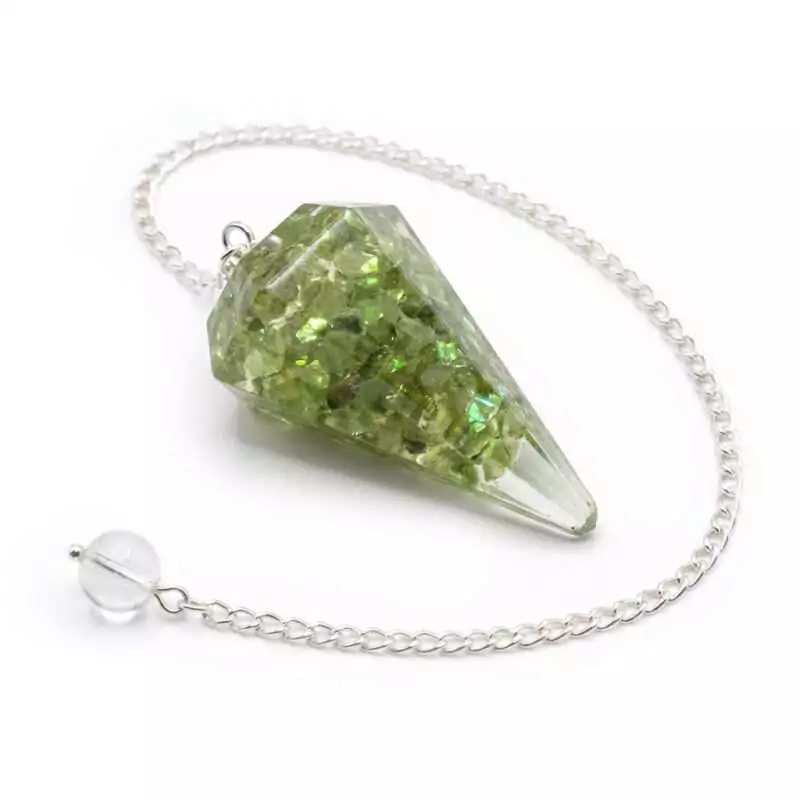
- Stone: Peridot (gem-quality olivine)
- Format: Orgone composite – peridot crystal embedded in metal shavings and resin matrix
- Shape: Pendulum bob
- Chain: Included
Peridot in Olivine, Meteorites, and Solar Tradition
Peridot is the gem-quality variety of olivine, a magnesium iron silicate that mineralogists write as (Mg,Fe)2SiO4 – specifically the forsterite-fayalite solid-solution series. It registers 6.5 to 7 on the Mohs scale, which makes it genuinely durable for daily handling. The color – that bright, almost electric yellow-green – comes from iron substituting for magnesium in the crystal lattice. You cannot heat-treat or irradiate peridot to change that color; the chemistry is baked in. The oldest recorded source is Zabargad Island in the Red Sea, where ancient Egyptians mined it for millennia and called it the “gem of the sun.” Today the San Carlos Apache Reservation in Arizona and deposits in Pakistan’s Kohistan region produce most of the world’s gem-grade material.
What I find genuinely remarkable about peridot is where it also forms naturally: inside pallasite meteorites. Pallasites are stony-iron meteorites built from olivine crystals suspended in a metallic nickel-iron matrix, and some of those crystals are gem-quality peridot. That means the same mineral in your pendulum crystallized deep inside a parent asteroid billions of years before Earth’s continents existed. Spiritually, peridot has a long association with the heart chakra and with solar energy – abundance, warmth, and clearing envy or resentment. Ancient Egyptians ground it into talismans for protection against night terrors. That lineage is real history, not marketing copy.
The orgone part needs an honest explanation. Wilhelm Reich, a psychiatrist working in the 1930s and 1940s, proposed that a universal life-force energy he called “orgone” permeated all living matter and could be accumulated or blocked. His theories were never validated by mainstream science and are not accepted by the scientific community today. Modern “orgonite” – the composite material this pendulum is made from – is a later folk-craft interpretation: metal shavings (usually aluminum or copper) and crystals cast together in resin. Whether that combination does anything energetically is genuinely contested. What it does do physically is create a dense, stable, hefty pendulum with real peridot content. The mineral is not a metaphor. The orgone theory is contested. I think you deserve to know both things.
How to Use a Peridot Orgone Pendulum
Three steps for your first session with a peridot orgone pendulum.
- Set your intention
Hold the pendulum over your palm and breathe slowly. Ask a simple yes or no question you already know the answer to, to calibrate the swing direction for your session.
- Read the swing
Watch how the peridot orgone pendulum moves – circular, back and forth, or still. Most practitioners read clockwise as yes and counterclockwise as no, but establish your own key first.
- Close and store
Thank the pendulum, set it down on a clean cloth, and rinse your hands with cool water. Store it away from direct heat, which can stress the resin composite over time.
The Tarot Fellow Standard
I want to be clear about what you are getting and what you are not. The peridot in this pendulum is a real mineral – olivine, gem-quality, with the color chemistry and geological history described above. That is not contested. The orgone framework – the idea that the metal-resin composite accumulates or transmits a measurable life-force energy – is not scientifically validated. I carry orgone products because a lot of people in this community find value in them as ritual tools and because the physical craftsmanship is real. I do not carry them by pretending the physics is settled, because it is not. What you get with this pendulum is a dense, well-made divination tool with genuine peridot content and a satisfying weight for pendulum work.
One practical note on color: peridot’s yellow-green hue varies naturally based on iron content. Specimens with higher iron read more golden-olive; lower iron reads brighter lime-green. In an orgone composite, the peridot may appear darker or slightly muted compared to a faceted gem stone, because the resin matrix affects how light passes through. That is normal and expected, not a quality defect.
If this pendulum speaks to you, you might also want to explore our full crystal pendulum collection or browse the broader range of orgone products we carry.
Frequently Asked Questions
Orgone is a life-force energy proposed by Wilhelm Reich in the 1930s. Mainstream science does not recognize it. Orgonite is a modern craft material – metal shavings and crystals cast in resin – not a scientifically validated technology.
Peridot is gem-quality olivine, a magnesium iron silicate with the formula (Mg,Fe)2SiO4. It rates 6.5 to 7 on the Mohs scale and forms in volcanic rock and in pallasite meteorites.
Hold the chain between thumb and forefinger, let the bob hang free, and ask yes or no questions. The subtle movements are driven by the ideomotor effect – small unconscious muscle responses.
Wipe with a soft dry cloth. Avoid soaking in water, as prolonged moisture can degrade the resin. Keep away from prolonged direct sunlight to preserve the resin color.



I just got this item today and it has a very tight knot in the chain which I can’t get out. I am very disappointed after taling so long to get itm
I approved your refund request. The order was delivered within estimates and typical USPS timeframes.