
Quick Specs
- Material: Sodalite
- Shape: Sphere
- Diameter: 40mm (about 1.6 inches)
- Finish: Polished
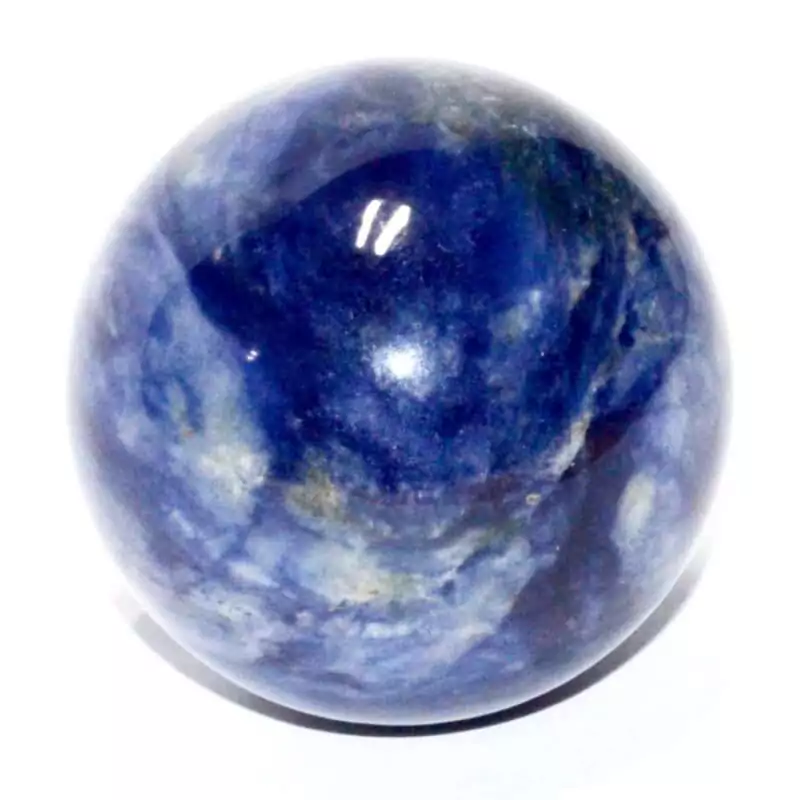
- Color: Deep blue with pale blue, grey and white patches
- Mohs Hardness: 5.5 to 6
Sodalite: A Blue Mineral With a Long Trade History
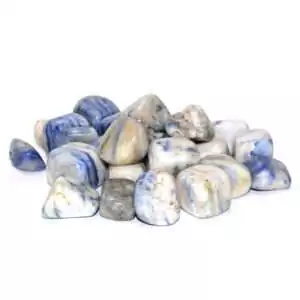
Sodalite is a sodium aluminum silicate with chlorine in its structure, a member of the feldspathoid group. Its name points to the sodium content. It forms in igneous rocks low in silica, such as nepheline syenite, often as vein fillings. European mineralogists first described sodalite in 1811 from Ilimaussaq in Greenland, but it didn’t become an important ornamental stone until 1891, when large deposits of fine blue material were found in Ontario, Canada. People valued it much earlier: the Caral culture of Peru traded for sodalite from the Andean highlands thousands of years ago. Its usual color is a bright blue crossed by white veins or streaks, and the white is commonly calcite running through the blue. Sodalite can also be grey, yellow, green or pink. The more uniformly blue material goes into jewelry, while patterned stone is cut into ornamental objects, and massive material is shaped into beads, cabochons, carvings and spheres. Well-formed crystals are rare, so sodalite usually reaches the market as massive, grainy stone. Well-known sources include Ontario in Canada, northern Namibia, Brazil, and the American states of Maine and Arkansas.
This sphere was cut from massive sodalite, the solid, opaque form of the mineral, and polished to a high gloss. The ground is a deep royal blue, with patches of pale periwinkle, grey and white drifting across the surface, the mottling sodalite usually shows. The polish catches room light in bright highlights. Because the sphere is polished all over, the pattern wraps around it with no flat face or back. No two spheres carry the same map, and turning the ball in your hand brings a different region of blue to the front. Because massive sodalite is opaque, the interest sits on the surface, where the blues shift in shade as the light moves. At 40mm it fills a closed hand comfortably, and on a small stand it works as a compact desk or shelf piece. Sodalite is brittle, so hold the sphere over a soft surface such as a cloth or your lap until you have a secure grip.
Practical Ritual Applications
Set the sphere on a stand at your writing desk, where it gives the eye something calm to rest on between paragraphs. Crystal guides call sodalite the logic stone, one that joins logical thinking with intuition, and one guide names it a support stone for Tarot readers and others who consult oracles. In modern crystal practice it is also linked with the throat chakra and the third eye, which gives you a reason to hold it before speaking, journaling or giving a reading. Roll it between your palms while you settle on the question for a Tarot spread, or leave it beside your deck as a visual anchor on the table. To see other stones in this shape, browse my crystal balls and spheres collection.
How to Use a Sodalite Sphere
Three steps for giving the sphere a place and a purpose.
- Seat the Sphere
Spheres roll, so give yours a stable base. Set a stand or a shallow dish lined with cloth on a flat, solid surface, away from the edge of a desk or shelf, and rest the sphere in it. Tap the table gently to check that nothing shifts. Keep it out of reach of pets and small children.
- Spend a Few Minutes with the Surface
Hold the sphere in both hands and turn it slowly in good light. Follow one pale patch with your eyes as it travels around the ball, then pick a second patch and follow that one. After a few minutes, set the sphere down and write or say aloud the question, or the sentence, that brought you to the sphere. The ball gives your eyes one slow, simple thing to track while you settle.
- Wrap It Alone for Storage
When you move or store the sphere, wrap it alone in a soft cloth and keep it apart from quartz, topaz and other harder stones, which can scratch it. Household dust is harder than sodalite as well, so wipe the sphere gently with a soft cloth. A small pouch or a cloth-lined box gives it a place of its own in a bag of stones.
The Tarot Fellow Standard
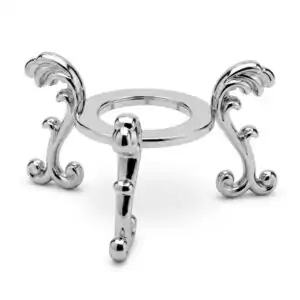
I stock this sphere for people who want a smooth blue stone to hold and a color that stands out on a shelf. At 40mm it is small enough to carry in a pouch to a reading and large enough to anchor a small display. A sphere shows the blue and white patterning from every side, and the deep blue reads well against a Tarot cloth, a wooden desk or a shelf of books. Because a sphere needs a base, browse my crystal ball stands to seat it.
Frequently Asked Questions
They look alike at a glance, but they are different materials. Sodalite is a single mineral, while lapis lazuli is a rock made mainly of lazurite and related blue minerals, usually with calcite and flecks of golden pyrite. Sodalite rarely contains pyrite, so a blue stone free of metallic flecks points to sodalite. White veining shows up in both, so it won't settle the question. Lapis can also contain some sodalite, which is part of why the two get confused.
Often it does. Most sodalite fluoresces orange under ultraviolet light, though the glow is weak in many pieces and varies from stone to stone, so a given sphere may glow strongly, faintly or not at all. A sulfur-rich variety called hackmanite is known for strong fluorescence, and it can also change color when exposed to light and then fade back in the dark.
Washing is fine: use a soft brush or cloth, warm water and a drop of mild detergent, then dry the sphere. Heat is the concern, since heating may cause sodalite to lose its color, and a sphere left in strong sun can get hot, so a shaded shelf is the safer spot. Keep the sphere away from radiators and heating vents too, for the same reason.
Reviews
There are no reviews yet