
Quick Specs
- Material: Sold as afghanite (blue feldspathoid mineral)
- Quantity: 1 lb lot of tumbled stones
- Stone Size: 20-30mm (about 0.8 to 1.2 inches)
- Finish: Tumbled and polished
- Color: Blue with white, cream, grey and tan patches
- Mohs Hardness: 5.5 to 6 for afghanite
Afghanite: A Blue Mineral From a Lapis Mine
Afghanite belongs to the feldspathoid group, in the cancrinite family, and its chemistry is a hydrous sodium, calcium and potassium aluminosilicate that also holds sulfate, chloride and carbonate. It was described as a new mineral in 1968 from the Sar-e-Sang lapis lazuli mine in Badakhshan Province, northern Afghanistan, and takes its name from the country. The color runs from light to dark blue, and microcrystals from Italy can be white, colorless or pale yellow. Afghanite rates 5.5 to 6 on the Mohs scale, the same as sodalite. One gem reference lists its colors as dark blue, light blue, cream and white, often with white, cream or translucent inclusions, and describes the crystals as long prisms or double-terminated bipyramids, or as crusts coating a matrix, usually calcite or marble. At Sar-e-Sang it occurs in lazurite veins in marble beside calcite and pyrite, and large crystals sit embedded in white marble. Afghanistan remains the main source. Smaller occurrences come from Germany, Italy, the Pamir Mountains of Tajikistan and the area around Lake Baikal in Siberia. Afghanite is rare.
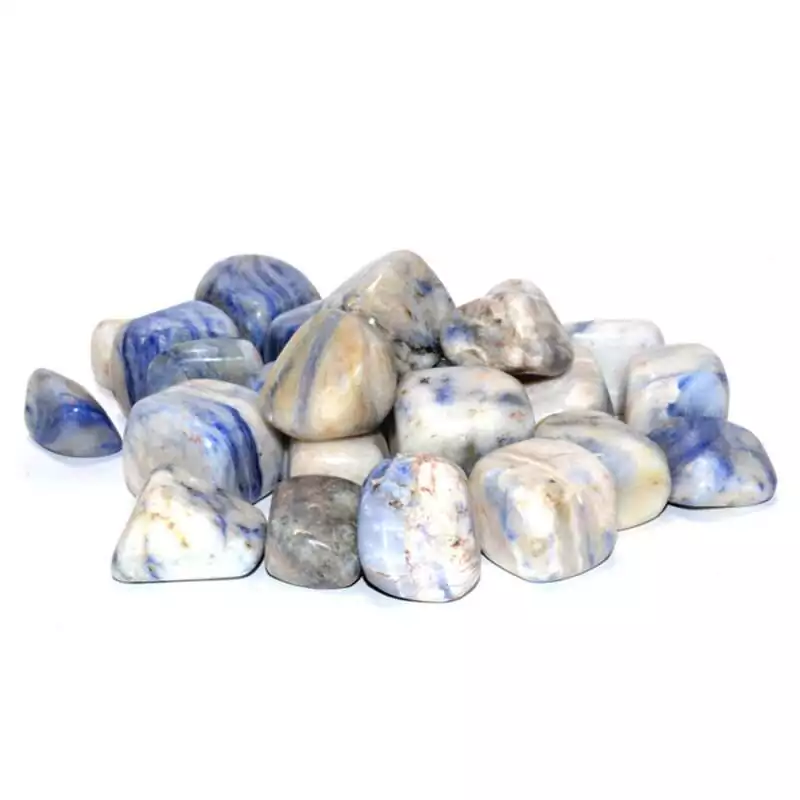
The stones in this lot are polished tumbles, 20 to 30mm across, about 0.8 to 1.2 inches. Their blues range from royal and cobalt to pale periwinkle, set against creamy white, soft grey and tan. On some stones the colors lie in parallel bands and streaks, and on others they form patches that blur into one another. A few stones are mostly grey with only a touch of blue. The shapes are rounded and blocky with softened corners, and the polish shows bright highlights. Tumbling creates that finish by turning the stones in a barrel with abrasive grit and then a fine polishing powder. Each stone sits comfortably between thumb and fingers, and the full pound lets you compare many patterns side by side. The share of blue to white changes from stone to stone, so every piece you pick up looks a little different. At 5.5 to 6, afghanite sits below quartz, so store the stones apart from quartz and other harder stones, and wrap any you carry in a soft cloth.
Practical Ritual Applications
Crystal guides link afghanite with the third-eye chakra, and some add the crown or throat chakras and a theme of intuition. Hold one stone for a minute before you open a journal or begin a meditation, noticing where the blue deepens. Keep the bluest stone from the pound beside your Tarot deck. A few stones in a small dish on a reading table add color to the setup, and a row of three on a shelf gives your meditation corner a point of focus. Stones near 30mm anchor a grid, and the 20mm pieces fit around them. For other stones that crystal practice connects with intuition, browse my intuition and spiritual development stones.
How to Work With Afghanite Tumbled Stones
Three steps for putting a pound of afghanite to use.
- Sort the Blues From the Whites
Pour the stones onto a plain cloth in good light and turn each one slowly. Group them by how much blue they carry: deep blue, blue with white banding, and mostly white or grey. Pick your three bluest stones for your table or altar and leave the rest in a bowl. Come back to the cloth whenever you want a different stone, since no two patterns match.
- Hold One While You Shuffle
Take one stone in your non-dominant hand and your deck in the other. Shuffle slowly while you think of your question, then set the stone beside the deck before you lay out the cards. Using the same stone each time turns it into a cue that tells you the reading is starting. When the reading ends, return the stone to its dish and write down the cards before you do anything else.
- Store the Stones Apart
Keep the stones in a shallow dish or a cloth-lined box, separate from quartz and other harder stones. Wrap any stone you carry in a soft cloth or a small pouch. Wipe a stone with a soft dry cloth when it needs freshening, and set stones down gently on a padded surface so the polished faces stay smooth.
The Tarot Fellow Standard
Afghanite earns its place in my shop for its blue and white patterns and for an easy story to tell: a mineral named for the country where it was first found, in the lapis lazuli mine at Sar-e-Sang. At 20 to 30mm, the stones are large enough to anchor a grid and small enough for a pouch or a reading table. A pound lets you pick favorites and still have plenty to pass along. For other stones sold by the pound, browse my bulk tumbled stones collection.
Frequently Asked Questions
Yes. Afghanite fluoresces orange under ultraviolet light. One gem guide reports that the non-blue areas glow a creamy pumpkin orange under long-wave UV, and a mineral dealer describes the response as very bright under long-wave light and absent under short-wave light. A long-wave UV flashlight in a dim room shows the glow best.
No. Afghanite and sodalite are separate minerals, both feldspathoids, and afghanite belongs to the cancrinite group. Lapis lazuli is a rock made mostly of lazurite with white calcite and flecks of pyrite. The three overlap in the lapis lazuli mine at Sar-e-Sang, where afghanite was first found and where it grows as veinlets alongside lazurite and minerals of the sodalite group.
Afghanite is rare. Its main source is the Sar-e-Sang lapis lazuli area of Badakhshan in northern Afghanistan, where large crystals sit in white marble. Smaller finds come from Germany, Italy, the Pamir Mountains of Tajikistan, the Lake Baikal region of Siberia, eastern Canada and a few U.S. states. One gem guide calls it a relatively recent gemstone, first discovered in 1968.
Reviews
There are no reviews yet